
23 min read ·
How to Measure and Choose a Burial Container That Fits
An 84 × 28 × 23 in casket exterior may correspond to about 78-79 × 23 × 15 in of usable interior. Tapered coffins need several width checks.
Editorial review: Mortuary Guide · Updated: August 17, 2026
Methodology note: This guide distinguishes provider-specific measurements from general guidance and checks dimensions against the linked manufacturer, retailer, funeral-provider, and burial-site specifications. Mortuary Guide says its articles are written from a death-care administration perspective and reviewed for factual accuracy. Case-specific fit and acceptance must still be confirmed with the professionals and facilities involved.
There is no universal set of coffin dimensions. Traditional tapered coffins and rectangular caskets differ in shape, while manufacturers, countries, and providers use different size categories. Published dimensions may describe the usable interior, exterior shell, widest point, or total span across handles.
The correct choice therefore depends on a verified chain of measurements:
- Professionally obtained body measurements must fit the usable interior.
- The finished container must pass through doors, corridors, stairs, and vehicle openings.
- Handles, carrying arrangements, straps, and lowering equipment must work with the loaded container.
- The exterior must be accepted by the cemetery, burial vault, crypt, mausoleum, or crematory.
Use published figures as planning benchmarks, not fit guarantees. Before ordering or building, request the exact usable interior and finished exterior specifications and obtain approval from every provider involved.
Coffin dimensions at a glance
No single size applies to every adult coffin or casket. A six-sided tapered coffin cannot be described as precisely with one width as a rectangular casket, and two products carrying the same size label can have different usable interiors.
Traditional tapered-coffin benchmarks
| Example | Approximate dimensions | Measurement type | How to use the figure |
|---|---|---|---|
| Typical adult tapered coffin reported by an Australian funeral provider | 195 × 58 × 36 cm | Approximate regional benchmark; source does not identify every figure as internal or external | Preliminary comparison only; see the provider’s coffin and casket comparison |
| Approximate conversion of the Australian benchmark | 77 × 23 × 14 in | Converted regional benchmark | Not a worldwide standard |
| Green-burial starting guideline from one burial site | 72 × 23 × 15 in | Adjustable, site-specific guideline; internal/external convention not stated | Change as needed for the occupant and report the final dimensions to the burial site under its earth-friendly container guidelines |
The Australian figure represents one funeral provider’s description of a typical tapered coffin in its market. The green-burial figure is likewise not an average or mandatory adult size: Carolina Memorial Sanctuary expressly says burial containers are not one-size-fits-all and directs builders to adjust the starting measurements as needed.
Rectangular U.S. casket benchmarks
| Dimension | Approximate measurement | Measurement type | What it affects |
|---|---|---|---|
| Exterior length | 84 in | Approximate external U.S. commercial benchmark | Transport, grave, vault, crypt, and equipment compatibility |
| Exterior width | 28 in | Approximate external shell benchmark; handles may not be included | Doorways, vehicle space, vault or crypt clearance |
| Exterior height | 23 in | Approximate external benchmark | Vehicle, crypt, vault, and equipment clearance |
| Interior length | 78–79 in | Approximate usable internal benchmark | Occupant height and positioning |
| Interior width | 23 in | Approximate usable internal benchmark | Widest lying-down body measurement |
| Interior depth | About 15 in, where stated | Approximate usable internal benchmark | Body depth, bedding, clothing, and lid clearance |
A U.S. retailer reports typical exterior dimensions of 84 × 28 × 23 inches and interior dimensions of 78 × 23 × 15 inches, while noting that dimensions can vary by manufacturer in its standard casket dimension guide. Another retailer reports approximately 79 × 23 inches internally. These are recurring commercial benchmarks, not a binding national standard.
Differences among published figures are not necessarily errors. A source may be describing:
- A coffin rather than a casket
- A particular regional product range
- Interior space rather than the exterior shell
- A nominal category rather than a finished measurement
- The widest point of a tapered design
- A shell measurement that excludes handles
- A particular model, material, or custom plan
Compare like with like: interior length with interior length, shell width with shell width, and handle-inclusive width with the actual maximum permitted width.
Coffin versus casket: why the shape changes the measurements
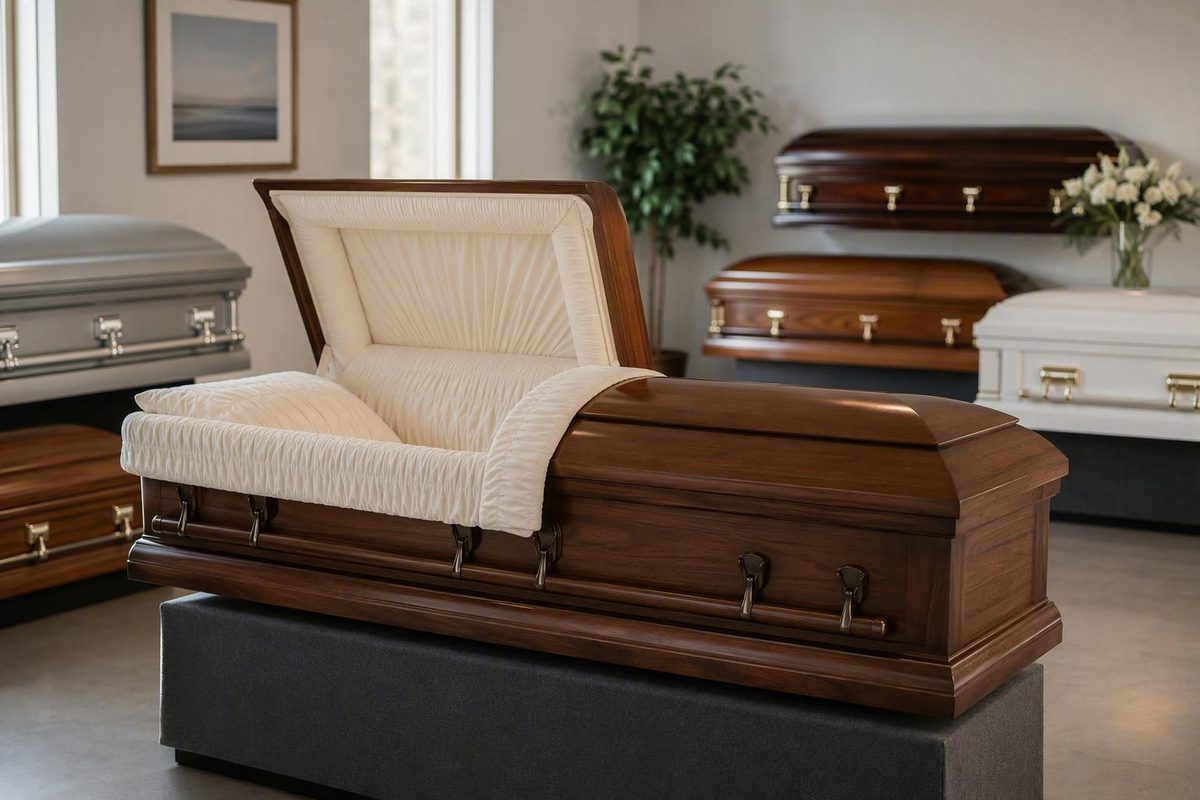
A traditional coffin is generally a six-sided container that broadens around the shoulder or upper-body area and narrows toward the head and feet, especially at the foot end. A casket is generally rectangular and commonly has a hinged lid.
The words are sometimes used interchangeably in conversation and product marketing. Their measurements should not be treated as interchangeable.
A rectangular casket can often be summarized as length × width × height because its width remains relatively consistent along the shell. A tapered coffin needs a profile that may include:
- Interior and exterior length
- Shoulder width
- Hip or elbow width
- Maximum overall width
- Head-end width
- Foot-end width
- Interior depth
- Exterior height
- Total span across handles
The difference is illustrated by two commercial benchmarks: approximately 195 × 58 × 36 cm, or 77 × 23 × 14 inches, for one Australian provider’s tapered coffin, compared with approximately 84 × 28 × 23 inches externally for a recurring U.S. rectangular-casket benchmark. These figures illustrate different forms and regional product conventions; they do not establish that every casket is larger than every coffin.
For a tapered coffin, the advertised width may mean only the widest point. It says little about the narrower head and foot sections. A person whose widest lying-down measurement fits that maximum may still require a different taper or sectional profile.
A useful specification drawing should label:
- Usable interior length
- Finished shell length
- Interior depth at relevant points
- Maximum shell width
- Shoulder width
- Hip or elbow width
- Head-end width
- Foot-end width
- Exterior height with the lid closed
- Total span across handles and other projecting hardware
If a product page uses “coffin” and “casket” interchangeably, ask for a photograph or technical drawing of the actual item. Confirm whether every listed measurement is internal, external, nominal, or handle-inclusive. The product’s shape and specification sheet matter more than its marketing name.
Internal, external, and handle-inclusive dimensions
Internal dimensions describe usable space inside the container. External dimensions describe the finished shell. Handle-inclusive dimensions describe the greatest overall span after handles and other projecting hardware are fitted.
Each set answers a different question:
- Interior length, width, and depth: Will the occupant fit with the intended clothing, bedding, lining, and position?
- Exterior shell dimensions: Will the closed container fit through the transport route and into the intended grave, vault, crypt, or equipment?
- Maximum finished dimensions: Will handles, hinges, decorative fittings, or the lid profile create an obstruction?
The U.S. casket benchmark shows why the distinction matters. An exterior of approximately 84 × 28 × 23 inches may correspond to only about 78–79 × 23 × 15 inches of usable interior space. The shell, structure, lining, mattress, lid, and other components occupy part of the exterior envelope.
Do not estimate the interior by subtracting an assumed wall thickness.
Measurement glossary
| Term | Meaning | Primary use |
|---|---|---|
| Inside length | Usable length inside the lining or shell, as defined by the manufacturer | Occupant height, footwear, headwear, and positioning |
| Inside width | Usable interior width, ideally measured at the relevant body section | Shoulder, elbow, hip, or widest-point fit |
| Inside depth | Usable vertical space from the interior base or bedding surface to the closed lid | Body depth, clothing, bedding, and lid clearance |
| Outside length | Finished end-to-end shell length with the lid closed | Doorways, vehicle, grave, vault, crypt, and equipment |
| Shell width | Width across the container body without projecting hardware, if defined that way | Basic exterior compatibility |
| Maximum width | Widest part of the shell or tapered profile | Route and burial-space checks |
| Handle-inclusive width | Total span across handles, bars, hinges, or other projections | Narrow openings, carrying, lowering, grave, vault, and crypt clearance |
| Exterior height | Finished base-to-top measurement with the lid closed | Vehicle, equipment, crypt, and crematory checks |
| Nominal width | A model label or category that may not equal a precise finished dimension | Initial product comparison only |
A quoted width does not automatically reveal whether handles, hinges, decorative fittings, or lid hardware are included. Musgrove Willows, for example, tells customers to allow separately for side handles when determining the external dimensions of its woven products, illustrating why shell and handle-inclusive measurements must be distinguished.
Before committing to a product, request one or more of the following:
- The manufacturer’s current specification sheet
- A labeled technical drawing
- Written finished dimensions from the builder
- Written confirmation of both usable interior space and maximum exterior span
Do not infer usable space from labels such as “standard,” “28-inch,” “XL,” or “adult.” Ask exactly what the number measures.
How the correct interior size is determined
Body measurement should be coordinated by a funeral director or another qualified death-care professional. Families should not be asked to move or position remains solely to obtain coffin dimensions.
The measurements needed depend on the selected container, but generally include:
- Body height or lying-down length
- Widest point while lying down
- Lying-down body depth
For a tapered coffin, the professional or supplier may also need:
- Shoulder width
- Hip or elbow width
- Head-end requirement
- Foot-end requirement
- Location of the widest point relative to the taper
Depth must also be evaluated independently from width: a container can be wide enough but too shallow once clothing, bedding, and lid clearance are considered.
Factors that can reduce usable space
Allow for all planned presentation and positioning details, including:
- Clothing and layered garments
- Shoes or boots
- Hats, veils, or other headwear
- Pillows, mattresses, and cushioning
- Interior lining and side padding
- Arm and hand position
- Leg and foot position
- Base contour
- Lid slope or shape
- Structural ribs or interior projections
Height and approximate weight may help a supplier narrow the choices, but neither guarantees fit. People of the same height and weight can have different shoulder, hip, abdominal, and lying-down depth measurements.
How much extra space should be allowed?
There is no universal occupant-clearance rule.
Carried Away Coffins in New Zealand recommends that interior length exceed the person’s height by at least 5 cm, with additional allowance for shoes or a hat. Its chart separately identifies inside length, overall length, approximate hip and shoulder widths, and inside height, showing why all three dimensions must be checked in its coffin size guidance.
Musgrove Willows uses another product-specific method for its made-to-measure woven coffins: two inches more than the person’s length and two inches more than the person’s width. Neither method is an industry-wide rule.
Treat any suggested allowance as the beginning of a fit discussion:
Given these professionally obtained body measurements, the planned clothing and bedding, the intended position, and this model’s usable interior, can you confirm an appropriate fit?
If the funeral professional or manufacturer cannot confirm adequate interior space, do not accept an uncertain fit. Investigate a wider, deeper, extra-long, or custom option, and then repeat every exterior, loaded-handling, transport, and facility check for the larger product.
Interior-fit worksheet
| Field | Measurement or answer |
|---|---|
| Professionally obtained body height or length | ________ |
| Widest lying-down point | ________ |
| Location of widest point | ________ |
| Lying-down body depth | ________ |
| Shoulder width, if needed | ________ |
| Hip or elbow width, if needed | ________ |
| Head-end width required | ________ |
| Foot-end width required | ________ |
| Clothing planned | ________ |
| Footwear planned | ________ |
| Headwear planned | ________ |
| Pillow, mattress, or bedding | ________ |
| Arm and hand position | ________ |
| Other positioning considerations | ________ |
| Proposed usable interior length | ________ |
| Proposed usable interior width or sectional widths | ________ |
| Proposed usable interior depth | ________ |
| Manufacturer and model | ________ |
| Person who confirmed fit | ________ |
| Organization and contact details | ________ |
| Date confirmed | ________ |
| Written confirmation received | Yes / No |
Standard, oversize, extra-long, and child-size options
“Standard,” “oversize,” “XL,” “extra-long,” “child-size,” and “custom” are supplier categories rather than fixed industry definitions. One manufacturer’s oversize model can overlap another manufacturer’s regular range, especially when one publishes exterior measurements and another publishes interior space.
Standard
A standard container is the supplier’s regular adult model or range. The label does not guarantee that it will fit every adult or work with every vault, grave, crypt, transport arrangement, or crematory.
Check the actual interior length, width, and depth. Then obtain the finished exterior dimensions instead of relying on the category name.
Wider, deeper, or oversize
An oversize container may be wider, longer, deeper, or some combination of the three. Do not apply a definitive body-height or body-weight cutoff. Those values can help identify models to investigate, but body shape, lying-down depth, position, and construction determine actual fit.
The variability between vendors is substantial. Titan Casket lists oversize exterior widths from 28 to 52 inches in its casket dimensions chart. Trusted Caskets reports oversize interiors approximately 28–44 inches wide and 80–94 inches long; the same retailer gives infant and child interior examples of approximately 12–24 inches wide and 36–60 inches long in its retailer sizing guide.
Those figures are not directly interchangeable: the first range describes exterior product widths, while the second describes interior space. Their useful lesson is that larger and smaller options exist and that category labels alone are insufficient.
Extra-long
Extra-long products provide greater length without necessarily adding the same amount of width or depth. Ask whether “extra-long” means:
- Greater interior length
- Greater exterior shell length
- A nominal model category
- An extension or custom modification
A longer interior can address a height requirement while leaving width or depth unchanged. Confirm all three usable interior dimensions.
Infant and child containers
Infant and child containers are proportionally smaller, but there is no universal size system. Age alone is not a dimensional specification. The funeral professional and supplier should determine the required usable interior and verify it against the selected model.
The 12–24-inch interior width and 36–60-inch interior length range above is one retailer’s commercial example, not a comprehensive standard. Other products may be smaller or differently proportioned.
Custom containers
A custom container may be appropriate when stocked products do not provide the required combination of length, sectional width, and depth. Custom construction may also serve a burial tradition, green-burial requirement, material preference, or handmade design.
Larger containers can require different structural, carrying, transport, vault, grave, crypt, and equipment arrangements. One retailer says oversize caskets may use reinforced construction and handles, but that is a product-category description rather than independent engineering evidence. Verify the structure and handling provisions for the actual model.
Use neutral descriptions such as wider container, deeper model, extra-long casket, or custom-sized coffin. Do not describe a person by a product category.
Decision path for a nonstandard size
- Confirm the required usable interior. Use professionally coordinated measurements and account for clothing, bedding, lining, and position.
- Identify an available product or custom design. Match every relevant interior dimension, not merely height or approximate weight.
- Obtain the finished exterior specifications. Include the closed lid, handles, hinges, fittings, and other projections.
- Assess the loaded handling arrangement. Include the container, occupant, clothing, bedding, and accessories.
- Verify the transport route. Check doors, corridors, stairs, loading openings, vehicle space, orientation, and turning room.
- Verify final-disposition compatibility. Obtain approval from the cemetery, vault or crypt supplier, mausoleum, or crematory.
- Secure written confirmation before ordering. Record the model and specification revision so approval applies to the product delivered.
Checking the grave, vault, crypt, transport route, and equipment
A container can fit its occupant and still fail at a doorway, vehicle, vault, crypt, or piece of lowering equipment. Verify the complete compatibility chain:
Occupant → usable interior → finished container → transport route → vehicle → carrying and lowering equipment → vault, grave, crypt, mausoleum, or cremator
Use the maximum finished exterior dimensions for these checks. Include projecting handles, hinges, decorative fittings, lid contours, and any hardware that increases length, width, or height.
Why a nominal grave or vault size is not enough
A nominal vault width does not necessarily equal usable internal width. An advertised casket width may also exclude its handles. Even when two quoted numbers appear compatible, the combination may fail because of:
- Wall thickness
- Interior ledges or tapers
- Lid or sealing components
- Handle projections
- Required working clearance
- Lowering straps or frames
- Restricted site access
- Facility-specific procedures
Do not assume that a particular casket width will fit a “standard” grave or vault. Obtain the actual usable internal length, width, and depth of the selected vault or crypt, together with the facility’s required clearance.
Cemeteries may request exterior casket dimensions in advance so the burial space can be prepared. A funeral provider specifically notes this need while emphasizing that published casket sizes are approximate rather than universal in its casket-selection guidance.
Before ordering an oversize or custom container, obtain written confirmation from the cemetery and, where relevant, the vault, crypt, or mausoleum supplier. Approval based only on a nominal width is insufficient.
Do not use a universal grave-clearance formula
Published grave guidance is inconsistent about whether an allowance means:
- Clearance on each side
- Total clearance added to width or length
- Working room for excavation
- Space inside a vault
- Space needed by lowering equipment
Do not prescribe one universal allowance to a cemetery or gravedigger. Ask the facility which finished dimensions it requires and what clearance its staff will provide.
Grave depth, excavation dimensions, vault use, and equipment requirements can vary with local rules, cemetery policy, soil, terrain, burial practice, and provider procedure. Grave preparation should be determined by the cemetery or burial-ground operator, not by the family or container supplier acting alone.
Compatibility call checklist
Ask the cemetery, crematory, or equipment provider:
- What are the maximum permitted exterior length, width, and height?
- Do those limits include handles and hardware?
- What are the usable internal dimensions of the actual vault or crypt?
- Is a particular vault, liner, or container type required?
- Are there separate dimensional limits for lowering equipment?
- Is there a maximum loaded weight for the relevant equipment?
- Are there route or site-access restrictions?
- Are there material, finish, adhesive, or hardware restrictions?
- Does the facility need a drawing or specification sheet?
- Must final dimensions be submitted by a particular date?
- Who is authorizing acceptance?
- Can approval be provided in writing?
Record the approving person’s name, role, contact details, and date. If the model or finished dimensions change, repeat the approval process.
DIY and green-burial coffin dimensions
A DIY plan is a product-specific construction design. It is not a substitute for sizing the occupant, assessing the loaded handling arrangement, or obtaining approval from the intended cemetery or crematory.
Worked example: a toe-pincher plan
One commercially published six-sided toe-pincher plan gives these dimensions:
| Part | Plan dimension | Type of measurement |
|---|---|---|
| Finished coffin | 80 × 26 × 18 in | Product-specific finished size |
| Lid | 80 × 26 in | Construction panel dimension |
| Floor panel | 78 × 24 in | Construction panel dimension, not stated usable interior space |
| Upper head-side panels, quantity two | 24.375 × 18 in each | Construction panel dimensions |
| Lower toe-side panels, quantity two | 56.375 × 18 in each | Construction panel dimensions |
| Head panel | 16 × 18 in | Construction panel dimensions |
| Foot panel | 12 × 18 in | Construction panel dimensions |
These figures apply only to that design. The builder chose an 18-inch depth for the intended occupant and cushioning and says the plan can be adjusted to 15 or 16 inches. Neither depth is an independent standard. The measurements and cut list are published in Casket Builder Supply’s DIY toe-pincher plan.
Keep three sets of measurements separate during construction:
- Panel dimensions used to cut the material
- Finished exterior dimensions after assembly, lid, handles, and fittings
- Usable interior dimensions after structure, lining, mattress, and cushioning
A 78 × 24-inch floor panel does not prove that the completed coffin has a usable interior of the same size. Side-wall angles, material thickness, internal cleats, lining, and cushioning can reduce available space.
Comparing the plan with a green-burial guideline
The toe-pincher plan’s finished 80 × 26 × 18-inch dimensions are larger in every listed direction than Carolina Memorial Sanctuary’s 72 × 23 × 15-inch starting guideline. That does not make either set universally correct. They describe different designs and intended uses.
The burial site instructs builders to adjust its starting dimensions to the occupant and communicate the final size before burial. Its guidelines also contain site-specific requirements for materials, finishes, metal components, adhesives, handles, and carrying arrangements. Another cemetery may impose different rules.
Loaded weight and handling
Dimensions are only one part of a DIY design. The complete loaded arrangement includes:
- Empty container
- Occupant
- Clothing and footwear
- Lining, mattress, pillow, and cushioning
- Lid and fasteners
- Handles or carrying points
- Straps and lowering arrangement
Carolina Memorial Sanctuary’s site-specific guide calls for a design that can accommodate six carriers, with three on each side, and for handles or holds capable of supporting the loaded container while permitting lowering straps. Treat this as that burial site’s handling requirement, not a universal formula.
Do not treat seller-reported capacity or testing as independently verified engineering evidence. Ask how the joints, fasteners, handles, and carrying points will be assessed for the anticipated load, and obtain approval for the handling plan.
Before buying materials or making the first cut, confirm:
- Accepted wood or alternative material
- Permitted adhesives
- Permitted screws, nails, and other metal hardware
- Accepted paints, stains, and finishes
- Maximum exterior dimensions
- Whether handles count toward maximum width
- Required number and location of carrying points
- Planned use of straps
- Crematory combustibility and hardware requirements, if applicable
- Cemetery or green-burial acceptance
- Who will inspect or approve the completed container
Obtain these requirements from the intended facility. A design accepted for natural burial at one site is not automatically accepted elsewhere, and a burial design should not be assumed suitable for cremation.
Final measurement and approval checklist
Print or copy this checklist before a coffin or casket is ordered, built, modified, or delivered.
Occupant fit
- [ ] Body measurements were obtained or coordinated by a qualified death-care professional.
- [ ] Height or lying-down length: ________
- [ ] Widest lying-down width: ________
- [ ] Location of widest point: ________
- [ ] Lying-down body depth: ________
- [ ] Shoulder width, if required: ________
- [ ] Hip or elbow width, if required: ________
- [ ] Head-end and foot-end requirements recorded for a tapered coffin.
- [ ] Clothing has been selected and accounted for.
- [ ] Footwear has been selected and accounted for.
- [ ] Headwear has been selected and accounted for.
- [ ] Bedding, mattress, pillow, and cushioning have been accounted for.
- [ ] Lining thickness has been accounted for.
- [ ] Arm, hand, leg, and foot positioning has been considered.
- [ ] Required usable interior length: ________
- [ ] Required usable interior width or sectional widths: ________
- [ ] Required usable interior depth: ________
- [ ] A funeral professional or manufacturer has confirmed the proposed interior fit in writing.
Container specifications
- [ ] Product type: tapered coffin / rectangular casket / other
- [ ] Manufacturer or builder: ________
- [ ] Model, size, or plan name: ________
- [ ] Specification or plan revision: ________
- [ ] Interior length: ________
- [ ] Interior width: ________
- [ ] Interior depth: ________
- [ ] Shoulder width: ________
- [ ] Hip or maximum sectional width: ________
- [ ] Head-end width: ________
- [ ] Foot-end width: ________
- [ ] Exterior shell length: ________
- [ ] Exterior shell width: ________
- [ ] Exterior height with lid closed: ________
- [ ] Total width across handles and hardware: ________
- [ ] Maximum finished length across all fittings: ________
- [ ] Empty container weight: ________
- [ ] Stated load rating, if supplied: ________
- [ ] Basis or test information for the stated load rating requested.
- [ ] Interior specifications identify whether lining and bedding are included.
- [ ] Exterior specifications identify whether handles, hinges, and fittings are included.
- [ ] Current specification sheet or finished drawing is attached.
Transport and handling
- [ ] Narrowest doorway measured: ________
- [ ] Narrowest corridor measured: ________
- [ ] Corners and turning space checked.
- [ ] Stairs, landings, elevators, and ramps checked.
- [ ] Vehicle loading opening measured: ________
- [ ] Vehicle interior length, width, and height checked.
- [ ] Container orientation during loading confirmed.
- [ ] Pallbearer or carrier arrangement confirmed.
- [ ] Carrying points and handles confirmed.
- [ ] Straps and lowering arrangement confirmed.
- [ ] Loaded weight considered for carrying and equipment.
- [ ] Lowering-equipment limits confirmed in writing.
- [ ] Contingency plan established if the intended route becomes unavailable.
Final-disposition compatibility
- [ ] Cemetery, burial ground, mausoleum, or crematory identified.
- [ ] Facility has received the finished exterior dimensions.
- [ ] Maximum permitted length: ________
- [ ] Maximum permitted width: ________
- [ ] Maximum permitted height: ________
- [ ] Facility has confirmed whether handles and hardware count.
- [ ] Usable vault dimensions: ________
- [ ] Usable crypt dimensions: ________
- [ ] Required vault or grave-liner type confirmed.
- [ ] Grave-preparation requirements confirmed.
- [ ] Crematory equipment dimensions confirmed, if applicable.
- [ ] Material restrictions confirmed.
- [ ] Adhesive and finish restrictions confirmed.
- [ ] Metal-hardware restrictions confirmed.
- [ ] The actual manufacturer model or DIY plan has been approved.
- [ ] Written acceptance has been received before ordering or construction.
Approval record
| Party | Name and role | Date | Written confirmation received? |
|---|---|---|---|
| Manufacturer or builder | ________ | ____ | Yes / No |
| Funeral provider | ________ | ____ | Yes / No |
| Cemetery or burial-ground contact | ________ | ____ | Yes / No |
| Vault supplier | ________ | ____ | Yes / No / N/A |
| Crypt or mausoleum contact | ________ | ____ | Yes / No / N/A |
| Crematory contact | ________ | ____ | Yes / No / N/A |
| Transport or equipment contact | ________ | ____ | Yes / No / N/A |
This guide provides general benchmarks rather than a guarantee of fit, safe handling, facility acceptance, or compliance with local requirements. Mortuary Guide describes its content as general information rather than a substitute for advice from a licensed funeral director or another relevant professional, and notes that requirements can vary by locality in its terms of use.
Frequently asked questions
What is the average size of an adult coffin?
There is no universal worldwide average. One Australian funeral provider describes a typical tapered adult coffin as approximately 195 × 58 × 36 cm, or about 77 × 23 × 14 inches. The provider does not clearly identify every figure as internal or external, so the measurements are only a regional benchmark.
A green-burial site separately uses 72 × 23 × 15 inches as an adjustable starting guideline and says the dimensions should be changed as needed for the occupant. These examples describe different products and practices rather than a standard size.
What are the standard internal and external dimensions of a U.S. casket?
A recurring U.S. commercial benchmark for a rectangular adult casket is:
- Exterior: approximately 84 inches long × 28 inches wide × 23 inches high
- Interior: approximately 78–79 inches long × 23 inches wide × about 15 inches deep, where depth is stated
These figures are typical retailer measurements, not a universal standard. Construction, lining, mattress, hardware, and manufacturer specifications can change both the usable interior and finished exterior.
How much longer should a coffin be than the person?
There is no universal allowance. Carried Away Coffins recommends at least 5 cm of additional interior length, with more space for shoes or a hat. Musgrove Willows uses a made-to-measure allowance of two inches in length and two inches in width for its own woven products.
Both are provider-specific methods. The required allowance should be confirmed after considering position, footwear, headwear, bedding, lining, interior contours, and lid clearance.
Do coffin dimensions include the handles?
Not necessarily. A quoted width may mean interior width, shell width, maximum tapered width, a nominal model category, or total width across the handles.
Request two separate exterior figures:
- Finished shell width without projecting hardware
- Maximum total width across handles, hinges, bars, and fittings
Use the maximum finished span for route, transport, equipment, grave, vault, and crypt checks unless the relevant provider specifically requests another measurement.
Will an oversized coffin or casket fit a standard burial vault or grave?
It cannot be assumed. “Oversize” and “standard” are not fixed dimensions, and nominal vault or plot measurements do not establish usable clearance.
Obtain the container’s maximum finished exterior length, width, and height, including handles and hardware. Then ask the cemetery and vault supplier for the actual usable internal dimensions, required clearance, access restrictions, and lowering-equipment limits. Written approval should identify the specific model or finished DIY design.
The useful answer to coffin dimensions is not one supposedly standard number but a verified chain of measurements. Identify whether the container is a tapered coffin or rectangular casket, compare professionally obtained body measurements with clearly labeled usable interior specifications, record the maximum finished exterior size across all hardware, and obtain approval from the funeral provider and final-disposition facility before ordering or building.