
23 min read ·
Crafting a Funeral Order of Service: Practical Guide with Sequences and Samples
Programs often run 2-6 pages, with a folded four-page booklet a common default. Adapt copyable templates and compare Christian and secular sequences.
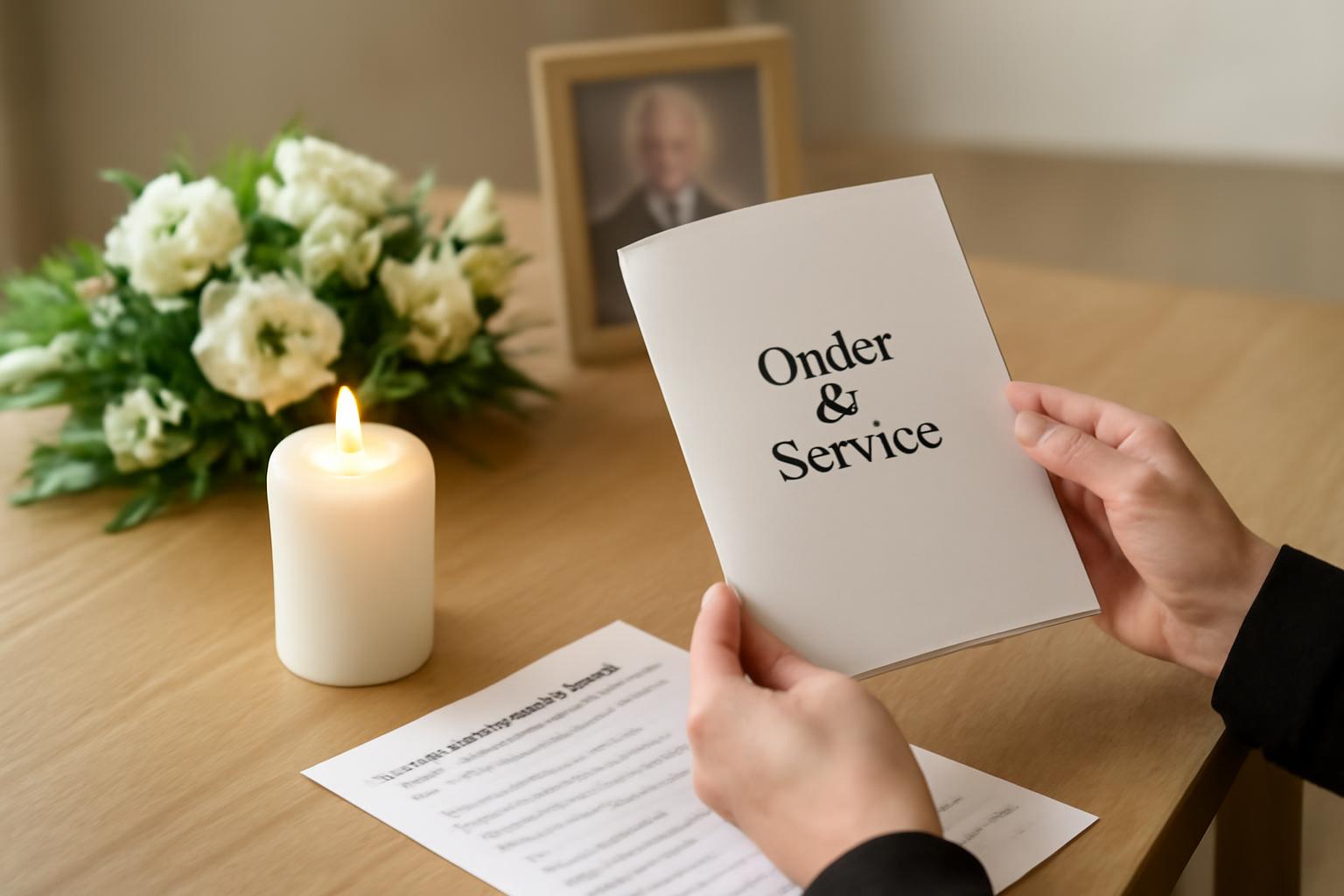
When you are planning a service after a death, the order of service for funeral arrangements can feel both practical and deeply emotional. Its immediate purpose is simple: it tells guests what will happen, in what order, and who is taking part. But it often becomes more than that. Many families keep it as a memorial item long after the day itself.
There is no single universal format. A church funeral, a graveside committal, a memorial service held after cremation, and a celebration of life may all use different language and different structures. The clearest published examples available for this guide are mainly Christian church services and secular memorials, so those are the main models used below. If your family is planning a service in another faith tradition, the same planning principles still help, but the final wording and sequence should be confirmed with the relevant clergy or officiant.
This guide explains what a funeral order of service is, what to include, how common Christian and secular versions differ, how to format it, and how to put one together without overcomplicating it. It also includes copyable templates, sample sequences, and a practical checklist.
What Is a Funeral Order of Service?
A funeral order of service is a printed or digital guide that outlines what will happen during the ceremony and in what order. Depending on the source, you may also see it called a funeral program, funeral bulletin, memorial folder, pamphlet, or itinerary. Whatever the label, the function is the same: it helps attendees follow the service respectfully.
Across funeral guides, the order of service is described as doing three jobs at once:
- giving guests a clear schedule of events
- adding structure and dignity to the ceremony
- serving as a keepsake for family and friends
In practical terms, it often includes:
- the name of the person being honored
- the date, time, and location of the service
- the sequence of prayers, readings, music, eulogies, or tributes
- the names of officiants, speakers, readers, or musicians
- a closing note, reception details, or memorial donation information
Several guides describe a folded single sheet as a common format because it creates a simple four-page booklet:
- Front cover — name, dates, photo, and service details
- Inside pages — the actual order of events
- Back cover — acknowledgements, reception details, or donation notes
That is common, not mandatory. Some services use a card or one-page handout. Others use a longer booklet if the family wants to include an obituary, full readings, song lyrics, or extra photos. One how-to guide says programs often run from two to six pages, while another treats the folded four-page version as the standard starting point. The useful takeaway is not the number itself, but the principle: use only as much space as the service actually needs.
If you are unsure what format fits the occasion, ask the officiant, church office, pastor, or funeral director early. Multiple sources recommend checking local or venue-specific expectations before printing anything final.
Essential Elements to Include in Every Program
A strong funeral program does not need to be elaborate. It needs to be clear, respectful, and easy to follow. The simplest way to plan it is to think in sections: cover, inside sequence, optional memorial content, and closing page.
| Program area | What usually goes here |
|---|---|
| Front cover | Full name, dates of birth and death, photo, service date, time, and place, plus an optional quote, verse, or line such as “In Loving Memory” |
| Inside pages | The order of events, names of participants, hymn or song titles, scripture references, poems, readings, or tributes |
| Optional sections | Short obituary or biography, full texts or lyrics, pallbearers, family messages, photos, or service-related notes |
| Back cover | Thank-you message, acknowledgements, reception details, and memorial donation instructions if relevant |
Here is what matters most in each part.
Front cover essentials
Most guides agree on the core information for the cover:
- the deceased’s full name
- date of birth
- date of death
- a photograph
- the service date
- the service location
Many families also add a line that sets the tone. That might be:
- a scripture passage
- a favorite quotation
- a short poem line
- a simple phrase such as In Loving Memory, A Life Well Lived, or Forever in Our Hearts
Design-wise, sources consistently treat the cover as the emotional introduction to the booklet. It should feel personal, but it also needs to communicate the basic facts quickly.
Inside pages: the ceremony itself
The inside pages usually carry the most important part of the document: the sequence of the service itself.
Common items include:
- welcome or opening words
- prayers, readings, or reflective passages
- music selections or hymns
- obituary reading or life summary
- eulogy or personal tributes
- closing prayer, blessing, or reflection
- recessional or reception note
Multiple guides recommend including the names of the people leading each section where possible. That helps guests know who is speaking and how that person is connected to the service. If space allows, it is also helpful to include:
- hymn or song titles
- scripture references
- poem titles
- names of readers, soloists, or speakers
Some programs print only the title or citation. Others include full text for prayers, readings, or lyrics so guests can follow along. Both approaches are common.
Optional content that can be meaningful
The order of service can stay very simple, but many families add one or more personal elements. Common examples in the source material include:
-
A short biography or obituary A brief life story may mention family, work, major milestones, community involvement, interests, or achievements.
-
Poems, prayers, or song lyrics These are especially useful when the congregation or guests are expected to read or sing together.
-
Personal tributes or family messages These can be short and do not need to be formal.
-
Additional photographs Some families add a collage or a few interior photos beyond the main cover portrait.
-
Pallbearers or honorary roles These appear more often in formal programs.
-
Resting-place details Some guides mention burial or cremation timing or location, especially when those details matter to attendees.
The main tradeoff is space. The more material you include, the more likely the booklet will grow beyond a simple folded format. If time is short, start with the sequence and participant names first. Those are the most practical elements.
Back cover details
The back page is often the family’s direct message to attendees. Typical uses include:
- thanking guests for attending
- acknowledging support, flowers, cards, or prayers
- giving reception details
- providing memorial donation instructions
The wording does not have to be ornate. Short and clear is usually best.
Copy-and-use template: four-page funeral program
If you want a starting point you can adapt, this basic template covers the usual structure.
Front cover
In Loving Memory of [Full Name] [Date of Birth] – [Date of Death] [Optional quote, verse, or line]
Funeral Service [Day, Date, Time] [Venue Name] [City/Location]
Inside left
Order of Service Prelude Welcome Opening Prayer or Opening Remarks Reading Hymn or Musical Selection Obituary or Life Reflection
Inside right
Eulogy or Tributes Additional Reading / Poem / Reflection Sermon, Message, or Closing Reflection Closing Prayer / Benediction / Final Words Recessional
Participants Officiant: [Name] Reader: [Name] Music: [Name or title] Speaker: [Name]
Back cover
The family of [Name] thanks you for your presence and kindness. [Reception details, if any] [Donation instructions, if any]
Copy-and-use template: one-page handout
For a graveside service, memorial gathering, or small private event, a one-page format may be enough.
Celebrating the Life of [Full Name] [Years or full dates] [Date, time, place]
Order of Service Welcome Reading Music Eulogy / Tributes Moment of Reflection Closing Words
Thank you for being here to honor [Name]. [Reception or memorial details]
Typical Sequence for Traditional Religious Funerals
For many church funerals, the order of service follows a familiar pattern even though the exact wording varies by denomination and venue. The strongest detailed examples in the source material are Christian. Taken together, they show a common flow: music as people gather, an opening led by clergy, readings and music, tribute elements, a closing prayer or blessing, and sometimes a graveside committal afterward.
A broad Christian sequence often looks like this:
- Prelude music
- Processional or welcome
- Opening prayer
- Opening hymn or song
- Scripture reading or readings
- Additional reading, poem, or reflection
- Obituary, acknowledgements, or life summary
- Eulogy or tributes
- Sermon or message
- Closing hymn or song
- Closing prayer or benediction
- Recessional
- Committal or graveside service, if applicable
That is a composite pattern drawn from published examples. It is useful as a planning model, but it is not a single official order for all religious funerals.
Common elements in more detail
Prelude music This is the music played as guests arrive. One guide notes that pallbearers may escort the casket during the prelude in some services. Other programs simply use it as gathering music.
Processional or welcome Some church funerals formally process clergy and family into the service. Others begin with spoken words from the officiant.
Opening prayer and hymn Christian samples often move early into prayer and congregational or special music. These elements mark the formal beginning of the service.
Scripture readings Readings are a standard feature in the religious examples. In one published Baptist order, both Old and New Testament readings are listed separately. In a general Christian sample, suggested passages include Psalm 23 and John 14:1–6.
Obituary, acknowledgements, tributes, and eulogy This part varies the most. Some examples place the obituary before remarks. Others place personal tributes before the main eulogy. Some programs also include acknowledgements or resolutions.
Sermon or message In clergy-led Christian examples, a sermon or message of hope often follows the tribute portion.
Closing music, prayer, and recessional The religious samples typically end with a hymn or musical selection, a final prayer or benediction, and a recessional. A separate committal may follow later at the cemetery.
Denomination-specific variation matters
One of the biggest mistakes families can make is treating every church funeral as interchangeable. The published examples show clearly that they are not.
A published Baptist church form gives this order:
- Prelude
- Processional of clergy and family
- Hymn
- Prayer of comfort
- Old Testament scripture
- New Testament scripture
- Song
- Resolutions and acknowledgements
- Remarks
- Obituary reading
- Song
- Eulogy
- Closing prayer
That same form is venue-specific. It also says remarks should be limited to no more than three people for two minutes each, and it states that the senior pastor has final approval of the eulogist. Those are not universal church rules. They are examples of how one congregation handles funeral services.
A published Reformed Church in America liturgy is more formal and begins with prescribed liturgical elements such as:
- Votum
- Sentences of Scripture
- Salutation
- Statement of purpose
- Prayer for comfort or illumination
- Psalter reading
- additional Old Testament reading
That liturgy also says the casket should be closed before the service and may be covered with a white pall. Again, those are not general Christian rules. They belong to that specific liturgical tradition.
Music and reading choices seen in published examples
Published Christian samples in the evidence repeatedly mention:
- Psalm 23
- John 14
- Amazing Grace
- Great Is Thy Faithfulness
These are best understood as common examples, not defaults. If the funeral is taking place in a church, the safest step is still to confirm the final order and selections with the officiant or church office before printing.
A practical rule for religious funerals
If the service is clergy-led or held in a church, treat your family draft as a starting point. The final printed order should match the local practice of that congregation.
Secular and Celebration of Life Variations
A secular funeral or celebration of life uses the same basic idea as any order of service: it helps people follow the gathering. What changes is the content and tone.
Instead of centering the service on formal prayers, scripture, or liturgical language, secular examples focus on memory, music, storytelling, reflection, and the person’s life.
A common secular sequence might look like this:
- Welcome
- Opening remarks
- Reading or poem
- Musical selection
- Personal tributes or shared memories
- Eulogy or life tribute
- Video montage or reflective moment
- Closing reflection
- Reception
This is a composite sample based on published secular examples rather than a fixed ceremony template.
How secular programs differ
No required religious structure Some secular services omit prayers and scripture entirely. In their place, they may use a poem, literary passage, personal letter, or moment of silence.
Music tends to be more personal The music may be a favorite song, a meaningful recording, or a piece associated with the person’s life rather than a hymn chosen for worship.
More flexibility in pacing Celebration-of-life examples frequently make room for:
- personal stories
- informal tributes
- video montage
- memory sharing
- reception as part of the event
A less formal layout often works well One funeral stationery example contrasts a traditional religious layout using tab leaders with an informal program where all text is centered and names appear directly below each role. That simpler, more contemporary approach can suit secular gatherings especially well.
When a secular format is a good fit
A more flexible order can be especially suitable when:
- the gathering is a memorial service held after cremation
- the family wants the focus on stories and personality
- the venue is not a church
- the deceased did not want a formal religious service
- several friends or relatives will speak informally
FTC guidance on funeral types also helps explain why some services are more flexible. Direct burial and direct cremation may happen without a full formal ceremony, with memorial services held later if the family chooses.
The balance to aim for
A celebration of life can feel warm and personal without being loose or confusing. A written program still helps, especially when the service includes several moving parts.
Even a simple version can make a big difference:
- Welcome — [Name]
- Reading — [Name]
- Song — [Title]
- Memories — family and friends
- Closing reflection — [Name]
That small amount of structure is often enough.
Design and Formatting Basics
Once you know what belongs in the program, the next question is design. Good design is not about making the booklet look fashionable. It is about making it readable, respectful, and appropriate for the service.
Match the layout to the tone
The sources show two broad formatting styles.
Formal religious style
- often uses a traditional layout
- may use dotted leaders or a neatly aligned list
- tends to feel symmetrical and ordered
- works well when the service follows a set church sequence
Informal or contemporary style
- often centers the text
- may put each participant’s name directly under the section title
- usually feels simpler and more relaxed
- suits many memorial services and celebrations of life
Neither style is inherently better. The right one is the one that matches the setting.
Keep the visual theme personal but restrained
Template libraries and funeral stationery sites show a wide range of themes. Common examples include:
- floral
- classic
- minimalist
- modern
- nature
- religious
- military or police
- sports or hobby-related
You do not need to use a themed template, but these categories can help if you are starting from a blank page.
A few safe design choices:
- use one or two readable fonts
- choose colors that feel calm and appropriate
- include one strong cover photo if possible
- leave enough white space for the order to be easy to scan
- use symbols only if they fit the person or the service
How long should the program be?
There is no fixed page count. One guide says funeral programs often run two to six pages, while several others describe the folded four-page booklet as a common default. In practice, the right length depends on the content.
A simple way to decide:
- one page or card for a brief service or small gathering
- four pages for the basic cover, order, and thanks
- longer booklets only if you truly need room for an obituary, full readings, lyrics, or extra photos
If a shorter format keeps the program clearer, that is usually the better choice.
Small formatting details that improve clarity
A few habits make almost any order of service easier to use:
- put each event on its own line
- list names beside or below roles where possible
- include song titles and reading references
- keep punctuation and capitalization consistent
- double-check all names, dates, and venue details
These are small details, but they are the ones guests notice most.
Print and digital options
Printed booklets remain common, but digital versions are increasingly practical. Published guides and template services mention options such as:
- a PDF shared by email or message
- a memorial website
- QR codes
- livestream links
- online guestbooks
- digital flipbooks
For printed copies, one planning guide suggests printing about 10 to 15 percent more than the expected attendance. That can be useful, but it should be treated as a rule of thumb from a guide, not a requirement. Some families want many extra copies as keepsakes; others do not.
Sample Orders from Real Examples
Seeing a complete sequence is often easier than reading abstract advice. The samples below are clearly labeled so you can tell which are composites and which come from a published form or liturgy.
Sample 1: Composite sample — traditional Christian funeral
This model combines common features from published Christian guides and sample programs.
Cover wording
In Loving Memory of James Robert Wilson January 15, 1945 – March 20, 2024 A Life Well Lived
Funeral Service 11:00 a.m. Saturday, March 30 First Community Church
Inside order
- Prelude Music — about 5 minutes
- Welcome and Opening Prayer — about 2 to 3 minutes
- Scripture Reading — about 3 to 5 minutes
- Congregational Hymn or Special Music — about 3 to 5 minutes
- Eulogy and Personal Tributes — about 10 to 15 minutes
- Reading, Poem, or Reflection — optional
- Sermon or Message of Hope — about 10 to 15 minutes
- Closing Song or Hymn — about 3 to 5 minutes
- Closing Prayer and Benediction — about 2 to 3 minutes
- Committal or Graveside Service — optional
Examples of selections named in published samples
- Scripture: Psalm 23, John 14:1–6
- Hymn: “Amazing Grace” or “Great Is Thy Faithfulness”
Back page
The family of James Robert Wilson thanks you for your prayers, presence, and kind expressions of sympathy. Reception immediately following the service in the fellowship hall.
This is a planning model, not a mandatory church format.
Sample 2: Published example — Baptist church order of service
One published Baptist church form uses the following order:
- Prelude
- Processional of Clergy and Family
- Hymn
- Prayer of Comfort
- Old Testament Scripture
- New Testament Scripture
- Song
- Resolutions and Acknowledgements
- Remarks
- Obituary Reading
- Song
- Eulogy
- Closing Prayer
That same form asks the family to supply details such as:
- singer’s name for the prelude
- opening hymn
- names of scripture readers
- solo titles and soloists
- name of the reader for resolutions and acknowledgements
- eulogist information
- burial or cemetery address
It also says remarks should be limited to no more than three people for two minutes each, and that the senior pastor has final approval of the eulogist. Because those details come from a specific church form, they should be read as a published local example, not a general Baptist standard.
Sample 3: Published example — Reformed liturgical burial service
A published Reformed Church in America order for Christian burial begins more liturgically than the samples above. Its opening includes:
- Votum
- Sentences of Scripture
- Salutation
- Statement of Purpose
- Prayer for Comfort or Illumination
- Psalter Reading
- Additional Old Testament Reading
The liturgy also provides examples of scripture sentences and psalm readings and says the service should be conducted in the church with the casket closed before the service. A white pall may be used.
This example is helpful because it shows how strongly some traditions depend on inherited liturgical structure rather than a family-created sequence.
Sample 4: Composite sample — secular or celebration of life
This model brings together the common elements in published secular examples.
Cover wording
Celebrating the Life of Helen Brooks 1948–2026 Memorial Gathering Sunday, 2:00 p.m. Lakeside Hall
Inside order
- Welcome
- Opening Remarks
- Reading
- Musical Selection
- Personal Tributes
- Eulogy or Life Tribute
- Video Montage
- Closing Reflection
- Reception
This format leaves more room for personality. The reading might be a poem or literary passage. The music might be a favorite recording. The reception may be a major part of the event and deserves a place in the printed order if it follows immediately.
Sample thank-you note wording
A short acknowledgement is often enough. For example:
The family thanks you for your presence, prayers, flowers, cards, and every act of kindness shown during this time.
Or:
In lieu of flowers, memorial gifts may be made in her memory.
Short wording usually reads best.
How to Create, Print, and Distribute Your Program
Creating a funeral program becomes more manageable when you break it into steps. You do not need to design it from scratch unless you want to.
1. Gather the service details first
Start by collecting the information that will actually appear in print:
- full name
- dates of birth and death
- service date, time, and location
- officiant name
- names of speakers, readers, and musicians
- titles of songs, hymns, poems, or readings
- reception or committal details
- cover photo
- thank-you wording or donation information
One planning guide suggests beginning this process within two to three days after the death. That may be realistic for some families, but it should be treated as a planning example, not a universal schedule. In practice, the right time is simply: as soon as the service details are stable enough to print.
2. Confirm the sequence with the venue or officiant
This is the step most likely to prevent last-minute problems.
If the service is taking place in a church or another setting with established practice, confirm:
- the order of events
- who will speak
- the names and titles to print
- whether a graveside committal should be listed
- whether any wording needs approval
This matters especially in traditions or congregations that use a prescribed liturgy or specific funeral form.
3. Choose how you want to produce it
The source material points to three common approaches.
Have the funeral home prepare it Some guides recommend asking the funeral home to handle planning and printing. This is often the easiest route when time and energy are limited.
Use a template platform Canva offers customizable funeral program templates, and funeral stationery sites offer themed layouts as well. These can help you move quickly without advanced design skills.
Design it yourself Some how-to sources mention creating the program in Canva, Adobe Illustrator, Photoshop, or a similar layout tool. This gives you more control, but it also means you are responsible for proofreading and setup.
One funeral stationery site also advertises a “Design It for Me” service and a shareable digital flipbook. Even if you do not use that service specifically, it is a reminder that hybrid print-and-digital options are now common.
4. Build the program in priority order
If time is tight, build it in this order:
- cover information
- event sequence
- participant names
- optional obituary or tribute text
- back-page thanks and reception details
That way, the most important information is finished first.
5. Proofread carefully
Funeral programs are often assembled quickly, which makes mistakes more likely. Ask one person who is not overwhelmed to review:
- spelling of every name
- dates and times
- venue name
- order of speakers
- song or hymn titles
- reading references
- reception or donation details
- page order if folded
Reading it aloud once from beginning to end often catches errors the eye misses.
6. Print or export enough copies
If you are printing, make sure you have enough for guests plus a few family keepsakes. As noted earlier, one guide suggests printing roughly 10 to 15 percent more than expected attendance, but that is only a planning rule of thumb.
If you are going digital, export a clean final PDF and test any QR code or link before sharing it.
7. Distribute it simply
Printed programs are usually handed to guests on arrival. Digital versions can be shared:
- by email
- through a family group message
- on a memorial website
- through a livestream page
- by QR code at the venue
If the service and the cemetery committal are separate, decide whether one program will cover both or whether the later portion will just be announced verbally.
8. Use a practical planning checklist
Here is a concise checklist you can work from.
Funeral order of service planning checklist
- [ ] Confirm service date, time, and venue
- [ ] Confirm officiant or service leader
- [ ] Gather full name, dates, and photo
- [ ] List the order of events
- [ ] Confirm names of readers, speakers, and musicians
- [ ] Add hymn, song, or reading titles
- [ ] Decide whether to include obituary or biography
- [ ] Write the thank-you note
- [ ] Add reception or donation details if needed
- [ ] Check with church or officiant before printing
- [ ] Proofread names, dates, and sequence
- [ ] Print copies or export final digital version
- [ ] Arrange handout or digital sharing on the day
9. Keep perspective
The order of service matters, but it does not need to be perfect to be meaningful. If the names are correct, the sequence is clear, and the program reflects the person being honored, it has done its job.
FAQ
Do all funerals need an order of service program?
No. A program can be very helpful, but it is not required for every funeral or memorial.
It is most useful when there is a formal gathering with several parts, such as readings, music, tributes, clergy remarks, or a reception. But not every arrangement includes that kind of ceremony. FTC consumer guidance notes that direct burial and direct cremation may take place without a viewing or full formal service, and a memorial may be held later or kept very simple. In those cases, a printed order of service may be unnecessary, or a one-page handout may be enough.
How long should a typical service last according to sample orders?
The safest answer is that sample orders show a range, not a rule.
One published Christian sample totals roughly 38 to 59 minutes before any optional graveside committal, depending on how long the readings, eulogy, music, and message run. Other published examples list the sequence without assigning exact times.
So if you are using sample orders as a planning guide, many formal services may land somewhere under an hour for the main ceremony, but that is only a sample-based estimate, not a universal standard.
Should I include participant names and music details?
Yes, if you have them.
Several guides specifically recommend listing the names of the people conducting each section, along with music selections, scripture references, poems, or other readings. This helps guests follow the service and understand who is speaking.
If space is limited, prioritize:
- officiant
- readers
- speakers
- song or hymn titles
- reading references
Who approves the order in church settings?
Usually the officiant, church office, or pastoral leadership should review it.
Published church examples show why. One funeral stationery guide explicitly says families should check with church officials for necessary rules and formats. One Baptist church form sets its own sequence, limits remarks, and gives the senior pastor final approval of the eulogist. A published Reformed liturgy shows that some churches follow a prescribed order that should not be improvised around.
If the service is church-based, it is wise to get confirmation before printing the final version.
Can the program be fully digital?
Yes. A funeral program can be fully digital if that suits the service and family.
Published guides mention digital formats such as:
- PDF programs
- memorial websites
- QR codes
- livestream links
- online guestbooks
- digital flipbooks
Printed programs remain common because they are easy to hand out and keep, but a digital-only version can work well for remote attendance, smaller memorials, or families who prefer a simpler distribution method.
A funeral order of service does not have to be elaborate to be useful. Start with the essentials, choose a structure that fits the service, and treat published examples as models rather than fixed rules. The clearest path is usually the simplest one: match the program to the faith, venue, and wishes involved, then confirm the final details with the clergy or funeral professionals guiding the service.