
19 min read ·
Prayer Cards as Memorial Keepsakes: Practical Steps to Create Meaningful Tributes
Find 50+ prayer-card verse titles and a no-cost Google Docs layout method, plus size, printing and turnaround choices for the service.
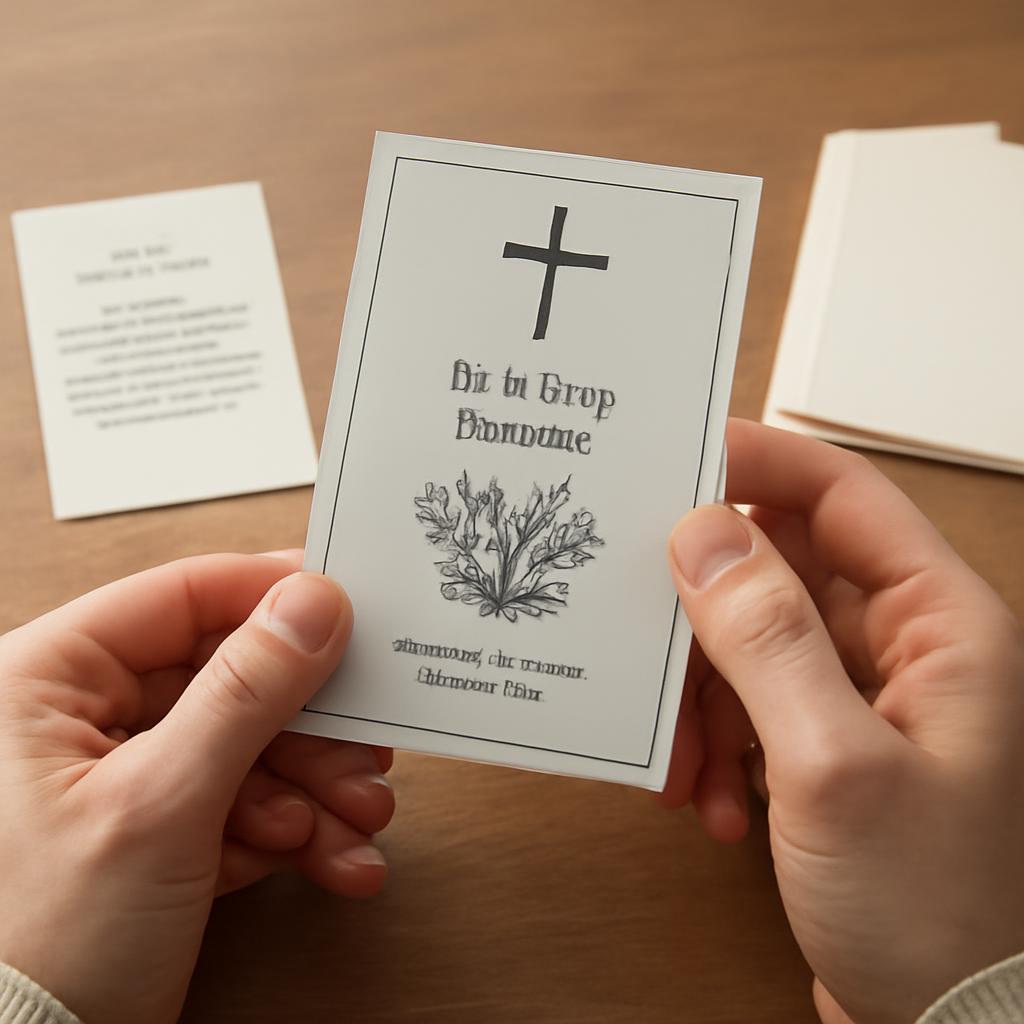
Families planning a memorial often want one small item guests can carry home. Prayer cards can fill that role well: they are compact, personal, and familiar in many faith traditions, while still flexible enough for less formal or less religious gatherings. For people searching for prayer cards for memorial service planning, the challenge is usually not whether to use them, but how to choose the size, wording, design, printing method, and budget under time pressure.
The available public guidance is helpful, but it is uneven. Funeral homes and verse libraries tend to be most useful for wording and service use, while specialist stationery sellers publish the clearest details on sizes, paper stocks, finishes, and turnaround. Taken together, those sources show a fairly consistent market pattern: prayer cards are small remembrance cards, usually printed on cardstock or in laminated form, most often with a photo or devotional image on one side and a prayer, verse, poem, quote, or brief memorial text on the other (Elegant Memorials, The Funeral Program Site, FuneralPrints).
Because much of the detail comes from current seller pages, it is best to treat sizes, materials, and price points as examples from today’s market, not as rigid industry rules. That framing matters: a family does not need the “perfect” prayer card format to create something meaningful. A simple, accurate, readable card usually matters more than following any one vendor’s template.
What Are Prayer Cards and Their Role in Memorial Services
Prayer cards are small keepsakes distributed at funerals, memorial services, celebration-of-life gatherings, and homegoing services. Guides from memorial-stationery sellers and funeral providers describe them as remembrance cards guests can keep in a wallet, Bible, or memory box after the service (Elegant Memorials, The Funeral Program Site, New Comer Syracuse).
The usual front-and-back split is simple. One side commonly carries a portrait photo, religious image, or decorative background. The other side usually carries the person’s name, birth and death dates, and a short text such as a prayer, poem, scripture passage, favorite quote, or brief life sketch (Elegant Memorials, The Funeral Program Site). That division works well because it keeps a very small card readable.
These cards are especially common in Catholic and Christian settings. FuneralPrints, for example, organizes its religious prayer cards around images such as the Virgin Mary, Jesus Christ, St. Francis, saints, and crosses (FuneralPrints). At the same time, the term is used loosely online. Funeral.com distinguishes among memorial cards, which can be more general or secular; prayer or holy cards, which are more explicitly devotional; and bookmarks, which are narrow enough to hold longer text (Funeral.com). In everyday use, though, many families and sellers blur those categories.
That is why it helps to focus less on the label and more on the format. If the card includes a faith-based prayer or saint image, it functions like a prayer card. If it is a photo-and-quote keepsake with no devotional content, it may be closer to a memorial card.
Their purpose is practical and emotional. They give attendees something tangible to keep after the gathering is over.
Standard Sizes, Formats, and Material Options
There is no single universal size for prayer cards, and the evidence reflects that. FuneralPrints lists its religious prayer cards at 2.5 x 4.25 inches (FuneralPrints). Elegant Memorials describes prayer cards as typically about 4.5 x 2.25 inches (Elegant Memorials). Renaissance Funeral Home, writing more broadly about memorial cards, points readers to A7 at 2.9 x 4.1 inches and A6 at 4.1 x 5.8 inches (Renaissance Funeral Home).
That variation is easier to understand if you separate traditional prayer-card sizes from general memorial-card sizes. The narrower wallet-style pieces are closest to what many people picture when they hear “prayer card.” The larger A7 and A6 sizes appear more often in DIY memorial-card instructions, where families may want larger type, more text, or easier home printing. If you want a classic devotional keepsake, the smaller format is usually the better fit. If you need more room for a longer poem or want better readability for older guests, the larger formats can be more practical.
Formats vary almost as much as size. Most prayer cards are flat rectangular pieces, but folded versions exist. MemorialPrayerCards.com separately offers regular memorial prayer cards and folding memorial prayer cards (MemorialPrayerCards.com). Staples’ memorial-card templates can also be filtered by single- or double-sided layouts, while Elegant Memorials notes that some home-printable templates can print 8 per sheet (Staples, Elegant Memorials). Folded cards give you more space, but they also move the finished piece away from the classic wallet-card feel.
Material choices are one of the biggest differences between home printing and professional printing. FuneralPrints publishes unusually specific options: no lamination, velvet lamination, or double thick lamination, along with standard, extra thick, or pearlescent cover stock (FuneralPrints). The Funeral Program Site contrasts home cardstock printing with professional finish choices such as matte and glossy printing (The Funeral Program Site).
Lamination should be treated as a choice, not a requirement. Some seller pages describe prayer cards as laminated, but DIY guides often present lamination as optional. Honor You recommends lamination for durability and weather resistance, while Elegant Memorials describes cards that may be printed on sturdy cardstock or laminated after printing (Honor You, Elegant Memorials). If the card is likely to stay in a wallet or be mailed to relatives, a more durable finish may be worth it. If it is mainly intended as a one-day service keepsake, plain cardstock may be enough.
Bookmarks are the main alternative when text length becomes the deciding factor. That can be helpful for a long poem, a full prayer, or a passage that would feel cramped on a small card.
For families printing at home, paper quality matters more than it may seem at first. In other words, a free template does not eliminate the practical costs of ink, paper, test printing, and trimming.
Content Ideas: Front and Back Layouts
The clearest way to plan a prayer card is to think of it as having two jobs: recognition on the front and remembrance on the back.
On the front, the most common choice is a portrait photo of the person who died. Several guides recommend choosing a clear, well-lit image, and Honor You specifically advises avoiding distracting background clutter (Honor You). If you have an older or imperfect image, some specialist printers also advertise photo enhancement or retouching. MemorialPrayerCards.com says professional photo retouching is included with its memorial products (MemorialPrayerCards.com).
If a suitable portrait is not available, families can use devotional art or a scenic background instead. FuneralPrints organizes its card designs around religious images such as Mary, Jesus, St. Francis, Guadalupe, and crosses, while other guides mention flowers, landscapes, and nature scenes as common design directions (FuneralPrints, Elegant Memorials, Renaissance Funeral Home).
The back is usually where the identifying and commemorative text goes. Common elements include the full name, birth and death dates, a prayer, poem, scripture passage, quote, or short life sketch (Elegant Memorials, The Funeral Program Site). Some families also use a short obituary-style paragraph. That approach can work especially well for celebration-of-life services, where the family wants the keepsake to sound more biographical than devotional.
Short captions matter because they set the tone before the longer text is read. Elegant Memorials suggests lines such as “In Remembrance,” “In Loving Memory,” and “Honoring Her Spirit,” while Funeral.com gives examples like “Forever in our hearts” for more general memorial use (Elegant Memorials, Funeral.com). These little phrases do not take much space, but they help the card feel intentional.
The strongest designs are usually the simplest. Honor You warns against overcrowding because the format is small, and The Funeral Program Site emphasizes legible fonts, readable contrast, and thoughtful use of backgrounds and color (Honor You, The Funeral Program Site). A practical rule is to choose one focal image, one short caption, and one clearly readable text block rather than trying to shrink a full obituary onto a wallet-size card.
Theme options are broader than many families expect. MemorialPrayerCards.com advertises 30+ theme categories including Jesus, Virgin Mary, Catholic, patriotic, nature, pets, and sports (MemorialPrayerCards.com). Zazzle’s memorial prayer card listings show styles such as “celebration of life,” “in loving memory,” and full-photo memorial designs (Zazzle). That range can be useful when the service is centered on a profession, military background, hobby, or personal style rather than on church imagery alone.
If you want the card to feel personal without becoming busy, the safest places to personalize are the photo, the text choice, and the background theme. Those three decisions usually carry more emotional weight than adding extra decorative elements.
Popular Prayers and Verses from Established Libraries
For many families, choosing the wording is harder than choosing the design. Established verse libraries can help because they narrow the choices to texts that are already commonly used in funeral programs and memorial prayer cards.
New Comer Syracuse’s verse library says it offers over 50 prayer-card verse options and over 80 program verse options (New Comer Syracuse). Its prayer-card list includes familiar titles such as 23rd Psalm, Afterglow, Angel Dance, Hail Mary, Our Father, and Serenity Prayer (New Comer Syracuse). For families with a clear faith tradition, those titles may already identify the text they want. For families who are undecided, they give a manageable starting point.
The same New Comer page also includes a useful process tip: make a note of the verse title and share it with the funeral director (New Comer Syracuse). That sounds small, but it can save time. When a funeral home or printer already knows the title of a common prayer, it is easier to match the right text to the right layout.
Memorial Press USA describes a broader prayer library with hundreds of prayers organized by categories such as Catholic, Protestant, mother, father, children, veteran, professions, Spanish, Polish, Lithuanian, Italian, and Croatian. It also says families may submit their own prayer or poem at no additional cost (Memorial Press USA). That category structure can be especially helpful when the service centers on a relationship or identity, such as honoring a parent, a veteran, or a bilingual family member.
The difference between those two kinds of libraries is practical. A title-based library like New Comer’s is useful when you already know the broad tone you want and need a shortlist. A category-based library like Memorial Press USA’s is useful when you want to browse by faith, family role, or language. Either way, the card tends to work best when the wording matches the emotional tone of the service.
A church memorial may naturally call for Psalm 23, the Hail Mary, or the Our Father. A less formal gathering may feel better with Afterglow or a short remembrance poem. The point is not to choose the “most popular” text, but the one that sounds like the service itself.
Because these libraries often rely on linked titles and repeated texts across multiple products, it is wise to confirm the exact wording before printing. New Comer’s page, for example, asks readers to click through to read the full verse and to share the verse name with the funeral director (New Comer Syracuse). A family should send the printer the exact final text it wants used, especially if a clergy member prefers a specific translation or version.
DIY Prayer Cards: Step-by-Step Using Free Tools
Making prayer cards at home is possible, especially when the budget is tight or the timeline is short. The tradeoff is that you take on the work of layout, proofreading, test printing, paper selection, and trimming.
Start by gathering the material before opening any design tool: the full name, birth and death dates, a chosen prayer or quote, a short caption, and a photo if you want one. Elegant Memorials and Honor You both describe this content-first approach, and Honor You notes that your photo choice affects how much room remains for text (Elegant Memorials, Honor You).
For free or familiar tools, Renaissance Funeral Home describes making a memorial card in Google Docs by going to Insert → Drawing → +New, then using a rectangle shape sized to the dimensions you want (Renaissance Funeral Home). The same guide also suggests Microsoft Word and notes typical memorial-card sizes such as A6 and A7. Elegant Memorials adds that cards can also be created from scratch in Word, Publisher, Photoshop, or Illustrator (Elegant Memorials). Renaissance also shows an example of a one-sided memorial card made with Spark from Adobe (Renaissance Funeral Home), so Adobe-based tools can also be part of a DIY workflow if that is what you already know.
A simple home process looks like this:
- Choose your finished size.
- Add the front photo or background image.
- Add the name, dates, and short caption.
- Place the prayer, poem, or quote on the reverse side.
- Check that the type is readable at actual size.
- Print a plain-paper test copy first.
- Check front-and-back alignment before doing the full run.
- Print on cardstock.
- Cut carefully.
- Laminate only if you want extra durability.
Those steps reflect the overlap between Renaissance Funeral Home’s DIY guide and Elegant Memorials’ step-by-step advice, both of which stress test printing and alignment checks before committing to a full batch (Renaissance Funeral Home, Elegant Memorials).
If you do not want to start from a blank page, Renaissance points families to template providers including Honor You, Disciple Press, and Greetings Island (Renaissance Funeral Home). Some templates are free; some cost money. Elegant Memorials recommends checking whether the text, fonts, and photo areas are truly editable in the software you have (Elegant Memorials). That is a useful warning, because a template that cannot be edited cleanly may waste more time than it saves.
The benefits of DIY are straightforward: low direct cost, immediate control, and no waiting for shipping. The drawbacks are just as real. You need good cardstock, enough ink or toner, a printer that feeds thicker stock reliably, and patience for trimming and alignment (The Funeral Program Site, Time Printers). DIY can work very well, but it is usually easiest when the design stays simple.
Professional Printing Services and Customization Options
If you would rather not manage printing, cutting, and alignment at home, the market divides into two broad groups: specialist memorial printers and general card printers or marketplaces.
Among specialists, FuneralPrints publishes some of the clearest specifications. Its religious prayer card section lists 2.5 x 4.25-inch cards, multiple paper and lamination options, and same-day printing and shipping for orders placed by 3 pm EST Monday through Friday (FuneralPrints). A related FuneralPrints guide also says customers can personalize the card with a photo, name, dates, prayer choice, and background color, and states that customer service is available 8 am to 10 pm EST, 7 days a week (FuneralPrints).
MemorialPrayerCards.com is another specialist option with a slightly different emphasis. Its homepage says personalized memorials are shipped within 24 hours of approval, includes professional photo retouching, and advertises 30+ theme categories along with related products such as bookmarks, thank-you notes, and folding prayer cards (MemorialPrayerCards.com). That combination may appeal to families trying to improve an older photo or coordinate several matching printed pieces.
General printers can be useful if you want a broader memorial-card style rather than a traditional devotional look. Staples offers custom memorial cards that can be personalized with a photo and quote, with filters for orientation, photo count, sides, and sizes including 5 x 7 and 4 x 7.75 (Staples). It is not a prayer-card specialist, but it can suit families who want a larger card with more contemporary memorial-card formatting.
Marketplaces widen the design range even further, but they can be harder to compare cleanly. Zazzle shows thousands of memorial prayer card listings, including “Celebration of Life Photo Funeral Prayer Card” and other photo-forward designs (Zazzle). Amazon search results for funeral prayer cards with photos also show a mix of cards and memorial bookmarks; one displayed Copy King listing offered 50 personalized memorial prayer cards at $39.95, or about $0.80 each at the time of the captured result (Amazon). Those figures should be treated as snapshots, not promises, but they do show the wide spread between specialist printing and marketplace listings.
Local and regional printers may also offer memorial prayer cards. In cases like that, the online details may be thin, so families may need to call and ask about sizes, paper, proofs, and turnaround rather than relying on the website alone.
One practical point that is easy to miss: not every provider serves every location. Memorial Press USA states that it does not service Illinois or Indiana (Memorial Press USA). If you are ordering under deadline, confirm not only production speed but also whether the company actually serves your area, especially if the funeral timeline is already tight.
Cost Factors, Bulk Pricing, and Savings Tips
Prayer-card costs are difficult to summarize in one neat number because the market mixes free layouts, paid templates, professionally printed packs, marketplace listings, and larger memorial cards that are not always directly comparable. The safest way to think about cost is by category.
For DIY, the lowest-cost route is a free layout method in a tool you already have, plus your own cardstock and ink. Renaissance Funeral Home specifically describes a no-cost Google Docs method (Renaissance Funeral Home). If you prefer to start with a design file rather than a blank page, Elegant Memorials advertises templates “as low as $2,” while The Funeral Program Site lists prayer-card templates at $39.95 (Elegant Memorials, The Funeral Program Site). So “DIY” can mean almost-free, or it can mean paying for a template and still doing all the production work yourself.
For professionally printed products, the examples in the evidence show a broad range. The Copy King listing visible in the Amazon search result showed 50 cards for $39.95, or roughly $0.80 per card at that moment (Amazon). The Funeral Program Site showed a printed pack of 50 for $112.50 (The Funeral Program Site). Zazzle’s memorial prayer card listings showed sale-priced products ranging from $2.01 to $28.56 in the captured results, but those listings mix different card types and promotional pricing, so they are best read as marketplace examples rather than a stable benchmark (Zazzle).
The main cost drivers are more consistent than the headline prices. Quantity matters. Paper thickness matters. Lamination or premium finishes usually add cost. Photo retouching can add value, although some specialists say it is included; MemorialPrayerCards.com, for example, says professional photo retouching is included (MemorialPrayerCards.com, FuneralPrints). Discounts also appear often on commercial sites, but they change frequently enough that they should not be treated as dependable planning figures.
A few practical ways to control cost are usually more useful than chasing live promotions:
- Start with a free or low-cost layout tool if your design is simple.
- Use an established verse library instead of paying for custom wording.
- Skip premium finishes if long-term durability is not important.
- Order for expected attendance, plus a small margin for mailed relatives and family keepsakes.
- Use professional printing when photo quality, alignment, or time pressure makes it worth paying for.
New Comer’s verse library and Memorial Press USA’s prayer categories can reduce the time spent finding wording, and Memorial Press USA says families may submit their own prayer or poem at no additional cost (New Comer Syracuse, Memorial Press USA).
It can also help to apply the same comparison-shopping habit families use for other funeral expenses. Mortuary Guide’s explainer on funeral home pricing notes that, under the FTC Funeral Rule, funeral homes must accept outside-purchased caskets without charging a handling fee. That rule applies to funeral-home merchandise, not to prayer-card sellers, but the broader lesson still applies: ask for itemized options, compare suppliers, and decline upgrades you do not value.
Personalization, Themes, and Etiquette for Distribution
The most memorable prayer cards are usually the most specific ones. A generic design can still be dignified, but a card often feels warmer when it reflects the person’s faith, profession, heritage, interests, or style.
Faith-based themes are easy to find. FuneralPrints highlights Catholic imagery such as saints, Jesus, Mary, and crosses, and also points families to Irish, military, and police or first-responder designs (FuneralPrints, FuneralPrints). MemorialPrayerCards.com adds patriotic, nature, pets, and sports themes (MemorialPrayerCards.com). For less religious services, Zazzle and Staples both support photo-and-quote memorial styles that can lean more toward “celebration of life” than formal devotional language (Zazzle, Staples).
Personalization usually comes down to three decisions: the photo, the text, and the background or theme. FuneralPrints says customers can upload a photo, add a name and dates, choose a prayer, and change the background color (FuneralPrints). Honor You recommends choosing a clear, well-lit portrait photo (Honor You). If the available photo is old, faded, or damaged, a provider that includes retouching may be worth considering.
Etiquette around distribution is simple. Prayer cards can be set out at the entrance, given with the program, or included with other printed memorial items (Funeral.com, New Comer Syracuse). They are also useful when the memorial is held after cremation. As Mortuary Guide explains in its comparison of cremation vs. burial, direct cremation does not prevent a family from holding a memorial service later, sometimes weeks or months afterward. In that situation, prayer cards can still be distributed at the later gathering or mailed to relatives who cannot attend.
Quantity planning is mostly common sense: estimate attendance, add a few for family members, and include extras if you plan to mail keepsakes to those who were absent. Before printing, proof everything one last time. Elegant Memorials emphasizes proofing and test printing, and New Comer advises coordinating verse choices with the funeral director (Elegant Memorials, New Comer Syracuse). In practice, the mistakes families regret most are not design choices but wrong dates, misspelled names, and poorly cropped photos.
What is the most common size for memorial service prayer cards?
There is no single universal size, but the most traditional wallet-style examples in the evidence are 2.5 x 4.25 inches from FuneralPrints and about 4.5 x 2.25 inches from Elegant Memorials. More general memorial-card guides also use A7 at 2.9 x 4.1 inches and A6 at 4.1 x 5.8 inches when families want more room for text (FuneralPrints, Elegant Memorials, Renaissance Funeral Home).
Are there free templates or verses for DIY prayer cards?
Yes. New Comer Syracuse publishes a verse library with 50+ prayer-card titles, and Renaissance Funeral Home describes a no-cost way to lay out memorial cards in Google Docs. That same guide also points readers to template sites such as Honor You, Disciple Press, and Greetings Island, though some templates may be paid rather than free (New Comer Syracuse, Renaissance Funeral Home).
Can prayer cards be made without religious content?
Yes. Although prayer cards are most common in Catholic and Christian settings, families can use a more general memorial-card format with a photo, dates, and a short quote instead of a formal prayer. Funeral.com distinguishes secular memorial cards from explicitly devotional prayer cards, Renaissance Funeral Home includes poems and obituary text among content options, and Zazzle listings include “celebration of life” memorial styles (Funeral.com, Renaissance Funeral Home, Zazzle).
How quickly can custom prayer cards be printed and shipped?
Some specialist providers advertise very fast turnaround. FuneralPrints says orders placed by 3 pm EST Monday through Friday are printed and shipped the same day, while MemorialPrayerCards.com says personalized memorials ship within 24 hours of approval (FuneralPrints, FuneralPrints, MemorialPrayerCards.com). Because approval steps and carrier delivery times vary, it is still wise to confirm the full timeline before relying on a rush order.
What should I include on a prayer card to make it personal?
The usual essentials are the full name, birth and death dates, a clear portrait photo, and a short back-side text such as a prayer, poem, quote, or brief life sketch. To make it more personal, add a caption like “In Loving Memory,” choose a background or symbol that reflects the person’s faith or style, and keep the design readable rather than crowded (Elegant Memorials, The Funeral Program Site, Honor You).
Prayer cards can be a simple, lasting extension of a memorial service rather than one more stressful task on a long checklist. Families generally have two workable paths: create them at home with free tools and careful proofreading, or order professionally printed cards when timing, finish, or photo quality matters more. Either way, the strongest results usually come from clear choices about size, wording, and tone—not from elaborate design. This article is general information only and is not a substitute for advice from a licensed funeral director or other professional adviser.