
14 min read ·
The Simple Way to Place and Secure a Boutonniere
Use the wearer's left lapel, with the bloom near the buttonhole on its broad section. Follow the lapel's angle and keep all hardware concealed.
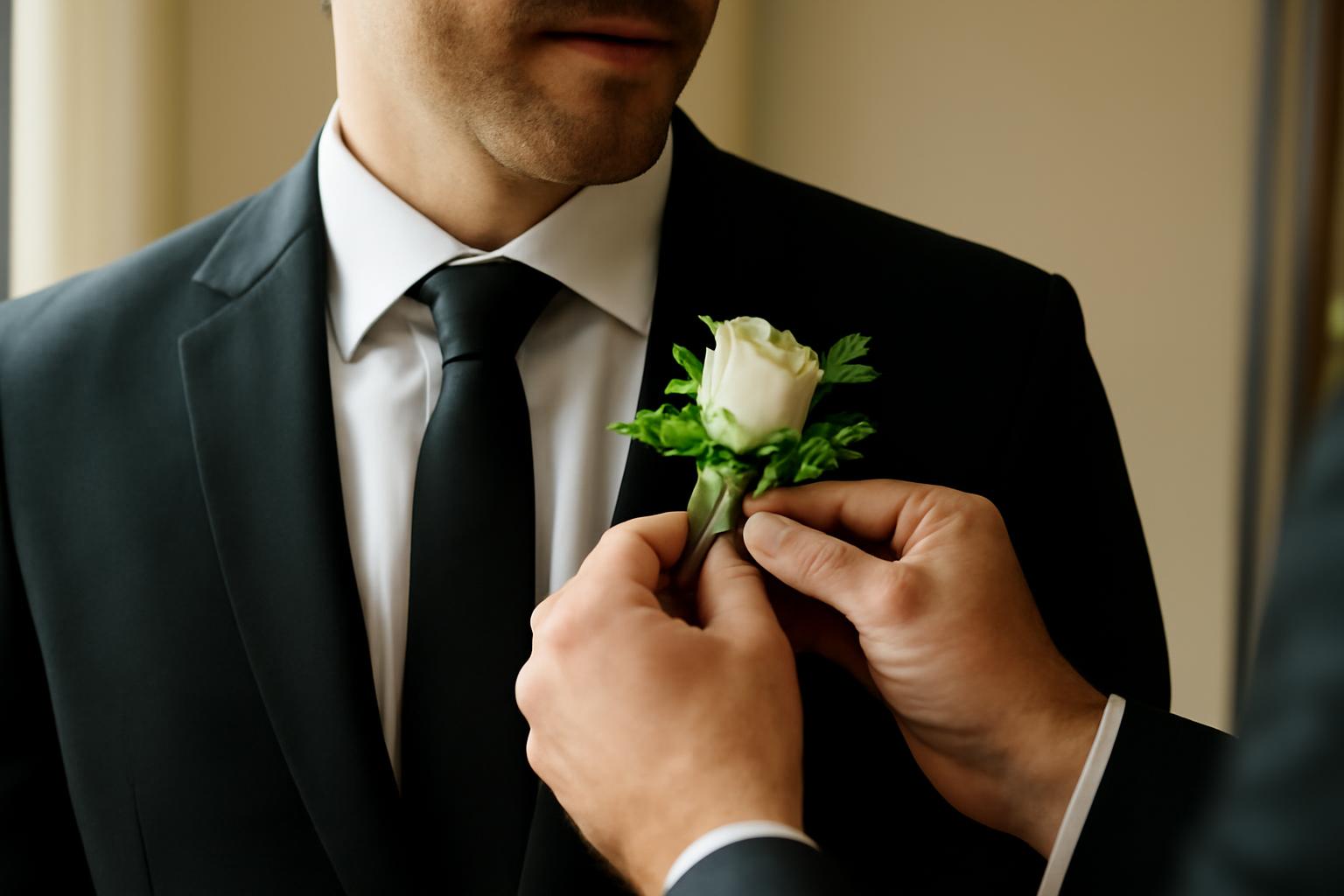
The short answer: place it on the wearer’s left lapel
Traditionally, a boutonniere goes on the wearer’s left lapel. If you are standing face-to-face with the wearer and attaching it, that lapel will be on your right.
Place the flower near the lapel buttonhole, on the broad part of the lapel and above the breast pocket. The bloom faces upward, the wrapped stem points downward, and the arrangement follows the lapel’s natural slant. This is a strong Western formalwear tradition rather than an exceptionless rule for every culture, garment, or floral design (SuitShop’s boutonniere placement guide).
You may hear that the boutonniere is worn on the left because that places it “over the heart.” Treat that as a memory aid, not as a proven explanation of the custom’s origin. The practical rule is wearer’s left, not the side that looks left to the person doing the pinning.
Quick placement check
- Side: Wearer’s left
- Position: Broad part of the lapel, near the buttonhole
- Flower: Bloom up
- Stem: Wrapped stem down
- Finish: Flat against the jacket, with all hardware hidden
The available guidance does not establish a separate funeral-specific placement rule. A host, family, faith community, cultural custom, or florist may nevertheless request a variation.
Before inserting a pin, step back and view the whole jacket. The flower should look integrated with the lapel—not stranded near the shoulder, centered on the chest, or tucked into the pocket area.
How high and at what angle should it sit?
There is no universal measurement for every wearer and jacket. Lapel widths vary, buttonholes sit at different heights, and boutonnieres range from compact single blooms to longer arrangements with flowers and greenery. Visual landmarks are therefore more reliable than a fixed measurement from the shoulder or collarbone.
Place the main bloom:
- On the wider part of the left lapel
- Near the lapel buttonhole area
- Below the collar and shoulder area
- Above the breast pocket
- Far enough from the lapel edge to be supported
- Far enough from the neck that it does not crowd the collar
One florist guide recommends positioning the top of the arrangement about two inches below the collarbone (Ethos Floral Events’ placement instructions). Another uses the less exact landmark of placing the bloom a few inches below the shoulder seam (Fiore Designs’ pinning guide). These are reference points, not mandatory dimensions. The better test is whether the prominent part of the flower sits naturally near the buttonhole without crowding the collar or approaching the pocket.
If the arrangement has one principal bloom, place that bloom—or the design’s visual weight—near the broad part of the lapel. The entire arrangement does not need to be geometrically centered. Greenery and smaller flowers may extend above or to one side if the design remains balanced.
Follow the lapel rather than gravity. The wrapped stem should generally follow the lapel’s diagonal line instead of being forced into a rigid vertical position. The bloom still points generally upward toward the shoulder, while the stem points downward.
Many boutonnieres have a flatter back and a fuller front. Rest the flat side against the jacket. If the flower twists outward or projects like a shelf, check whether it has been placed backward before changing the pin position.
Labeled placement map — wearer’s left side, viewed from the front
| Landmark | Correct relationship |
|---|---|
| Left shoulder and collar | The boutonniere sits below this area without crowding it |
| Main bloom | Faces upward and rests near the buttonhole area |
| Lapel buttonhole | Serves as the main placement landmark |
| Broad lapel area | Supports the largest part of the arrangement |
| Wrapped stem | Points downward and follows the lapel’s diagonal |
| Left breast pocket | Forms the lower boundary; the standard boutonniere stays above it |
On a narrow notch lapel, the flower may need to sit close to the buttonhole to remain supported. A wide peak lapel offers more room, but the boutonniere should not drift toward the center of the chest.
Once the position looks right, check it from normal conversational distance. Make sure the flower does not compete with the collar, tie, bow tie, pocket square, or lapel edge. If it looks too high or low, move the entire arrangement before pinning rather than trying to correct the position by changing only its angle.
Should it go through the lapel buttonhole or over it?
The lapel buttonhole is both a traditional flower location and a useful visual landmark. It does not mean every boutonniere stem must pass through the opening.
If the jacket has a functional flower buttonhole and the wrapped stem fits without crushing the arrangement, the stem may pass through the opening and be secured on the underside of the lapel. If the buttonhole is decorative, sewn shut, too small, or poorly positioned for the design, place the boutonniere over or near it and attach the flower from behind. Both methods preserve the customary location on the broad area of the left lapel (ART Flowers LA’s placement guide).
Before using the opening, check:
- Is the buttonhole actually open?
- Can the wrapped stem pass through without crushing the flowers or greenery?
- Does the bloom remain flat once the stem is inserted?
- Will the entire arrangement remain above the breast pocket?
- Does the method support the flower without distorting the lapel?
Do not cut open a decorative buttonhole or improvise alterations to an expensive, rented, borrowed, vintage, or delicate jacket. If modifying the opening is under consideration, ask the garment owner, rental provider, or a tailor whether that is appropriate.
The buttonhole should not override the flower’s fit. If inserting the stem causes the bloom to crowd the collar, twist sideways, or hang too low, pinning the arrangement near the opening may produce a cleaner and more secure result. Think of the buttonhole as the correct neighborhood, not an inflexible attachment requirement.
How to pin a boutonniere securely
The goal is to secure the wrapped stem from behind the lapel so the flower lies flat, the hardware remains hidden, and the sharp point is contained.
First identify the boutonniere’s front and back. Find the firmest wrapped section beneath the bloom, and handle the arrangement by that section rather than squeezing the petals.
Use this sequence:
-
Position the boutonniere. Place it on the wearer’s left lapel, with the principal bloom near the buttonhole area and the stem following the lapel’s slant.
-
Hold it flat. Keep the arrangement in its final position without crushing the bloom or foliage.
-
Reach behind the lapel. Work from the underside so the visible face of the jacket remains clean.
-
Insert the pin from behind. Catch enough lapel fabric to hold the arrangement, then guide the pin through the thickest wrapped portion of the stem—not through the flower head or petals.
-
Contain the point. Guide the pin back into or behind the lapel so its sharp end is covered. The pinhead, shaft, and point should be concealed from the front.
-
Release the flower carefully. Check that it remains flat and does not rotate, wobble, or flop away from the jacket.
-
Inspect both sides. Look for visible metal from the front, then check behind the lapel for an exposed point.
Professional demonstrations vary in whether the pin travels upward, downward, or across the stem. The consistent technique is to work from behind, pass through a substantial wrapped section, and return the point to a concealed position. No single insertion angle works for every combination of lapel thickness, stem construction, and flower weight (Sydney Dunn’s demonstrated pinning method).
Do not pierce the petals or flower head when the wrapped stem is the intended attachment point. Pinning too high can damage the bloom, while catching only a thin layer of wrap can allow the arrangement to pivot.
After attachment, inspect the flower from normal viewing distance. Metal that appears hidden at close range may become visible when the lapel moves. If the pin shows, remove and reinsert it from behind rather than bending it while it remains in the garment.
Work slowly and with enough light to see the pin’s path. If the helper cannot control the pin comfortably while the jacket is being worn, stop and remove the jacket before making substantial adjustments. Place it on a stable surface and keep hands and the wearer’s body out of the pin’s path.
For a rented, delicate, or expensive jacket, confirm the approved attachment method before piercing the fabric. A florist, tailor, rental provider, or garment professional may recommend a less invasive option suited to that lapel.
Is one pin enough?
There is no universal pin count. One pin may be enough for a light, balanced boutonniere on a firm lapel. A large, heavy, long, or top-heavy arrangement may require another support point.
The decision depends on:
- The weight and size of the arrangement
- Whether most of the weight is concentrated near the top
- The length and thickness of the wrapped stem
- The lapel’s thickness and structure
- Whether the fabric is firm, stretchy, slick, or delicate
- Where the first pin passes through the stem
- How much the wearer will move
A practical approach is to begin with one pin through the thick wrapped section and add a second only if a large or heavy arrangement remains unstable (SuitShop’s pin-count guidance). Two crossed pins behind the lapel are another supported method for controlling a heavy or top-heavy design (Flowers by Janie’s attachment guide).
If one pin holds the arrangement flat, another may be unnecessary.
If the flower rotates around the first pin, reposition that pin through a thicker section or add support lower on the wrapped stem. Crossed pins can limit movement in more than one direction. Whatever method is used, keep all hardware concealed and contain every sharp end.
| What you see | Likely issue | What to try |
|---|---|---|
| Boutonniere rotates or wobbles | The attachment point is not controlling the arrangement | Reposition the pin through a thicker wrapped section or add another support point |
| Bloom droops forward | The design is top-heavy, or the pin catches too thin a section | Secure the thick wrap closer to the bloom; add lower support if needed |
| Stem swings sideways | The first pin is acting as a pivot | Add support lower on the stem or use crossed pins behind the lapel |
| Lapel puckers | The pin is pulling too much fabric or entering at an awkward angle | Remove it and catch less fabric from behind |
| Metal shows from the front | The pin entered or exited on the visible face | Remove it and reinsert it entirely from the underside |
| Flower twists outward | The flat back is not against the jacket, or support is uneven | Correct the orientation and reposition the attachment |
| Petals look compressed | The bloom was held or pinned instead of the stem | Release the pressure and work through the wrapped stem |
| Lapel sags | The arrangement is too heavy for the garment | Ask the florist about a lighter design or another attachment |
Once the flower is attached, ask the wearer to take a few normal steps or move one shoulder gently. The boutonniere should remain flat without bouncing or rotating. Avoid repeated tugging or repeated piercing; make one deliberate adjustment at a time.
What if the jacket has no standard lapel?
For a lapel-free jacket, shawl collar, or unusually constructed formal garment, use a firm, flat area on the wearer’s left chest as the practical equivalent of the traditional left-lapel position. The flower may need to sit slightly higher for visibility, but the exact location depends on the collar, seams, closures, and internal structure.
Keep etiquette and mechanics separate:
- Custom suggests the general left-chest location.
- Garment construction and flower weight determine whether and how the arrangement can be attached.
Do not assume that a shirt, vest, dress, shawl collar, or delicate garment can be pinned like a conventional suit lapel.
Before attaching anything to a nonstandard garment, consider:
- Whether the area is firm enough to support the flower
- Whether the fabric is likely to show holes or snags
- Whether seams or closures interfere with placement
- Whether the arrangement is light enough for the garment
- Whether the flower will remain flat as the wearer moves
If pinning could damage the garment, ask the florist or a garment professional to select an attachment for that specific fabric and arrangement. A smaller, lighter boutonniere may be a better solution than adding more hardware to support an oversized design.
Magnetic holders provide a pin-free option for some arrangements, but their suitability varies. Thick jacket material can prevent a holder from attaching effectively, while heavier flowers or slick fabric can make an arrangement less stable (Fiore Designs’ discussion of attachment options). Follow the holder manufacturer’s instructions and safety warnings; if its warnings make the product unsuitable for the wearer, choose a professionally selected alternative.
A shawl collar curves rather than forming the straighter outer line of a notch or peak lapel. Place the flower where the collar offers adequate width and firmness, then align it with the curve so it looks intentional from the front. Keep the bloom up and the back of the arrangement against the garment.
For a lapel-free jacket, begin in the upper-left chest area and adjust the position until the flower appears visually connected to the collar rather than isolated in the center of the torso. Keep it above breast-pocket level when a pocket is present. If no stable area exists, do not force a conventional pin-on boutonniere onto the garment.
Boutonnieres, breast pockets, and pocket squares
A conventional wrapped-stem boutonniere belongs on the lapel, not tucked into the breast pocket. Use the pocket as the lower visual boundary: the standard boutonniere should remain on the broad lapel area above it.
A pocket-square boutonniere is a different floral design. Its construction does not mean that an ordinary stemmed boutonniere belongs in the pocket (Flowers by Janie’s overview of boutonniere styles).
A standard lapel boutonniere and an ordinary fabric pocket square may be worn together because they occupy separate locations:
- The boutonniere sits on the left lapel.
- The pocket square sits in the left breast pocket.
When wearing both, keep the overall effect balanced. A large floral arrangement and a highly projecting pocket-square fold may make the left side of the jacket look crowded. Simplify one element rather than moving the flower to the opposite lapel or placing it inside the pocket.
The wrapped stem should end above the pocket opening. If it overlaps the pocket square or disappears into the pocket, move the arrangement upward or ask the florist whether the design can be adjusted.
Before the wearer leaves, complete this final inspection:
- [ ] The boutonniere is on the wearer’s left
- [ ] The main bloom is near the buttonhole on the broad part of the lapel
- [ ] The arrangement is below the collar and above the breast pocket
- [ ] Its angle follows the lapel
- [ ] The bloom points upward
- [ ] The wrapped stem points downward
- [ ] The flat back rests against the jacket
- [ ] The flower is stable and does not rotate or droop
- [ ] No pinhead, shaft, or sharp tip is exposed
- [ ] No petals or leaves are crushed
- [ ] A pocket square, if worn, remains separate and unobstructed
The practical rule is straightforward: use the wearer’s left lapel, place the bloom near the buttonhole on the broad part of the lapel, follow the lapel’s angle, and keep the arrangement flat with concealed hardware. If the garment or floral design makes that method unsuitable, preserve the general left-chest placement while choosing an attachment appropriate to the fabric and flower.
A host, family, cultural practice, garment design, or florist may call for a reasonable variation. A deliberate and secure variation is better than damaging the garment or forcing the flower into a position it cannot hold.
Frequently asked questions
Does the boutonniere go on my left or the left of the person facing me?
It goes on your left as the wearer. If another person is facing you to attach it, your left lapel appears on that helper’s right. Confirm the side from the wearer’s perspective before pinning.
How far below the shoulder should a boutonniere sit?
There is no mandatory distance. Use the broad part of the lapel near the buttonhole, below the collar and above the breast pocket, as the primary guide.
If the flower crowds the collar, lower the whole arrangement slightly. If the stem approaches the breast pocket, raise it. The principal bloom should remain supported by the lapel’s wider area.
Can a boutonniere be worn with a pocket square?
Yes. Wear the conventional boutonniere on the left lapel and the pocket square in the left breast pocket. Keep the boutonniere above the pocket so the two elements remain distinct.
A pocket-square boutonniere is different because it is specifically constructed to sit inside the breast pocket.
Does a heavy boutonniere need two pins?
It may. Begin by checking whether a pin through the thick wrapped section keeps the flower flat and stable. If the arrangement rotates, droops, or swings, another support point or crossed-pin arrangement may help.
Use the fewest suitable attachment points needed to secure the design without puckering or unnecessarily piercing the fabric.
Where does a boutonniere go on a jacket without lapels?
Place it on a firm, flat section of the wearer’s left chest, in the same general visual area where a left lapel would normally be. It may need to sit slightly higher depending on the collar and jacket structure.
If the material is thin, delicate, slick, or unable to support the flower, ask the florist or a garment professional for an attachment suited to the garment and arrangement.