
7 min read ·
Choose Hymns Matched to Your Funeral's Moment
A service that is not a funeral Mass may not need a Communion selection. The parish's order shows which music belongs.
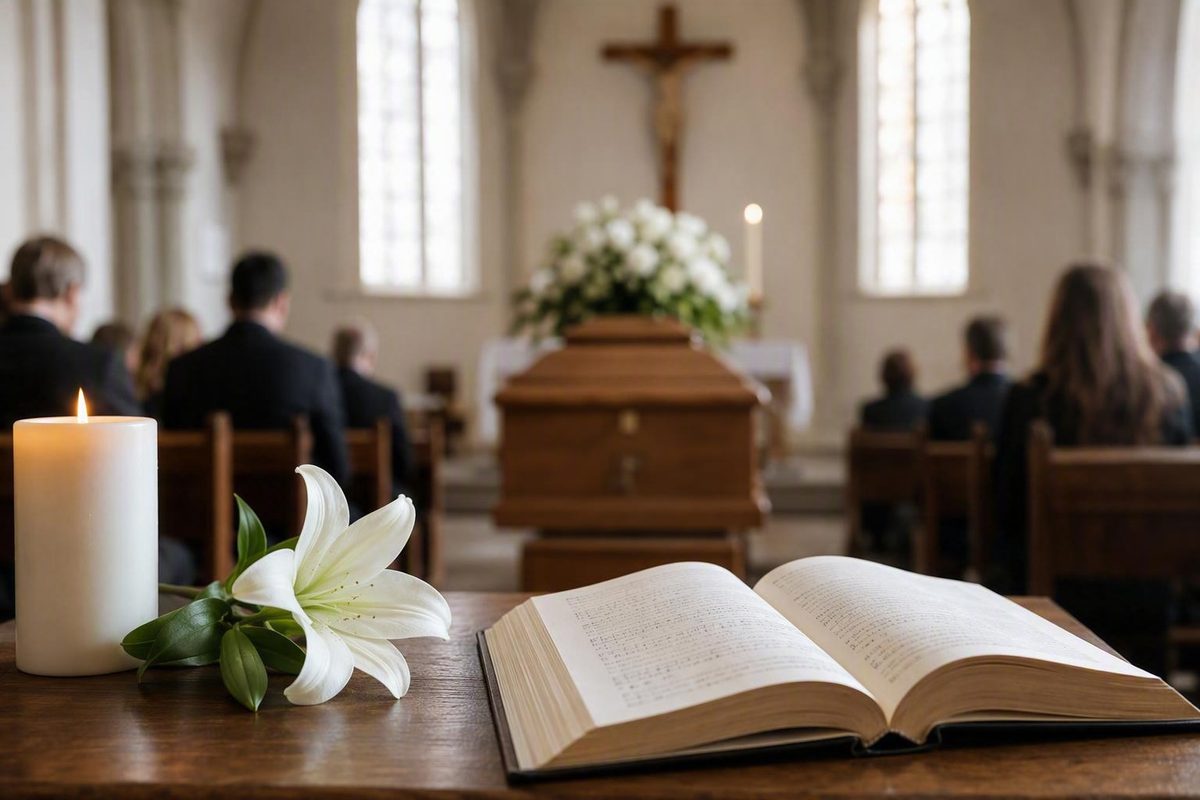
Suitable Catholic church songs for a funeral include Be Not Afraid, On Eagle’s Wings, The King of Love My Shepherd Is, I Am the Bread of Life, Jesus, Remember Me, In Paradisum, and How Great Thou Art. The right choice depends on where the music will occur in the liturgy, what the parish permits, and what its musicians can lead.
Before finalizing anything, send your proposed selections to the parish musician, funeral coordinator, or priest. A title that appears on one Catholic parish’s list may not be available—or may be assigned to a different part of the service—at another church. This guide offers a useful shortlist, not a universal approval list, and it does not reproduce song lyrics.
Start with the church’s own funeral music list
The easiest way to make appropriate choices is to work from the parish’s current list rather than assemble a playlist first. The Archdiocese of Los Angeles funeral-liturgy resource groups suggestions under opening, psalm, offertory, Communion, song of farewell, and recessional headings. Parish guides use similar groupings, but the exact titles and labels vary.
Ask the parish for:
- the order of service and the moments for which the family may choose music;
- its approved hymn list or planning form;
- the hymnal edition used at the church;
- available cantor, choir, organist, pianist, or instrumentalists;
- any seasonal, language, or cultural considerations; and
- the deadline for submitting selections.
The deceased’s known wishes are a meaningful starting point. A Catholic funeral-planning guide from The Art of Dying Well also notes that its suggestions are not an official or exhaustive approval list. In practice, a familiar favorite still needs to fit the liturgical moment and local parish guidance.
Opening or entrance hymn
The opening hymn accompanies the entrance and helps the gathered congregation begin singing together. Strong possibilities appearing on Catholic archdiocesan or parish lists include:
- Amazing Grace
- Be Not Afraid
- For All the Saints
- Here I Am, Lord
- I Heard the Voice of Jesus Say
- O God, Our Help in Ages Past
- On Eagle’s Wings
- The King of Love My Shepherd Is
Choose a melody the congregation can reasonably join. A song connected to the deceased can be especially fitting when it also works as communal prayer. If relatives come from different Catholic communities, confirm the tune and version: identical titles can have more than one musical setting.
Responsorial psalm
The responsorial psalm is not simply another optional favorite. It has its own place in the Liturgy of the Word, so select from the psalm settings the parish provides. Common funeral options on the researched church lists include:
- Psalm 23 — settings built around the Lord as shepherd
- Psalm 27 — settings centered on light and salvation
- Psalm 42/43 — settings expressing longing for God
- Psalm 63 — settings expressing thirst for God
- Psalm 103 — settings centered on mercy and compassion
- Psalm 116 — settings about walking in the presence of the Lord
- Psalm 130 — settings centered on mercy and redemption
The cantor or music director may recommend a setting that the parish already knows. That practical guidance matters: a familiar response makes it easier for mourners and guests to participate.
Offertory or preparation of the gifts
When the local order includes music during the preparation of the gifts, the selection can be reflective without becoming a private performance. Options found on parish and archdiocesan lists include:
- Be Thou My Vision
- Eye Has Not Seen
- Lord of All Hopefulness
- Make Me a Channel of Your Peace (also listed as Prayer of St. Francis)
- Precious Lord, Take My Hand
- Shelter Me, O God
- The King of Love My Shepherd Is
Not every church uses the same label or offers a family choice at this point. Put this line on your planning sheet as “offertory/preparation of the gifts, if applicable,” then let the parish confirm it.
Communion hymn at a funeral Mass
If the funeral is celebrated within Mass, Communion music is chosen for the Eucharistic moment. The St. John Paul II Parish funeral music guide places these among its Communion selections:
- Eat This Bread
- Gift of Finest Wheat
- I Am the Bread of Life
- One Bread, One Body
- Panis Angelicus
- Ubi Caritas
Other parish lists include Taste and See, Shepherd Me, O God, and No Greater Love. Ask the musician to recommend a setting suited to the expected congregation and available singers. If the service is not a funeral Mass, do not assume a Communion selection is needed; follow the order supplied by the parish.
Meditation or Marian selection
Some parishes offer an optional post-Communion meditation and may include Marian music there. Examples on the researched parish lists include:
- Ave Maria
- Hail Mary: Gentle Woman
- Salve Regina
This is one of the clearest examples of local variation. One parish may schedule a Marian selection after Communion, while another may not include a separate meditation at all. Confirm the placement, the musical setting, and whether it will be sung by a soloist or the assembly.
Song of farewell or commendation
The final commendation has a distinct liturgical purpose, so use a selection intended for that moment rather than moving a general favorite into the slot. The Los Angeles archdiocesan list and the St. Joseph Catholic Church funeral music guide include choices such as:
- I Know That My Redeemer Lives
- In Paradisum
- Jesus, Remember Me
- May the Angels Lead You into Paradise
- Saints of God, Come to His/Her Aid
- Song of the Angels
Names and translations can differ among hymnals. Give the musician the exact title from the parish’s list instead of relying on a remembered phrase.
Recessional or procession from the church
The closing selection accompanies the procession and can carry a confident, hopeful character. Common options include:
- For All the Saints
- How Great Thou Art
- I Know That My Redeemer Lives
- Jesus Christ Is Risen Today
- O God Beyond All Praising
- On Eagle’s Wings
- Sing with All the Saints in Glory
- We Walk by Faith
Some church guides call this the recessional; others describe a procession to the place of committal. Use the parish’s terminology when completing its form.
Can secular or recorded songs be used?
Do not assume that a meaningful popular song can be used during the church liturgy. Local rules and pastoral decisions matter. For example, St. John Paul II Parish states that music during its funeral liturgy must be live and sacred, and it directs secular or recorded music toward the wake, visitation, or a gathering after the funeral. That is a documented parish policy, not proof that every Catholic church applies identical wording.
If a secular song is important to the family, ask where it can be included respectfully. Possibilities may include the visitation, a photo presentation outside the liturgy, the reception, or another family gathering. The parish and funeral home can explain what is feasible in each setting.
A simple way to narrow the list
Use these four tests for each proposed title:
- Placement: Does the parish list it for the moment you are planning?
- Participation: Can the congregation or cantor sing the available setting comfortably?
- Meaning: Does the song support Christian prayer, hope, remembrance, or the specific action of the liturgy?
- Practical fit: Do the musicians have the music, rehearsal time, language ability, and instrumentation needed?
A restrained plan is usually easier to coordinate than a long wish list. Choose one preferred title and one backup for each slot the parish assigns to the family. Backups help when a piece is unavailable, unsuitable for the liturgical season, or beyond the available musicians’ preparation time.
Funeral music planning checklist
Before sending your choices, verify that you have:
- the exact church, date, and type of funeral service;
- the parish’s current planning form and music list;
- a preferred and backup selection for each family-choice slot;
- exact song titles and, where necessary, the composer or musical setting;
- confirmation of who will sing and play;
- any multilingual or culturally specific requests;
- a separate plan for meaningful non-liturgical music; and
- written approval from the parish musician, clergy, or funeral coordinator.
Customs and practical arrangements can vary by family, parish, diocese, country, and faith community. The most helpful choice is not necessarily the most popular title; it is one that fits the service, can be led well, and helps those present pray together.
Frequently asked questions
How many songs are needed for a Catholic funeral?
There is no single number to copy from an online list. The parish’s order of service determines how many selections the family makes. A funeral Mass may offer choices for entrance, preparation of the gifts, Communion, meditation, farewell, and recessional, while the parish may select or coordinate other sung parts. Ask for the planning form before counting songs.
Is Ave Maria appropriate for a Catholic funeral?
It can be, where the parish includes it on the approved list and assigns it an appropriate place. Researched parish examples place Ave Maria in an optional post-Communion meditation category. Confirm the version and placement rather than assuming it replaces a Communion hymn or the song of farewell.
What is a safe first shortlist?
Begin with Be Not Afraid or The King of Love My Shepherd Is for the entrance, a parish-approved setting of Psalm 23, I Am the Bread of Life for Communion when applicable, In Paradisum for the commendation, and How Great Thou Art or On Eagle’s Wings for the recessional. Treat that as a conversation starter; the parish’s own list remains authoritative for the service.