
7 min read ·
Funerals and Celebrations Honor Differently
A family might hold a funeral or graveside service soon after the death, then arrange a larger celebration when distant relatives can travel.
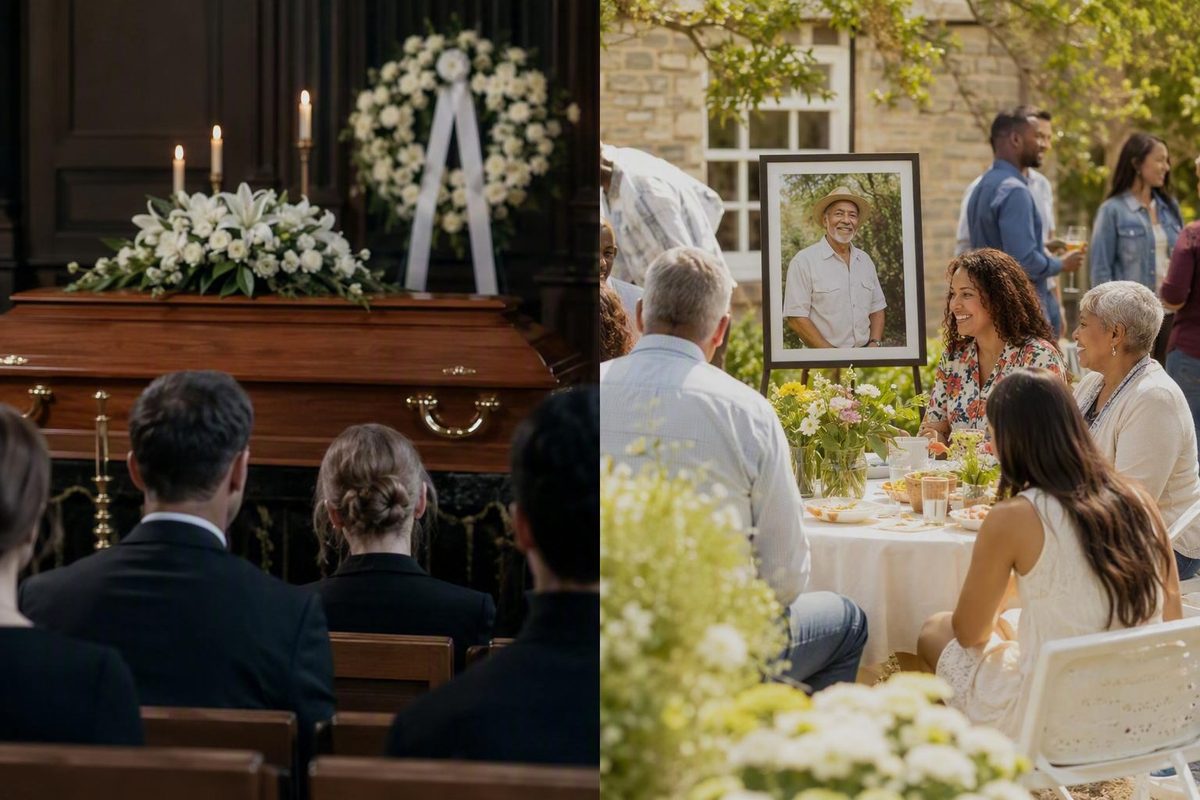
A funeral and a celebration of life are both gatherings that honor someone who has died and support the people who miss them. The usual difference is emphasis and structure: a funeral is often connected to care or committal of the body and may follow an established religious or cultural order, while a celebration of life is often more flexible and centered on memories, personality, and relationships. These are tendencies, not rules. A funeral can include warm stories and laughter, and a celebration of life can make full room for grief.
The names are not standardized. Families, faith communities, and funeral providers sometimes use funeral, memorial service, and celebration of life differently or interchangeably. To understand a particular gathering, look at what is planned, when it occurs, and whether the body or casket will be present—not the label alone.
Celebration of life vs. funeral at a glance
| Question | Funeral | Celebration of life |
|---|---|---|
| Main emphasis | Honoring the person, acknowledging the death, supporting mourners, and often carrying out religious, cultural, or committal rites | Remembering the person’s life through stories, relationships, interests, and personalized tributes |
| Body or casket | Often present, but not always; the casket may be open or closed | Usually not present; cremated remains may or may not be displayed |
| Timing | Often held relatively soon because it may be connected to burial, cremation, or other rites | Can be held soon or later, allowing more planning and travel time |
| Structure | May follow a set order led by clergy, a celebrant, or a funeral director | Often has a looser program, though it can still have an officiant and formal order |
| Tone | May be solemn, reflective, hopeful, warm, or a mixture | May be reflective, informal, uplifting, tearful, or a mixture |
| Location | Commonly a funeral home, place of worship, cemetery, or graveside | May be at a home, community hall, restaurant, park, place of worship, or another meaningful venue |
| Faith elements | Often shaped by a religious or cultural tradition | May be religious, spiritual, secular, or blended |
| Cost | Depends on body care, facilities, merchandise, transport, and professional services | Depends on venue, food, staffing, media, travel, and other choices; informal does not automatically mean inexpensive |
These columns describe common patterns, not requirements. A funeral-home explanation of funerals and memorial services notes the common distinction that a funeral has the body present while a memorial gathering does not. Another planning source cautions that modern families often use the three main terms interchangeably. Both observations can be true: the traditional distinction is useful, but actual invitations and practices vary.
What usually happens at a funeral?
A funeral is usually held in the period between death and final disposition, or closely connected with burial or cremation. Depending on the family and tradition, it may be one part of a sequence that includes a visitation or wake, a service, a procession, and a graveside or committal rite.
A funeral program may include prayers, readings, music, a eulogy or homily, viewing with an open or closed casket, a procession, and a reception. Not every funeral is religious, and not every funeral includes all of these elements. Even within one faith, local practice and family circumstances can affect the order.
For example, the United States Conference of Catholic Bishops describes a specific Catholic sequence: the Vigil Service, the Funeral Liturgy, and the Rite of Committal. Its overview of Catholic funeral rites explains that the funeral liturgy is an act of worship, not simply a personal remembrance event. A family planning Catholic rites should therefore speak with the parish before replacing, combining, or relocating parts of that structure. Other faith communities have their own teachings and customs; local clergy or community leaders are the best source for what is appropriate.
What usually happens at a celebration of life?
A celebration of life usually puts personal remembrance at the center. It may take place after burial or cremation, but it can also be the family’s primary public gathering. Because it is often not tied to immediate care of the body, families may have more freedom to choose the date, place, format, and participants.
Common elements include family stories, a photo display or memorial video, meaningful music, favorite foods, displays connected with the person’s interests, written memory cards, and a welcome or closing reflection. Personalized does not have to mean cheerful throughout. People may laugh at one memory and cry during the next. A useful gathering does not require guests to perform happiness or hide grief.
The date can be days, weeks, or months after a death, but practical and cultural limits still matter. Burial, cremation, death registration, transportation, venue rules, and religious timing are separate decisions. Requirements vary by jurisdiction and faith community, so a later celebration should not be treated as a reason to delay time-sensitive arrangements without local guidance.
Can you have both?
Yes. A funeral and a celebration of life do not have to compete. A family might hold a funeral or graveside service soon after the death, then arrange a larger celebration when distant relatives can travel. The first gathering may meet religious or committal needs; the later one may offer more time for stories, photographs, food, and community participation.
Families can also blend the approaches in one event. A funeral may include a slideshow and personal music. A celebration of life may have a formal order, clergy, prayers, and a moment of silence. What matters is that the plan respects the deceased’s stated wishes, the needs of close family, and any faith or cultural obligations.
If relatives disagree, separate the decisions:
- What care and disposition arrangements must happen, and by when?
- Are there religious or cultural rites the family wants to preserve?
- Who needs an opportunity to attend or participate remotely?
- Which memories or values should the gathering express?
- Would one gathering meet those needs, or would two simpler gatherings work better?
This turns an argument over labels into a conversation about concrete needs.
Which option costs less?
Neither name guarantees a lower price. A simple funeral can cost less than an elaborate celebration of life, and a home-based celebration can cost less than a service involving body care, facilities, vehicles, and merchandise. Compare actual components rather than assuming “informal” means free or “traditional” means a fixed package.
Funeral charges may include professional services, transfer and care of the body, facilities, transport, a casket or alternative container, printed materials, and cemetery or crematory fees. Celebration expenses may include venue rental, catering, audiovisual equipment, staffing, flowers, travel, and cleanup.
In the United States, the Federal Trade Commission’s Funeral Rule gives consumers using covered funeral providers the right to select separate goods and services, receive price information by phone, and get a written General Price List during an in-person visit. The rule does not cover every cemetery or third-party seller, so ask each provider what is included and request an itemized written estimate before agreeing.
How to choose without ranking one kind of grief
Start with the deceased’s documented wishes, if any. Then consider family traditions, religious guidance, the presence or absence of the body, timing, accessibility, and budget. A cremation provider’s planning overview highlights timing and venue flexibility, but practical advantages should be weighed alongside ritual meaning and family needs.
Before finalizing the plan:
- confirm body-care and disposition deadlines with a licensed local provider;
- ask clergy or a cultural leader about required or customary rites;
- get itemized estimates from venues and funeral providers;
- decide who will lead, speak, provide music, and manage the schedule;
- tell guests the expected setting, dress, accessibility, and whether children are welcome;
- obtain permission before sharing private photos, recordings, or livestreams;
- use licensed music or authorized recordings rather than copying lyrics or readings into public materials.
There is no universally correct tone. “Celebration” should not silence sorrow, and “funeral” should not exclude gratitude, humor, or affection. The most fitting choice is the one that makes honest space for the death, the life that was lived, and the people gathering to remember.
Frequently asked questions
Is a celebration of life the same as a memorial service?
Often, but not always. Both commonly occur without the body present and allow flexible timing. Some families use “memorial service” for a more structured ceremony and “celebration of life” for a more personalized gathering. Because usage varies, describe the event itself on the invitation.
Is the casket present at a celebration of life?
Usually not, but there is no universal naming rule. Cremated remains, photographs, or meaningful objects may be present. Ask the host or funeral provider if knowing will help you prepare.
What should guests wear?
Follow the invitation or ask the host. Dark formal clothing may be expected at some funerals; bright colors or casual clothing may be invited at some celebrations. Religious buildings and cultural traditions may have additional expectations.
Can a celebration of life include religion?
Yes. It may include prayers, scripture, blessings, or clergy. If the family wants a recognized religious funeral rite rather than an informal remembrance, consult the relevant faith community before planning, because the setting and order may matter.
How long should either gathering last?
There is no fixed length. A formal service may follow a set liturgy, while a celebration may combine a short program with a longer reception. Plan around the venue, participants, cultural expectations, and the emotional and physical needs of close family.