
15 min read ·
Coffin Rings: Gemstone Cuts, Sculptural Designs, Buying, and Care
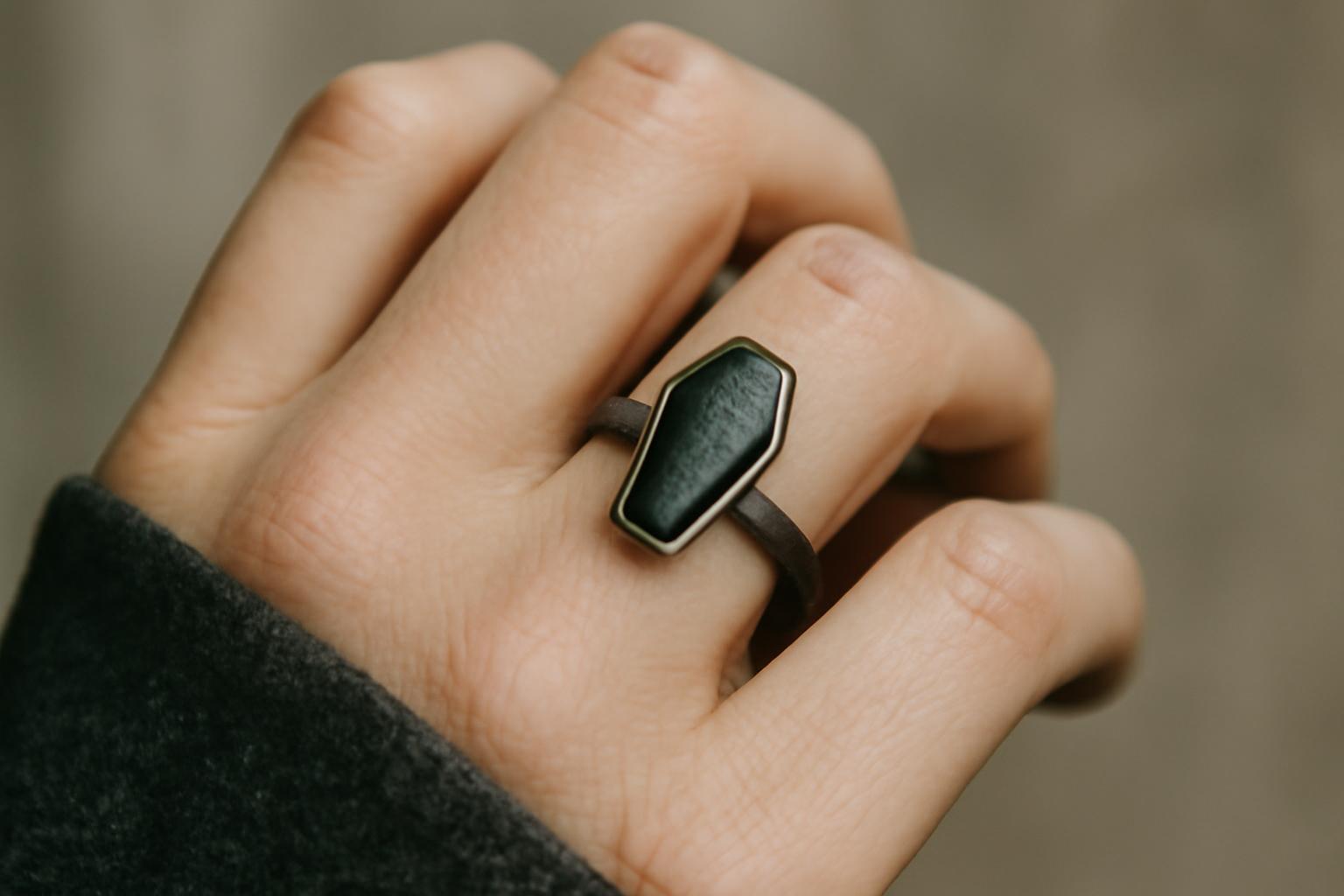
The name usually refers to one of two forms: a ring with an elongated, six-sided coffin-cut gemstone or a sculptural ring depicting a coffin.
Overview
A coffin ring usually means either a ring centered on an elongated, six-sided coffin-cut gemstone or a sculptural ring depicting a coffin. The right choice depends on which form the buyer wants, how the exposed corners are protected, the disclosed stone and metal construction, and the seller’s custom-order and service terms.
Merchant collections commonly position coffin-cut rings as gothic, dark-romantic, alternative bridal, or deliberately unconventional jewelry. Those descriptions identify an aesthetic, not a rule about who can wear the shape. Listings also show light-colored diamonds, moissanite, sapphire, alexandrite, moonstone, and other stones, so the finished ring need not be dark.
There is no single geometry demonstrated by the supplied sources. Aquamarise describes two long parallel sides and four shorter angled corners, while StarlandUS describes clean edges and tapered angles. Buyers should therefore compare the actual outline, dimensions, setting, and photographs rather than assume every product called a coffin ring has identical proportions.
The main practical issue is not appearance alone. The outline creates multiple corners, and merchants identify those corners as potential impact points. A bezel or carefully positioned prongs may offer protection, but no setting or gemstone makes every coffin ring automatically suitable for every kind of daily wear.
What a coffin ring is
In gemstone jewelry, a coffin ring is generally a ring whose principal stone has an elongated, six-sided outline intended to resemble a coffin. Aquamarise describes the shape as an elongated hexagon with two longer parallel sides and four shorter angled corners. StarlandUS likewise calls it an elongated hexagonal silhouette, although its descriptions emphasize straight edges and tapered angles.
The shape can be distinguished visually from familiar elongated forms without assuming a formal grading rule. An oval has a continuous curved perimeter, while an emerald-style outline is rectangular with clipped corners. A coffin-cut stone uses more pronounced angled sections to create its recognizable silhouette. The exact length, width, taper, corner angles, and facet arrangement can still differ between individual stones.
“Coffin cut” should therefore be treated as a descriptive design category. The supplied sources do not establish recognized proportions, a universal facet pattern, or a coffin-specific grading system. A buyer comparing two rings needs the actual measurements and images of each stone, not merely the cut name.
Coffin-cut stones and coffin-themed rings
The term does not always refer to a gemstone cut. One type is a conventional ring construction centered on a faceted coffin-cut gemstone. The coffin reference comes from the stone’s perimeter, while the surrounding ring may use a solitaire, bezel, halo, three-stone arrangement, or coordinated bridal bands.
The other type is sculptural or functional jewelry shaped like a coffin. For example, Hard Jewelry’s DYT Coffin Ring has an inner ring that slides out to reveal a hidden coffin-shaped compartment. In that product, “coffin” describes the object represented by the jewelry, not the cut of a center stone.
This distinction changes nearly every useful comparison. A sculptural statement ring and a fine ring set with a coffin-cut diamond differ in construction, material questions, maintenance, stone security, and price. Buyers should first decide whether they want the silhouette in a gemstone or a ring that depicts a coffin as an object.
Why the outline varies between sellers
The supplied merchant descriptions agree on an elongated six-sided form, but they do not describe one fixed outline. Aquamarise refers to two longer parallel sides with four shorter angled corners. StarlandUS refers to straight edges and tapered angles, language that can suggest a broader end narrowing toward the opposite end.
Neither description proves that one version is the correct coffin cut. Instead, the difference shows why the name alone is insufficient for comparing stones. The sources do not provide an independent standard specifying required ratios, angles, facets, or proportions.
Before ordering, inspect the face-up image and request the stone’s length and width. Check whether the sides appear parallel or tapered, whether the top and lower angled sections have the profile expected, and whether the stone shown is the stone that will be set. For a made-to-order ring, ask whether photographs are examples or represent the actual center stone.
This matters particularly when fitting a matching band. A sharply tapered outline may need a different contour than a more parallel-sided stone. The practical rule is simple: judge the pictured and measured shape, not an assumed geometry attached to the product name.
Meaning and aesthetic
Coffin ring symbolism is interpretive rather than fixed. Merchants repeatedly connect the shape with gothic, dark-romantic, alternative, and unconventional aesthetics. StarlandUS also associates it with the phrase “Till Death Do Us Part,” presenting the coffin form as a literal expression of enduring commitment in bridal jewelry.
That reading can make the shape meaningful to a couple, but the supplied evidence does not establish it as a universal historical meaning. A wearer might instead choose the ring for its architecture, personal relationship with mortality, alternative fashion, or simple preference for an uncommon angular shape. The symbolism should come from the wearer rather than a merchant description presented as fact.
A coffin ring also does not have to look uniformly gothic. Black stones, dark metal finishes, ornate details, and coordinated dark bands can strengthen that association. In contrast, merchant collections show white diamonds, moissanite, sapphire, alexandrite, moonstone, and other colored stones in sterling silver, white gold, yellow gold, and platinum. A light stone with a plain metal band or restrained bezel can place more visual emphasis on geometry than darkness.
For an engagement ring, the question is not whether the shape fits a prescribed identity. It is whether both people want the symbolism and appearance to remain part of an often-worn piece. For statement jewelry, the same design can be considered more freely as an occasional-wear object.
Gemstones, metals, settings, and bands
Current merchant listings demonstrate a wide range of coffin ring constructions. The stone establishes much of the color and transparency, the metal frames that color, the setting controls how exposed the perimeter is, and any matching band affects both fit and the visibility of the center silhouette.
These choices should be compared as a system. A buyer who selects a particular stone for appearance still needs to consider its disclosed treatments, care requirements, setting protection, and replacement feasibility. A preferred metal color likewise does not answer whether the piece is solid metal, plated, vermeil, or finished with a dark surface treatment.
Stone and metal choices
Coffin-cut rings are not limited to black gemstones. The supplied collections include moissanite, lab-grown and natural diamond descriptions, sapphire, alexandrite, moonstone, garnet, moss agate, opal, onyx, quartz, and other colored stones. Sapphire Studios Design lists fifteen hand-cut coffin-stone options, while Aquamarise describes choices including black diamond, salt-and-pepper diamond, moissanite, lab-grown diamond, and sapphire.
Observed metal options are similarly broad:
- Sterling silver, including listings paired with alexandrite or moonstone
- Gold vermeil, meaning gold plated over a sterling-silver base
- Solid gold described in 10K, 14K, or 18K forms
- Platinum
- Dark finishes, including black ruthenium examples
These are merchant-observed options, not a complete catalog of everything that can be made. Nor does their availability establish a simple best-to-worst durability ranking. Solid metal, vermeil, ordinary plating, and applied dark finishes are different constructions and may require different maintenance.
The FTC’s consumer guidance on precious-metal jewelry explains that a karat mark indicates the proportion of gold in an item. It also distinguishes solid gold from plated constructions and identifies vermeil as gold plating over sterling silver.
Buyers should obtain the exact construction in writing. “Gold color,” “gold finish,” “gold plated,” “vermeil,” and “14K gold” do not describe the same material. For a black finish, ask what the finish is applied over and what cleaning or refinishing limitations the seller specifies.
Settings and matching bands
The setting changes both the appearance of a coffin-cut stone and how exposed its corners remain. Aquamarise identifies solitaire and bezel settings in its collection and says the six corners need bezel protection or precisely placed prongs. StarlandUS similarly suggests considering a bezel or low-profile prong setting for buyers who work with their hands.
Common configurations shown or discussed across the merchant evidence include:
- Solitaire: Keeps attention on the center outline, but corner coverage depends on the exact prong arrangement.
- Bezel: Surrounds more of the perimeter with metal and may protect exposed edges and corners.
- Halo: Adds smaller stones around the center, changing the apparent scale and potentially making the coffin outline less visually isolated.
- Three-stone: Places side stones beside the center, so their size and shape affect whether the coffin silhouette remains dominant.
- Bridal set: Coordinates the engagement ring with one or more bands designed to sit around its shape.
A label such as “prong setting” is not enough to determine protection. Look at where each prong contacts the stone, whether every vulnerable corner has purposeful coverage, and whether the setting is high enough to catch easily during routine activity. The sources support carefully positioned or low-profile prongs as considerations, but they do not establish one universally safe arrangement.
Band pairing also needs advance planning. Aquamarise describes plain metal bands, custom-contoured bands, and coordinated black-metal bands. Sapphire Studios Design lists multi-piece bridal sets. A plain straight band may leave a deliberate gap if the center setting projects outward. A contoured band can follow the outline more closely, but it may be specific to that ring’s measurements.
Ask for photographs showing the complete set together and from the side. This reveals whether the bands sit flush, leave a gap, rub against prongs, or obscure the coffin outline.
Durability for everyday wear
A coffin-cut ring may be considered for regular wear, but suitability depends on more than the gemstone’s hardness. The stone material, inclusions or treatments, exposed corners, setting height, metal construction, and wearer’s routine all affect the decision. The supplied evidence does not support a blanket guarantee for engagement-ring wear or hands-on work.
Aquamarise describes sapphire, moissanite, diamond, and black diamond as high-hardness choices in its merchant guidance. That is useful as a seller’s material shortlist, but hardness and setting vulnerability are separate issues. Hardness concerns resistance to scratching. It does not mean that a protruding corner cannot receive an impact or that a loose prong cannot compromise stone security.
Both detailed merchant sources focus on the corners. Aquamarise recommends a bezel or precisely placed prongs around the six-corner outline. StarlandUS calls the corners the areas most exposed to everyday impact and suggests a bezel or low-profile prong setting for people who work with their hands. Together, these descriptions support examining the setting independently of the stone name.
A bezel may cover more of the perimeter, while well-positioned prongs can preserve a more open view of the stone. Neither approach can be declared universally superior from the supplied evidence. The quality of execution matters, including even contact, smooth finishing, and the absence of obviously unsupported corners.
The wearer’s routine remains important. Frequent lifting, gripping tools, contact with hard surfaces, and activities likely to catch a raised ring create different conditions from occasional wear. A buyer expecting frequent impact should show the seller the intended use and ask how the proposed setting addresses each corner. If the answer relies only on the stone being “hard,” it does not address setting security.
Inclusions and special finishes can introduce additional care considerations. Care requirements can vary with the stone, inclusions, treatments, and finish, so buyers should obtain construction-specific instructions from the seller. That does not prove that every such ring is fragile, but it does show why the complete construction must be evaluated rather than the cut name alone.
How to evaluate a coffin ring before buying
A sound comparison starts with verifiable specifications, clear images, and seller-specific terms. The FTC Jewelry Guides state that marketers should truthfully represent characteristics including metallic content, size, weight, cut, treatment, durability, origin, price, and value. Those categories provide a practical framework for checking a listing.
Use this pre-purchase checklist once the desired style has been narrowed down:
- Confirm whether “coffin ring” describes a faceted center stone or sculptural coffin-themed jewelry.
- Obtain the stone identity, dimensions, origin description, laboratory-created or imitation status where applicable, and any treatment or special-care disclosure.
- Verify the metal construction, including karat or silver marks and whether any gold or dark appearance comes from plating, vermeil, or another finish.
- Inspect how the bezel or prongs protect every corner, including side-profile images of the setting.
- Compare the photographed outline and measurements rather than relying on the cut name.
- Check the seller independently, including recommendations from known people and searches using the seller’s name with “complaint” or “review,” steps included in FTC consumer advice.
- Confirm sizing, custom approval, warranty, repair, return, and cleaning terms in writing before payment.
This checklist cannot produce a formal coffin-cut grade because the supplied evidence does not establish one. Its purpose is to expose missing information and make like-for-like comparison possible. A listing with detailed specifications can be assessed more meaningfully than one built primarily around aesthetic language.
Cut, setting, and documentation checks
A non-expert can make useful visual checks without claiming to perform gemological grading. Start with a straight-on photograph or video. Compare the left and right sides, the angled corners, and the ends of the stone. Notice whether an asymmetry appears intentional or whether one side seems visibly inconsistent with the other.
Next, examine the face-up appearance under more than one lighting condition if the seller provides video. Look for a large, obvious area that remains see-through or visually inactive compared with surrounding facets. Such an observation can justify asking the seller about the stone, but it should not be converted into a coffin-specific cut grade. The evidence pack does not supply a neutral standard for symmetry, windowing, facet performance, or acceptable proportions.
Inspect the perimeter closely. The corners should appear finished rather than visibly chipped in the provided images. In a prong setting, determine which corners are covered and whether the prongs look consistent in position. In a bezel, check whether the metal line appears even around the stone. Side views help reveal setting height, open gaps, and how the head joins the band.
Documentation should match the listing. Record the stated stone type, whether it is natural, laboratory-created, or an imitation, its listed weight and measurements, disclosed treatments, metal, and finish. The FTC Jewelry Guides specifically address truthful representations of jewelry characteristics, including type, quality, metallic content, size, weight, cut, treatment, durability, and price.
For gold, the FTC advises buyers to look for a karat quality mark and, near it, the name or United States registered trademark of the responsible company. The same source explains that 18K gold is 18 parts gold and six parts other metal, while 14K gold is 14 parts gold and 10 parts other metal.
Treatment disclosure matters because care can change with treatment. FTC guidance on jewelry advertising says disclosures should be made when a gemstone treatment is not permanent or special care is required. Ask for those instructions before purchase, not after the ring arrives.
Price and customization
The supplied listings show that “coffin ring” covers fundamentally different products. The examples below are captured merchant prices, not a universal market range, appraisal, or indication of present availability.
| Merchant example | Product described in the supplied listing | Listed price in the evidence |
|---|---|---|
| Hard Jewelry | DYT Coffin Ring with a sliding inner ring and hidden coffin-shaped compartment | Sale price of $47.95 |
| Black Diamonds New York | “Until Death” coffin-shape diamond wedding rings | From $640 |
| Sapphire Studios Design | 1.53-carat white diamond coffin-cut bridal set in 14K white gold | Original price of $7,263; listed price of $6,283 |
The Hard Jewelry example is sculptural jewelry rather than evidence of a coffin-cut gemstone price. The Black Diamonds New York listing provides a starting price for a diamond wedding-ring example. The Sapphire Studios Design listing is a specified white-diamond bridal set in 14K white gold. Comparing the amounts without those construction details would be misleading.
For any shortlist, compare the same categories: center-stone identity and size, natural or laboratory-created description, treatments, metal construction, setting, accent stones, number of bands, certification if offered, and custom labor included. A lower amount for a single statement ring does not make it directly comparable with a multi-piece fine-jewelry set.
Supported customization options include stone choice, metal, setting design, accent stones, engraving, and coordinated bands. Aquamarise lists customization across these categories, StarlandUS describes concept-to-finished-piece custom design, and Sapphire Studios Design says rings can be made according to metal and stone preferences. These are seller-specific offerings, not proof that every merchant provides the same options.
A custom quote should identify what will be made and how approval works. Request dimensions, materials, stone details, band count, and the final configuration in writing. Price should be interpreted only after those elements are aligned.
Sizing, repairs, returns, and warranties
Custom work and an unusual center-stone outline make after-purchase questions particularly important. The supplied evidence does not establish universal resizing, repair, replacement, warranty, or return outcomes, so each seller’s written policy controls the practical decision.
Before commissioning or ordering a ring, ask:
- Which sizing method should be used, and is the quoted size based on a particular regional scale?
- Can the finished ring be resized, and do the setting, engraving, finish, or multiple-band construction limit that work?
- Who is authorized to repair the ring without affecting the warranty?
- If the center stone is lost or damaged, can a replacement be sourced to the same outline and measurements?
- Will the buyer approve drawings, stone images, dimensions, or a final design before production?
- What defects or services does the warranty cover, for how long, and who pays shipping or inspection costs?
- Is a custom, engraved, resized, or made-to-order ring returnable, exchangeable, or final sale?
The answers should be retained with the invoice and specifications. An oral assurance that a custom ring is “covered” does not identify whether stone loss, plating wear, resizing, accidental impact, routine maintenance, or shipping is included. If a policy is absent or unclear, the buyer does not have enough evidence to assume a favorable outcome.
Replacement-stone feasibility deserves particular attention. Because merchant descriptions show variation in coffin outlines, another stone carrying the same cut name may not fit the existing setting. The seller should address whether replacement would involve finding a matching stone, recutting a stone, or rebuilding the setting, without the buyer assuming any one option is available.
Cleaning and maintenance
The evidence supports a gentle hand-cleaning baseline, but it does not support one machine-cleaning or service schedule for every coffin ring. Stone identity, inclusions, treatments, plating, dark finishes, and setting construction can all change the appropriate instructions.
A gentle hand-cleaning baseline should still yield to seller-specific guidance for the ring’s materials and construction. Willwork Jewelry similarly advises warm, soapy water and a soft brush while avoiding harsh chemicals and extreme temperatures.
A cautious hand-cleaning routine is:
- Confirm that the seller’s instructions permit water and mild soap for the specific stone, treatment, and finish.
- Clean gently with lukewarm or warm soapy water and a soft cloth or brush.
- Pay attention to residue around corners, prongs, and the underside of the setting without forcing or bending metal.
- Rinse and dry according to the seller’s material-specific directions.
- Stop wearing the ring and seek seller or jeweler guidance if a stone moves or a prong appears displaced.
Any cleaning restriction supplied by a merchant should be treated as construction-specific. That is merchant guidance for the constructions it describes, not a universal rule covering every stone or black-colored ring.
The supplied evidence does not establish when ultrasonic or steam cleaning is safe across all coffin-ring materials. It also does not provide a neutral inspection interval or professional-servicing schedule. The correct next step is to obtain written, treatment-specific care instructions from the seller and follow the most restrictive instruction applying to the stone, finish, and setting.
Gentle cleaning does not replace inspection. Before wearing the ring again, check that the stone remains seated, every corner is covered as intended, and the bands still fit together without rubbing vulnerable setting components. This material-specific approach preserves the distinction that matters throughout the buying process: a coffin ring’s appearance, wear, price, and care depend on its documented construction, not on the product name alone.