
12 min read ·
Dried Eucalyptus: A Guide to Dried and Preserved Bundles
"Dried" can mean fully dehydrated or glycerin-preserved eucalyptus. Preserved or dyed foliage needs particular care because moisture can release colored liquid.
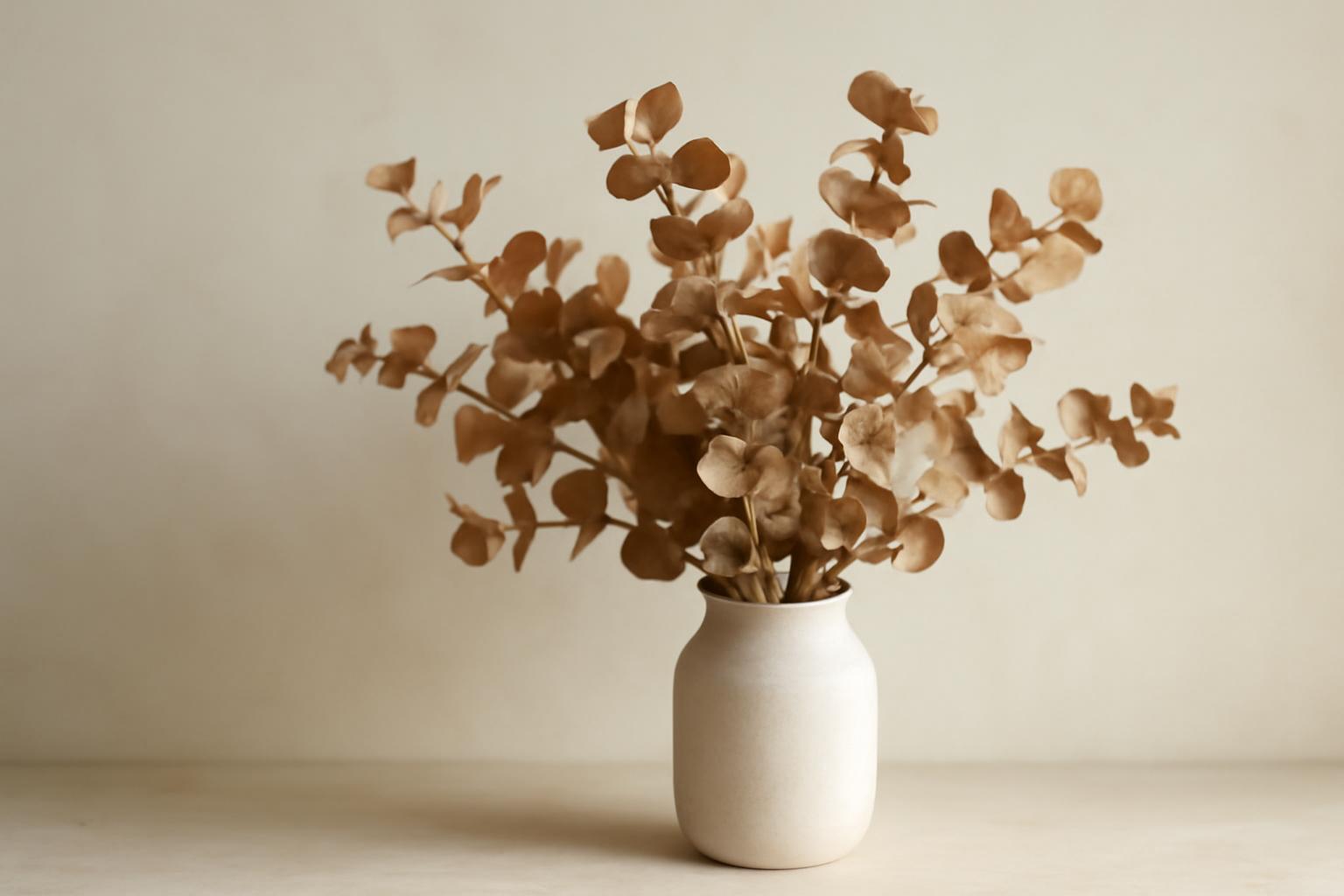
Overview
“Dried eucalyptus” may mean fully dried foliage or eucalyptus treated with glycerin, dye, or both. The right choice depends on the intended display, preferred color and texture, exposure to moisture, actual bundle specifications, and tolerance for fading scent. Shower use also requires realistic expectations because therapeutic benefits have not been established for dried bundles.
The distinction matters because sellers do not always use “dried” and “preserved” consistently. One product may arrive fully dried and intended for a vase, while another has had its natural water replaced with colored glycerin. A third listing may describe branches as both dyed and preserved. Reading the treatment description is therefore more useful than relying on the category name alone.
Both forms are sold for decorative arrangements, including standalone vases, bouquets, weddings, tabletop displays, wall hangings, bathrooms, and shower bundles. Fully dried eucalyptus can remain visually useful after its fragrance fades. Preserved eucalyptus may retain treated color, but colored preservation liquid can create a staining risk if the foliage gets wet.
Before buying, compare eucalyptus stem count, length, weight, overall dimensions, and included fillers separately. Treat scent as a variable feature rather than a promised lifespan, inspect the bundle promptly, and keep eucalyptus where pets cannot chew or ingest it.
Dried vs. preserved eucalyptus
Fully dried eucalyptus has been dehydrated for decorative use. A West Elm dried eucalyptus listing explicitly describes its bundle as “fully dried,” suitable for display by itself or in a bouquet, and cleaned by dusting. That is different from foliage sold as preserved.
Preserved eucalyptus has undergone an additional treatment intended to maintain its appearance. The Fukuoka preserved-bundle listing describes a process in which colored glycerin replaces water in the plant. Dried Décor likewise describes its branches as cut fresh, dyed, and preserved to retain color and fragrance for an extended period. These are seller descriptions, not standardized definitions that apply to every product.
Dried vs. preserved eucalyptus decision matrix
| Decision factor | Fully dried eucalyptus | Glycerin-preserved or dyed eucalyptus |
|---|---|---|
| Treatment wording to look for | “Fully dried” or an equally explicit drying statement | “Preserved,” “glycerin-preserved,” “dyed and preserved,” or a description of glycerin replacing water |
| Appearance | Intended to provide lasting decorative texture; one retailer describes its bundle as looking good from season to season | Treatment is intended to retain color, and some products are deliberately dyed |
| Fragrance | May fade even while the foliage remains visually usable | Sellers may describe retained fragrance, but customer reports still show that scent strength and duration vary |
| Basic care | Keep dry and dust gently, following the retailer’s dry-cleaning instruction | Keep away from direct water, especially when colored glycerin is used |
| Main quality concern | Crushing, brittle material, or shedding may be present in some delivered bundles | Wet foliage may release colored liquid and stain nearby surfaces |
| Best fit | Dry vases, bouquets, or displays where a naturally dried appearance is acceptable | Displays where treated color is a priority and the foliage can remain dry |
The matrix is a choice aid, not a lifespan guarantee. The sources do not establish a universal number of months or seasons for either form. To verify a listing, search the description for an explicit treatment statement, then check the care instructions. “Do not let the leaves get wet” and references to glycerin or dye strongly indicate that the product should be treated as preserved foliage rather than as an ordinary dried stem.
If the treatment is not stated, the category label alone cannot resolve the question. Ask the seller whether the eucalyptus is fully dried, glycerin-preserved, dyed, or treated by another method before placing it near fabric, grout, paint, or other potentially stainable surfaces.
Choosing eucalyptus for your intended use
Choose dried eucalyptus by matching its treatment, shape, dimensions, and handling requirements to the display. The supplied retail sources support uses ranging from standalone vases and bouquets to bridal arrangements, tabletops, walls, bathrooms, and shower bundles, but they do not support a universal number of stems for any arrangement.
A practical use-case selector is:
- Standalone vase: Check the listed stem length and the bundle’s overall diameter against the vase. A fully dried bundle can work alone; West Elm’s example measures 3 inches in diameter by 14 inches high.
- Bouquet or wedding arrangement: Look for foliage that provides the desired texture and tone. The Sola Flower Store collection shows preserved eucalyptus used in bridal bouquets and tabletop arrangements.
- Tabletop display: Give more attention to overall dimensions than headline piece count. A tall or spreading bundle may overwhelm a low arrangement even if the listed stem count seems modest.
- Wall hanging: Choose stems that can be secured without heavy handling. The Fukuoka listing identifies wall hangings, bedrooms, bathrooms, and restaurants as intended decorative settings.
- Bathroom or shower bundle: Confirm that the stems can hang behind the shower head without entering the direct water stream. Preserved or dyed foliage needs particular care because moisture can release colored liquid.
The desired visual effect should guide the final choice. Rounded, fine, or twisting foliage can change the arrangement’s texture even when the treatment is similar. For event use, inspect a sample or the first delivered bundle before assuming that color, fullness, or condition will be consistent across an entire order.
Moisture exposure is the clearest dividing line. A dry bathroom wall display does not face the same conditions as a shower bundle. If the foliage is dyed or glycerin-preserved, plan its position around the seller’s instruction to keep the leaves from getting wet.
How to compare dried eucalyptus bundles
Compare what is actually eucalyptus, not merely the largest number in the product title. Listings use different measurement conventions, including stems, individual flower pieces, weight, length, and completed-bundle dimensions. Those figures are not interchangeable.
For example, the Fukuoka package description lists 15 preserved eucalyptus stems plus 1.8 ounces of dried lavender, described as about 100 lavender pieces, with lengths of 15 to 17 inches. A shopper looking only at a prominent piece total could mistake the numerous lavender components for eucalyptus stems. The useful comparison is 15 eucalyptus stems against another product’s eucalyptus stem count, followed by a separate comparison of fillers.
Review these specifications before buying:
- Treatment wording, including “fully dried,” “preserved,” “glycerin,” or “dyed.”
- Actual eucalyptus stem count, separated from lavender, flowers, seeds, or other fillers.
- Stem length, bundle diameter, and any other overall dimensions.
- Weight, while recognizing that weight does not reveal the number or shape of usable stems.
- Included ties or accessories if the bundle is intended for hanging.
- Product photographs and description for the intended level of fullness, without treating photographs as a standardized measurement.
Price alone cannot establish value when listings measure different things. A bundle with more advertised “pieces” may contain fewer eucalyptus stems, while a lower-count bundle may have longer or broader foliage. Compare like with like first, then judge whether the dimensions and visual density suit the intended arrangement.
Varieties as design choices
Variety names are most useful as visual labels. The Sola Flower Store collection includes silver dollar, teardrop, and spiral eucalyptus and describes them as having different textures and tones. Dried Décor also lists parvifolia eucalyptus. The supplied evidence supports treating these as distinct design options, but it does not establish that one variety lasts longer, smells stronger, or performs better in a shower.
Use listing photographs and stated dimensions to judge how a variety will interact with the other materials in an arrangement. Silver dollar, teardrop, spiral, and parvifolia should not be ranked by unsupported performance assumptions. The practical question is whether the foliage’s visible texture and tone provide the desired contrast, softness, movement, or background structure.
When buying several bundles, check that the listing names the same variety and treatment throughout. A preserved spiral stem and a fully dried parvifolia stem may both be sold under the broad “dried eucalyptus” label even though their visual effect and care needs differ.
Arrival inspection checklist
Inspect dried eucalyptus soon after delivery so dimensions, contents, and condition can be checked against the listing. Reports attached to the Fukuoka product mention brittleness, falling lavender buds, dye leakage, mold, and variable fragrance. These are reported problems with that product experience, not defects that every eucalyptus bundle will have.
Check the following before arranging or hanging it:
- Confirm the number of eucalyptus stems separately from lavender, flowers, or other fillers.
- Measure the approximate stem length and overall bundle size against the description.
- Look for visible mold or damp material, including inside the tied center of the bundle.
- Check for crushed leaves, broken stems, excessive brittleness, and substantial shedding.
- Assess scent without assuming that a mild fragrance proves the product is defective.
- Place dyed or preserved stems over a protected surface and check for escaping colored liquid before using them near fabric or grout.
Document a mismatch or defect while the packaging and listing details remain available. Do not place visibly moldy foliage in a vase or shower. If colored liquid appears, isolate the bundle from absorbent or stainable materials rather than assuming it will stop leaking after installation.
Appearance, fragrance, care, and storage
Visual usefulness and fragrance duration are separate questions. West Elm says its fully dried eucalyptus looks good from season to season, while the Fukuoka seller says fragrance fades over time. Taken together, those statements support a limited conclusion: a bundle may remain decorative after its noticeable scent has weakened.
No supplied source establishes a universal lifespan. Scent can be weak on arrival, fade during display, or vary between bundles. Customer feedback included in the preserved-bundle source ranges from disappointing fragrance to a more noticeable shower scent, so neither a strong aroma nor a fixed duration should be promised.
Care should remain conservative and dry. West Elm instructs owners to dust its fully dried bundle clean. For preserved foliage, the Fukuoka listing specifically says not to let the leaves get wet. Those instructions support gentle dust removal and moisture avoidance, but not washing, soaking, misting, or attempting to refresh the bundle with unverified treatments.
For routine care and storage:
- Handle stems as little as practical if leaves or fillers are shedding.
- Dust gently rather than washing the foliage.
- Store the bundle dry and inspect it for mold before returning it to display.
- Keep dyed or glycerin-preserved material away from surfaces that could be stained by escaping liquid.
- Separate visibly moldy or leaking material from the rest of the arrangement.
The evidence does not provide a safe humidity threshold, a universal replacement schedule, or a detailed disposal standard. Condition should guide the decision. A dry bundle that remains structurally sound may continue to function as décor even without fragrance. A bundle with mold, persistent leakage, or extensive breakage has stopped serving that purpose and should be removed.
If the product combines eucalyptus with lavender or flowers, assess each material separately. The Fukuoka customer reports specifically mention falling lavender buds and brittle stems, which means filler deterioration can affect the bundle even when some eucalyptus remains usable. This is another reason not to judge longevity from the eucalyptus alone.
Using eucalyptus in a shower
A shower bundle should be secured behind the shower head and kept out of the direct water stream. The Fukuoka instructions say to bind the lavender and eucalyptus roots with the included hemp rope, hang the bundle behind the shower head, and avoid getting the leaves wet.
That placement uses the warm, humid environment without treating the bundle as something to be rinsed. It is particularly important for foliage preserved with colored glycerin because customer reports on the same listing describe neon-green dye leakage. Those reports do not prove that every preserved bundle will leak, but they establish a practical risk worth checking.
Use this placement checklist:
- Clear loose lavender seeds, leaves, or other material before hanging the bundle.
- Bind the stems firmly at their base with a suitable tie.
- Hang the bundle behind the shower head, not directly beneath the spray.
- Confirm that changing the shower-head angle will not send water onto the leaves.
- Protect nearby fabric, grout, paint, or other stainable surfaces until the bundle has been checked for colored leakage.
- Inspect the tied center and foliage periodically for dampness, mold, shedding, or structural failure.
- Remove the bundle if it becomes visibly moldy, persistently wet, or actively leaks dye.
Secure placement also matters because dried stems and fillers can be brittle. The supplied customer feedback mentions falling lavender buds and fragile stems, so position the bundle where loose pieces can be noticed and cleaned rather than allowed to accumulate unnoticed.
Fragrance should be treated as variable. The seller says fragrance fades, and the associated customer experience is inconsistent. Steam may make an existing scent more noticeable, but the supplied evidence does not support a guaranteed strength or number of days. A shower bundle should therefore be chosen primarily as a decorative product with possible fragrance, not as a reliable room-scenting system.
Avoid trying to intensify the effect by soaking the foliage. That conflicts with the product’s direct-water warning and may increase staining or mold concerns. The available evidence also does not establish that wetter foliage produces a safe or therapeutically useful exposure.
Shower benefit claims and safety limits
Research concerning eucalyptus essential oil or isolated 1,8-cineole does not prove that a dried eucalyptus shower bundle provides the same exposure or health effect. No supplied study measures how much oil a dried or preserved bundle releases in a shower, how steam and bundle age change that release, or whether the resulting dose is therapeutically meaningful.
A 2024 review of therapeutic applications of eucalyptus essential oils discusses respiratory uses of eucalyptus essential oils and cites research involving inhalation therapies, chest rubs, and cineole. It describes possible airway, cough, and congestion effects, including findings from preclinical models and studies of particular preparations or compounds. That evidence concerns essential oils, formulated products, or isolated cineole, not decorative stems hanging behind a shower head.
The distinction becomes clearer in the European Medicines Agency assessment of eucalyptus oil. The assessment states that clinical efficacy data for eucalyptus-oil preparations were unavailable and that findings from 1,8-cineole studies were not sufficient to establish well-established use for eucalyptus oil itself. It also notes that a distinct improvement in nasal airflow was not shown in healthy subjects and that comparable studies in people with rhinosinusitis were missing.
These sources are not necessarily contradictory. The review summarizes a broader body of potential and reported effects across essential oils, cineole, formulations, and preclinical evidence. The EMA assessment applies a narrower standard to whether eucalyptus-oil preparations have sufficient clinical evidence for particular uses. Neither source supplies the missing bridge between a measured essential-oil preparation and an unmeasured dried shower bundle.
The EMA report also describes an in-vitro experiment in which eucalyptus-oil exposure above 6.7 grams per cubic meter reduced ciliary activity in human respiratory cells. The cited authors considered concentrations above 5 grams per cubic meter unlikely with recommended dosing of essential-oil cold remedies but possible with overdose. This laboratory result should not be converted into a household shower threshold. A decorative bundle has no established release rate, and the evidence does not provide a method for translating shower size, steam, or bundle age into an airborne concentration.
The practical conclusion is limited but clear: a eucalyptus shower bundle may provide décor and a variable scent, but it should not be presented as a proven treatment for congestion, sinusitis, bronchial infection, cough, or another respiratory condition. Evidence about essential oil does not establish bundle dose or efficacy.
Pet access presents a separate, documented concern. The ASPCA identifies eucalyptus species as toxic to dogs, cats, and horses. It names essential oils, including eucalyptol, as the toxic principle and lists salivation, vomiting, diarrhea, depression, and weakness among the clinical signs.
Keep dried and preserved eucalyptus where pets cannot chew or ingest the leaves, stems, or fallen pieces. If ingestion is suspected, the ASPCA advises contacting its Poison Control service at (888) 426-4435 or a local veterinarian as soon as possible. The supplied evidence does not establish a safe amount for ingestion or a safe level of passive exposure, so it should not be used to invent either threshold.