
17 min read ·
From the Cremation Chamber to the Return of Remains: What Families Can Expect
The familiar 2-to-3-hour estimate refers to the monitored flame-based chamber cycle, not the complete timeline from death to return.
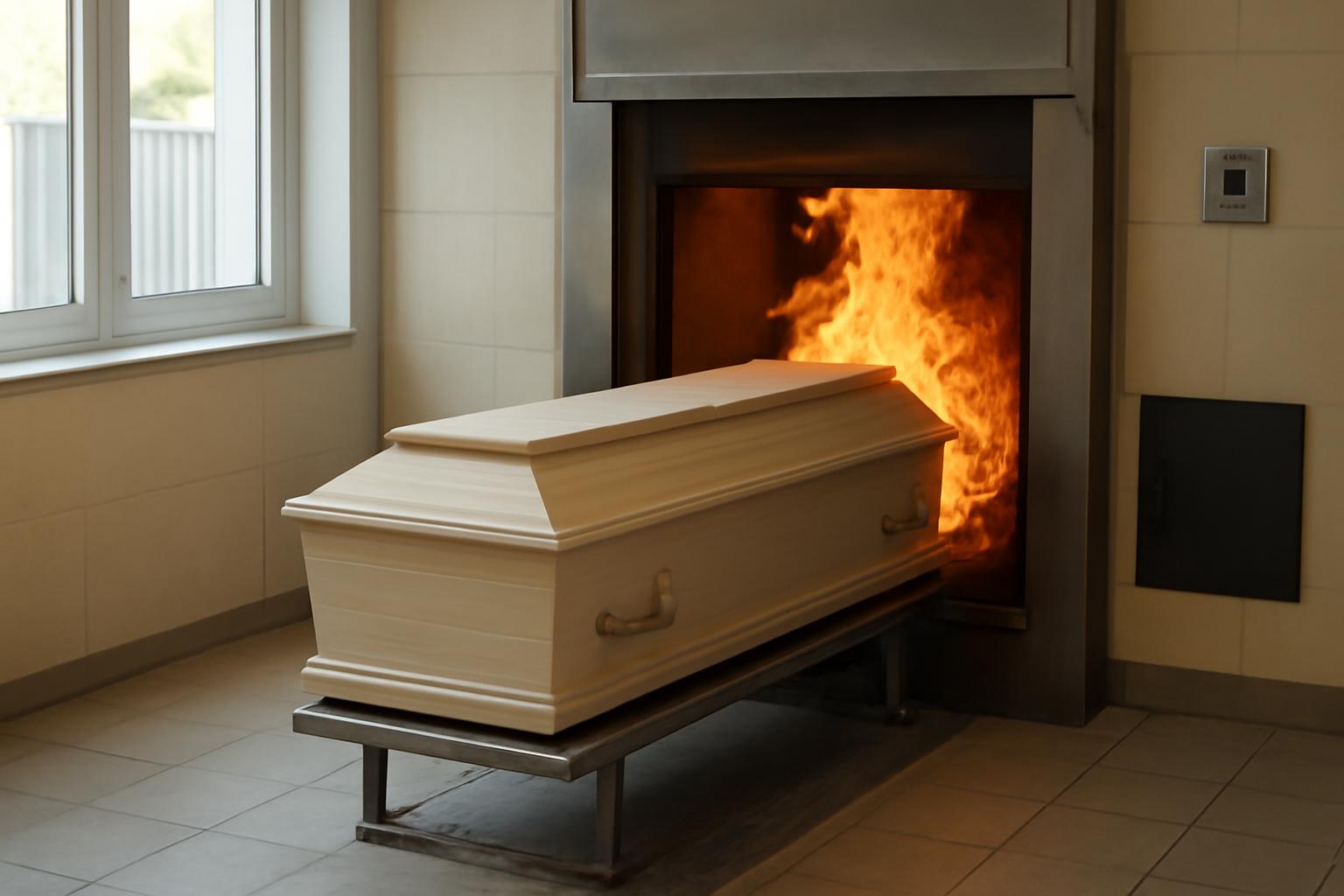
The short answer: hours for cremation, days for the full process
At a glance
- Time in the cremation chamber: Commonly about 2 to 3 hours. Published estimates range from approximately 1.5 to 4 hours, depending on the individual, container, equipment, and operating conditions. Individual facilities may report different results; for example, one British crematorium describes a chamber cycle of about 1.5 hours, while U.S. providers commonly publish longer ranges. See the facility-specific process described by Worthing Crematorium.
- Cooling and post-cremation processing: Commonly another 1 to 2 hours for cooling, metal removal, and mechanical processing of the remaining bone fragments. DFS Memorials separates the chamber cycle from this additional processing time.
- Complete timeline until the family receives the remains: Provider publications commonly describe a window near 7 to 14 days, while broader reported estimates extend from approximately 3 to 15 business days. These are practical estimates from individual providers, not a guaranteed national standard.
The central distinction is between the physical cremation and the complete arrangement. The family’s wait is generally measured in days because transportation, identification, death certification, authorization, any required permit or official release, scheduling, processing, and return arrangements occur around the chamber cycle.
Always ask what starts a provider’s quoted turnaround. Depending on the provider, the count might begin with:
- The date of death
- The family’s first call
- Transfer into the provider’s care
- Completion of the arrangement conference
- Receipt of signed authorization
- Permit approval
- Arrival at an off-site crematory
- Completion of the physical cremation
A seven-day estimate beginning when a permit is approved is not equivalent to seven days beginning on the date of death.
Also ask whether the estimate uses business days or calendar days. Business days generally exclude weekends and holidays. A period of 10 business days ordinarily covers two workweeks, and a holiday can extend the corresponding calendar period.
This article uses cremated remains, the more accurate term for what the family receives. Families and providers commonly say “ashes,” but the finished material consists primarily of processed bone fragments rather than literal fireplace-like ash.
A stage-by-stage cremation timeline
The following sequence is illustrative, not a promised schedule. Some stages can overlap, and their order may vary with the jurisdiction, provider, and circumstances of the death.
| Stage | What occurs | Approximate duration where supported | Why it may take longer |
|---|---|---|---|
| Transfer into care | The deceased is transported from the place of death to a funeral home, care facility, or cremation provider. | Provider- and circumstance-dependent | Official release, distance, weather, facility procedures, or transportation availability |
| Identification and secure care | The provider confirms identifying information, opens the case record, and maintains care before cremation. | Usually handled during the early arrangement period | Incomplete or mismatched identifying information |
| Death certification | A physician, medical examiner, coroner, or other authorized professional certifies the death as applicable. | No universal duration | Certifier availability, incomplete information, or an investigation |
| Family authorization | The person or people with authority under the applicable rules sign permission for cremation. | No universal duration | Missing signatures, uncertainty about authority, or disagreement |
| Permit or official release | The provider obtains any approval required by the jurisdiction or circumstances. | No universal duration | Filing delays, official review, weekends, holidays, or an investigated death |
| Crematory scheduling | The case is scheduled after the necessary clearances are available. | Provider-dependent | Backlogs, off-site transportation, witnessed-cremation scheduling, or equipment problems |
| Chamber cremation | The identified container and body undergo monitored flame-based cremation. | Commonly 2–3 hours | Body characteristics, container, implants, equipment, and chamber conditions |
| Cooling and metal removal | The remaining bone fragments cool, and recoverable metal is separated. | Part of approximately 1–2 additional hours in many provider estimates | Facility workflow and the individual case |
| Cremulation | The cooled bone fragments are mechanically reduced to a more uniform consistency. | Included in post-cremation processing | Equipment availability and facility procedure |
| Packaging | The processed remains are placed in an identified temporary container or selected urn. | Usually follows processing | Coordination may be needed for a selected urn or memorial product |
| Release and return | The family collects the remains or receives them through delivery, transfer, or authorized shipping. | Provider- and method-dependent | Notification, scheduling, transfer between facilities, or transit |
The table’s chamber and processing estimates reflect provider-published ranges rather than mandatory operating standards. One commercial provider, for example, estimates 2 to 4 hours for the chamber and 3 to 5 hours for total crematory work after cooling and processing are included. After.com distinguishes physical cremation from the total time spent at the crematory.
Transportation and care occur before the physical cremation. The provider also generally coordinates three recurring administrative gates: medical certification of the death, authorization from the appropriate decision-maker, and any permit, approval, or release required for that case. The exact documents and decision-makers vary by jurisdiction, so no single waiting period or authorization rule applies everywhere.
Once the necessary clearances are available, the crematory can schedule the case. The chamber cycle then consumes hours rather than days. Cooling, metal removal, cremulation, and packaging follow. Identification controls may continue through transfer, cremation, processing, and placement in the identified container.
The stages after processing also matter. Remains may need to travel from a third-party crematory back to the funeral home, be made available for pickup, be delivered locally, or be prepared for an authorized shipment. “Cremation completed” and “family received the remains” are separate milestones.
How long the body is in the cremation chamber
The familiar two-to-three-hour answer refers to the monitored flame-based chamber cycle. It does not describe the period from death through return of the cremated remains.
No exact chamber time applies to every case. Published examples range from approximately 1.5 hours at one crematorium to two to four hours in some U.S. provider guidance. Those figures do not necessarily conflict: facilities use different equipment and procedures, and each case has different physical characteristics.
Factors that may affect chamber time include:
- Body size and composition. Provider guidance indicates that an average-sized adult may be nearer the commonly quoted two-to-three-hour range, while a larger body may require three to four hours or longer. A smaller body may require less time. Memorials.com describes how body size and other case characteristics can affect the chamber cycle.
- The cremation container. Its dimensions, construction, and material can affect how the process progresses.
- Medical implants. Families should disclose known implants to the provider. Battery-operated devices such as pacemakers require attention before cremation, while some metal components may remain to be separated afterward.
- Equipment design and maintenance. Cremators differ in design, age, controls, and maintenance condition.
- Chamber conditions. Stored heat from prior operation, airflow, and other operating conditions may influence the cycle.
- Facility procedure. Monitoring practices and the point at which a facility defines the chamber cycle as complete can vary.
Temperature is part of flame-based cremation, but it does not determine duration by itself. Body characteristics, the container, equipment, airflow, stored heat, and facility procedures operate together.
Terminology can create further confusion. One provider may use “cremation time” to mean only the chamber cycle. Another may include cooling or processing. If a provider quotes four hours, ask which stages that figure covers.
These estimates apply only to flame-based cremation. They should not be used to predict the duration of alkaline hydrolysis, sometimes called aquamation, because it is a different process and the evidence used here does not establish its timeline.
What happens after the chamber cycle ends
The crematory’s work does not end when the monitored chamber cycle is complete. The material remaining after combustion consists primarily of bone fragments, along with metal that may come from implants or the cremation container.
The usual sequence is:
- Cooling: The remaining bone fragments are moved out of the chamber and allowed to cool.
- Metal removal: Metal is separated according to the facility’s procedures.
- Cremulation: The bone fragments are mechanically reduced to a finer, more uniform consistency.
- Packaging: The processed remains are placed in an identified temporary container or an urn selected or supplied for the arrangement.
- Storage and release: The identified container is held until pickup, transfer, delivery, shipping, or another authorized disposition.
Cremulation is the mechanical processing of cooled bone fragments. It creates the granular, relatively uniform material families commonly call ashes; it is not a second combustion stage. The Cremation Association of North America describes flame-based cremation as reducing human remains to bone fragments, followed by cooling, metal removal, and further processing. CANA explains these stages and the use of identification controls.
Provider estimates commonly allow approximately one to two additional hours for cooling and processing, although each facility divides and measures that work differently. Some facilities treat cooling and mechanical reduction as separate timed steps, while others publish one combined estimate.
Identification may be maintained through an identifying card, number, disc, tag, electronic record, or a combination of controls. One facility may use a different system from another, so families should ask the provider to explain its own chain-of-custody process rather than assume every crematory follows an identical method.
Even fully processed remains may not be immediately available to the family. They may still await:
- Completion of the provider’s release procedures
- Transfer from a third-party crematory to the funeral home
- Placement in a selected urn
- Family notification
- A scheduled pickup
- Local delivery
- Preparation for authorized shipping
For planning purposes, ask both when processing is expected to finish and when the container will actually be ready for the family.
Why the paperwork can take longer than the cremation
Three recurring prerequisites commonly shape whether cremation can proceed:
- Medical certification of the death
- Authorization from the person or people entitled to make the decision under the applicable rules
- Any permit, release, or official approval required by the jurisdiction or circumstances
The funeral home or cremation provider commonly coordinates these steps, but it does not control every part of the schedule. A physician or another authorized professional may need to complete the medical certification. A registrar may need to receive or file the record. A coroner or medical examiner may need to review the death. The appropriate family member, representative, or other authorized person may need to sign the cremation authorization.
A delayed medical certification or incomplete death record can pause later steps. Missing authorization signatures, inconsistent identifying details, uncertainty about who has authority, or disagreement among relatives can also prevent approval. Depending on the local rule and family circumstances, more than one signature or additional proof of authority may be requested. National Cremation’s funeral-director guidance identifies delayed certification, missing authorization, permit issues, scheduling conflicts, and family disagreements as recurring causes of delay.
Unexpected, unattended, sudden, accidental, unexplained, or otherwise investigated deaths may require medical-examiner or coroner review. That review can affect when the body is released or when the necessary permit or approval becomes available.
Medical devices are another reason complete information matters. Provider guidance states that pacemakers and other battery-operated devices must be disclosed and cannot remain in the body during cremation. The authorization form may therefore ask about implants and personal items as well as identity and disposition instructions. Lori’s Funeral Home discusses these disclosures alongside death certification, authorization, and approval requirements.
Waiting periods, forms, permit procedures, and authorization rules vary by state and locality. Do not rely on a generalized statement that every state requires the same delay or the same signatures. Ask the provider which current rule applies where the death occurred and, when necessary, confirm it through the appropriate state or local government or regulatory authority.
This article provides general information, not legal advice or a substitute for guidance from a licensed funeral director or attorney. Questions about authority to control disposition can be highly fact-specific.
What can delay the return of cremated remains
Delays are easier to understand when divided into three periods: before cremation, at the crematory, and after processing.
Before cremation
Possible pre-cremation delays include:
- Medical-examiner or coroner review
- An autopsy or active investigation
- Delayed medical certification
- An incomplete death record
- Mismatched names, dates, or other identifying information
- Missing authorization signatures
- Uncertainty about who has authority
- Disagreement among relatives
- A permit or official release that has not been issued
- Transportation or release problems at the place of death
These issues can prevent the crematory from scheduling the chamber cycle. Provider guidance indicates that an autopsy or investigation may add several days and, in some cases, weeks, making an ordinary turnaround estimate unreliable. DFS Memorials identifies autopsies, medical-examiner review, documentation problems, backlogs, transportation, weekends, and holidays as possible delays.
At the crematory
After the required clearances are available, timing may still be affected by:
- Current workload or a scheduling backlog
- Transportation to an off-site crematory
- Limited scheduling for a witnessed cremation
- Equipment maintenance or an unexpected malfunction
- The individual’s physical characteristics
- Weekends and holidays
- Coordination with a viewing, funeral, or committal service
An on-site crematory removes one transfer between facilities, but it does not guarantee faster service. Workload, staffing, equipment availability, and operating schedules still matter.
After processing
The remains may be processed but not yet received because of:
- Transfer back to the funeral home
- Provider release procedures
- Family pickup scheduling
- Local delivery arrangements
- Shipping preparation and transit
- A selected urn or memorial product that is not ready
- Difficulty reaching the authorized recipient
Weekends and holidays can affect more than the crematory’s operating schedule. They may also affect physician certification, government processing, facility transfers, family pickup, or delivery. That is why a business-day estimate may occupy substantially more calendar time.
Three illustrative scenarios
Routine direct cremation: The provider takes the deceased into its care, receives accurate information and completed authorization, coordinates certification and any required approval, and schedules the cremation. The physical work takes only several hours, but the complete arrangement may still take approximately one or two weeks because clearance, scheduling, processing, and return occur around it.
Cremation after a viewing or service: The family arranges a viewing, visitation, funeral, or witnessed cremation before the chamber cycle. Preparation, venue availability, family travel, and crematory scheduling must be coordinated. The service does not create a guaranteed delay, but it introduces additional scheduling dependencies.
Investigated death: A medical examiner or coroner reviews the death and may order an autopsy. The required release or approval remains unavailable until the official process is complete. The provider may be unable to offer a dependable cremation date based solely on its usual workload, and the total wait can extend beyond an ordinary two-week estimate.
Families can reduce some avoidable interruptions by returning complete forms promptly, providing accurate identifying information, helping the provider contact the correct decision-maker, disclosing implants, and selecting a return method. Other events—including official investigations, physician availability, permit processing, equipment failure, and severe weather—are outside the family’s control.
Prompt paperwork, pre-planning, and direct cremation should not be treated as guarantees that a particular number of days will be saved. Required certification, authorization, and official review still apply to the case.
When will the family actually receive the remains?
Four milestones should be distinguished:
- Cremation performed: The chamber cycle has occurred.
- Processing completed: Cooling, metal removal, cremulation, and packaging are finished.
- Ready for release: The provider has completed its remaining procedures and can release the identified container.
- Physically received: The family has collected the container, accepted delivery, received an authorized shipment, or obtained it through another funeral home.
Providers commonly publish overall windows near 7 to 14 days, but they do not always measure the same interval. One estimate may start on the date of death; another may begin after arrangements are finalized, permits are filed, or signed authorization is received. Central Bucks Crematory, for example, describes a 7-to-14-day death-to-return window for its own direct-cremation service while noting that certification and permitting can affect the schedule. Its timeline separates approvals, physical cremation, processing, and return.
The return method also affects when the family physically receives the container:
- Pickup: The family collects it after receiving notice that it is ready.
- Local delivery: The provider arranges delivery to the authorized recipient.
- Transfer: A crematory returns it to the funeral home, or one funeral home transfers it to another.
- Shipping: The provider prepares it for an authorized shipping method, adding handling and transit to the timeline.
Some facilities describe same-day return as possible, but it is a conditional exception rather than the normal expectation. It depends on the necessary approvals and authorization already being complete, available crematory capacity, sufficiently early scheduling, completed cooling and processing, a suitable container, and the provider’s procedures.
Do not schedule an irreversible event—such as scattering, interment, final-placement travel, or a cemetery appointment—solely around an unconfirmed estimate. If a memorial date must be selected, consider whether the gathering can proceed without the remains present or whether final placement can remain flexible until release is confirmed.
Ask for two distinct dates:
- When do you expect the cremation to occur?
- When do you expect the cremated remains to be ready for pickup, delivery, transfer, or shipping?
Those answers are more useful than a single statement such as “about a week.”
Questions to ask the funeral home or crematory
Use this checklist during the arrangement conference or a follow-up call:
- What event starts your quoted turnaround? Is it the death, first call, completed arrangements, signed authorization, permit approval, or arrival at the crematory?
- Does the estimate use calendar days or business days?
- How will upcoming weekends or holidays affect it?
- Which documents, signatures, permits, approvals, or releases remain outstanding?
- Who is responsible for each outstanding item?
- Is medical certification or a physician’s signature delaying the record?
- Is a coroner, medical examiner, investigation, or autopsy affecting the case?
- Have you identified the person or people whose authorization you require?
- Are multiple signatures or proof of authority needed in this case?
- Is the crematory on-site or operated by a third party?
- If it is off-site, when will transportation occur and when will the remains return?
- What is the crematory’s current scheduling backlog?
- Does your estimate cover chamber time only, or also cooling, metal removal, cremulation, packaging, and release?
- When is the cremation expected to occur?
- When are the remains expected to be ready?
- How will the family be notified?
- Will pickup, delivery, transfer, or shipping add time?
- Will a viewing, funeral, witnessed cremation, selected urn, or other request affect scheduling?
- What happens if the estimated date changes?
- What identification and chain-of-custody procedure do you use?
- How is identity maintained during transfer, cremation, processing, packaging, and release?
Ask the provider to put significant dates and outstanding requirements in writing when possible. If the answer is “seven to 10 business days,” follow up with: “Beginning with which event, and ending at which milestone?”
The practical answer remains two-part: flame-based cremation commonly takes about two to three hours in the chamber, and cooling and processing commonly add approximately one to two hours. The family may nevertheless wait several days or longer because certification, authorization, official clearance, scheduling, and return arrangements surround that work. After.com publishes a comparable distinction between chamber time, total crematory handling, and the longer end-to-end process.
A local provider with the case details can give a more useful estimate than any national range. Request the expected cremation date and the expected ready date separately, and confirm whether each estimate uses business or calendar days.
How long is the body actually in the cremation chamber?
For flame-based cremation, the body and cremation container are commonly in the chamber for approximately two to three hours, although published estimates extend from roughly 1.5 to four hours. Body size and composition, the container, implants, equipment, stored heat, and other operating conditions can affect the result. CANA explains that monitored combustion time varies with factors including body size and heat already stored in the chamber.
That estimate covers the chamber cycle, not cooling, metal removal, cremulation, packaging, paperwork, or return to the family.
How long does it usually take to get the ashes back after a death?
Individual providers commonly publish overall windows near seven to 14 days, while broader examples range from approximately three to 15 business days. These are practical estimates, not guarantees or a formal national average. National Cremation’s published funeral-director examples illustrate the variation by provider, location, and circumstances.
Ask when the provider begins counting. A window measured from permit approval or finalized arrangements is different from one measured from the date of death. Investigations, missing signatures, scheduling backlogs, weekends, holidays, facility transfers, and shipping may extend the wait.
Can cremated remains be returned on the same day?
Possibly, but only at some facilities and under limited circumstances. Same-day return may depend on completed authorization and approvals, available capacity, an early chamber schedule, completed cooling and processing, a suitable container, and provider approval.
Treat same-day return as a special arrangement to confirm directly, not as the normal timeline or a guaranteed expedited option.
Does body size affect how long cremation takes?
Yes. Provider guidance indicates that an average-sized adult may be closer to the commonly quoted two-to-three-hour chamber range, while a larger body may require three to four hours or more. Smaller bodies may require less time. Memorials.com identifies body size and composition among the factors affecting physical cremation time.
Size is not the only consideration. The container, implants, equipment design, maintenance, chamber conditions, stored heat, and facility procedures can also matter.
Can a medical examiner, autopsy, weekend, or holiday delay cremation?
Yes. A medical-examiner or coroner review can delay the release or approval needed for the case, and an autopsy or investigation may add days or, in some circumstances, weeks. Weekends and holidays may also affect certification, government processing, crematory schedules, transfers, and delivery. Provider guidance on cremation delays identifies investigations, incomplete documents, missing signatures, permit issues, and scheduling conflicts.
Ask whether the quoted window uses business days and whether any official review remains open. Until the necessary clearance is available, the provider may be unable to confirm a reliable cremation date.