
19 min read ·
Casket Weights Explained: Typical Ranges, Key Factors and Handling Realities
A standard empty casket is commonly cited at 150-250 lb; loaded totals often reach 300-600 lb. Ask its exact weight and whether a wheeled truck is used.
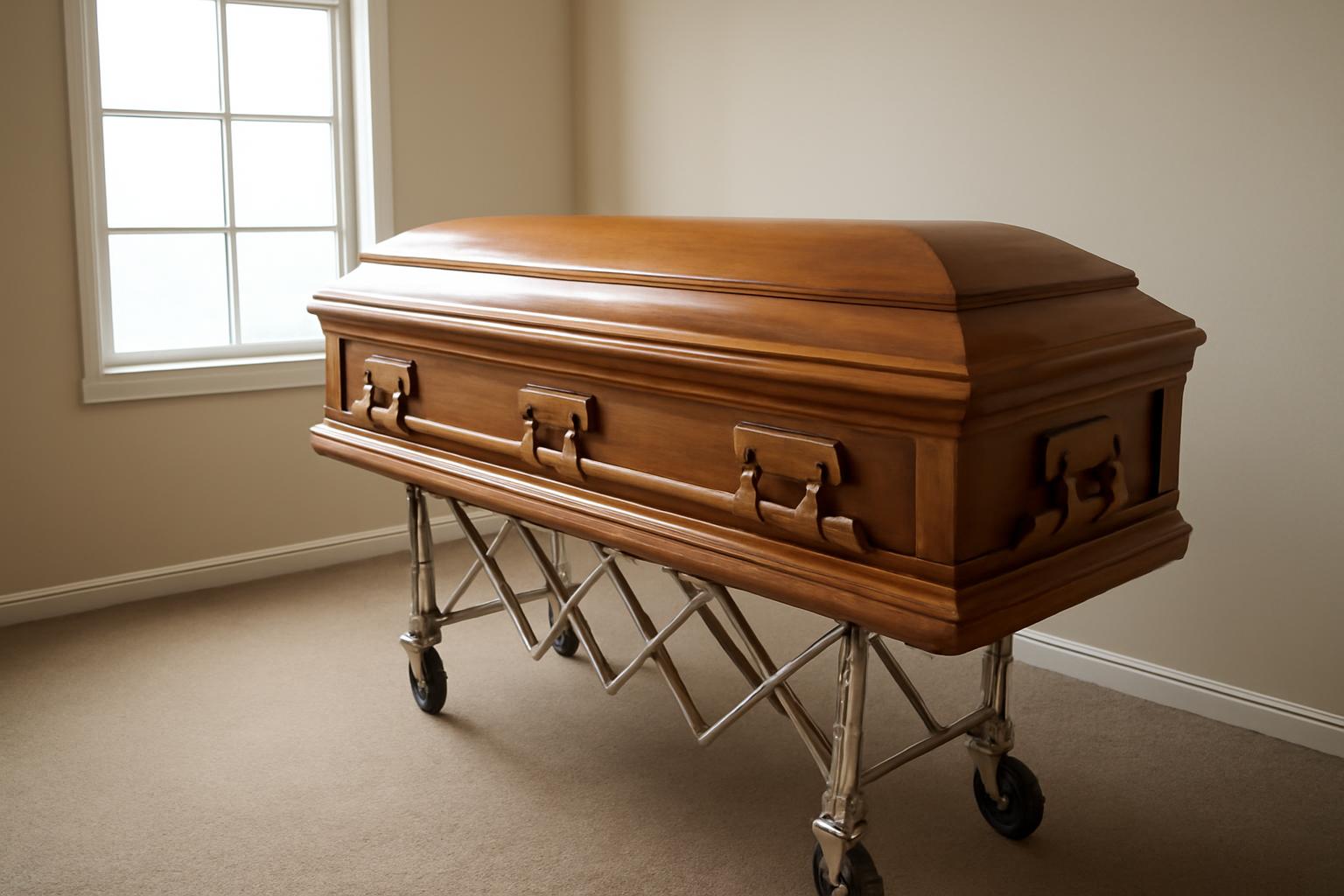
If you are asking for the quickest practical answer to how much does a casket weigh, the safest summary is this:
- A standard empty casket is commonly cited at about 150 to 250 pounds
- Many ordinary adult models are often described around 160 to 220 pounds
- A loaded casket can rise into the 300 to 600 pound range once the body is included
But those numbers need context. Public casket-weight information is not drawn from a single industry database or federal standard. Most published figures come from casket retailers, funeral-home explainers, and pallbearer guidance, and those sources do not always measure the same thing. Some discuss empty product weight, some discuss loaded weight, and some blend standard, oversized, and specialty models together.
That is why the most useful way to approach the question is to break it into three separate ones:
- How much does an empty standard casket weigh?
- How much do heavier materials or oversized caskets weigh?
- What will the total weight be once the body is inside?
For early planning, the public ranges below are useful. For an actual service, the best number is always the listed weight of the exact model the funeral home or seller is offering.
Average Empty Casket Weights at a Glance
Across publicly available consumer guides, the most repeated estimate for a standard empty casket is 150 to 250 pounds. A somewhat narrower planning band also appears often: 160 to 220 pounds for many mainstream adult wood or metal models.
Those figures are helpful, but they are not a universal rule. Published ranges vary because different sources may be describing:
- wood versus metal
- standard versus oversized
- thinner versus thicker steel
- simple versus upgraded interiors
- basic versus heavily decorated hardware
- empty product weight versus loaded carrying weight
A practical way to read the public numbers is as commonly cited estimates, not fixed specifications.
| Casket type | Commonly cited empty-weight estimate |
|---|---|
| Standard wood or metal casket | 150-250 lb |
| Frequently cited planning midpoint for mainstream models | 160-220 lb |
| Lightweight alternative models | about 20-110 lb, depending on material |
| Premium or specialized heavy models | 250-300+ lb |
| Oversized reinforced models | 220-500+ lb, depending on build |
Two clarifications matter.
First, when public guides say a casket weighs a certain amount, they are usually talking about the empty casket, including its shell, interior, and attached hardware unless stated otherwise. That is the number that matters for shopping, delivery, and basic comparison.
Second, the wider market is much broader than the standard adult burial category. One seller guide says caskets can range from about 60 pounds to 400 pounds or more, while other guides focus only on ordinary adult models and land in the 150 to 250 pound range. Those statements can both be true because they are describing different parts of the market.
So for planning purposes, the most defensible short answer is:
- Standard empty casket: commonly cited around 150 to 250 pounds
- Many mainstream adult models: often 160 to 220 pounds
- Much lighter or much heavier models: usually reflect alternative materials, upgraded metals, oversized dimensions, or reinforcement
That is useful enough to start a conversation. It is not precise enough to choose pallbearers or plan a difficult transfer without verifying the exact model.
Casket Weights by Material: Wood, Metal and Alternatives
Material is the biggest driver of casket weight. Two caskets can be similar in size and still differ sharply if one is made from pine, another from dense hardwood, and another from steel, copper, or bronze.
Because public sources vary, the best way to read the material ranges below is as rough consumer-facing estimates.
| Material | Commonly cited empty-weight estimate | Confidence note |
|---|---|---|
| Wood | 150-250 lb | Repeated across multiple public guides |
| Steel / stainless steel | about 160-300+ lb overall | Wide range because gauge varies |
| Bronze / copper | about 250-310 lb common | Usually described as premium and heavy |
| Plywood / fiberboard | about 80-180 lb | Lighter than many solid-wood or metal models |
| Wicker | about 50-110 lb | Often discussed in green burial |
| Cardboard | about 20-80 lb | Lightest common category, but published ranges differ |
| Fiberglass | often under 100 lb | Less consistently documented and less common |
Wood caskets
Wood caskets are commonly described in public guides as weighing about 150 to 250 pounds empty, but wood is not one category in any practical sense.
Published breakdowns usually point to a lighter-to-heavier progression:
- Pine is commonly placed near the lighter end, around 150 pounds
- Mahogany and sometimes cherry are often placed near the heavier end, reaching around 250 pounds and sometimes more in higher-end builds
- Oak, walnut, and maple are often described as middle-ground choices
Some seller material goes even more granular and separates wood caskets into softwood, hardwood, and premium hardwood bands. Those breakdowns are directionally useful, but they still do not create a universal standard. Moisture content, board thickness, veneer construction, and decorative build choices all affect the final number.
The reliable takeaway is simple: “wood” does not tell you enough. A pine box and a mahogany casket can be very different in handling weight.
Metal caskets
Metal caskets are usually described as heavier on average than many standard wood models, though the overlap is real and the range is broad.
Public guides commonly describe:
- metal caskets overall: about 160 to 300+ pounds
- many steel models: about 170 to 220 pounds
- 20-gauge steel: often around 170 to 190 pounds
- bronze or copper caskets: often 250 to 310 pounds
The reason the metal category spreads so widely is that “metal” covers very different products. A thinner steel casket and a heavy premium bronze casket are not close equivalents.
Just as important, gauge matters. One public explanation notes that most metal caskets use 16- to 20-gauge steel, with 20-gauge being lighter and thinner than 18- or 16-gauge. That helps explain why two steel caskets can have noticeably different empty weights even if they look similar online.
Lightweight alternatives
Alternative materials can weigh far less than traditional wood or metal models. Public guides most often cite the following ranges:
- Cardboard: about 20 to 80 pounds
- Wicker: about 50 to 110 pounds
- Plywood or fiberboard: about 80 to 180 pounds
Cardboard is the most inconsistent category in the published material. Some sources place it around 30 to 70 pounds, another puts it at 70 to 80, and another gives 20 to 80. The clearest synthesis is not that one exact number is right, but that cardboard caskets are usually among the lightest commonly discussed options.
Wicker also appears consistently as a lighter category and is often associated with green burial. Plywood and fiberboard tend to sit between very light eco-style containers and heavier conventional burial caskets.
Fiberglass
Fiberglass deserves extra caution. One funeral-home guide describes fiberglass caskets as often under 100 pounds, and presents them as among the lightest options. That same discussion also raises questions about durability and strength, and the broader public record on fiberglass is much thinner than it is for wood or metal.
So the careful version is this: fiberglass is sometimes described as very light, often under 100 pounds, but it is less commonly documented than the main wood, metal, cardboard, or wicker categories.
The practical material takeaway
If weight is your main concern, public consumer guides generally point to this order:
- Lightest common options: cardboard, wicker, and some plywood or fiberboard designs
- Mainstream conventional range: most wood and steel caskets
- Heavy premium range: bronze, copper, and reinforced oversized models
That is useful for orientation. For a real purchase, ask for the exact empty weight, not just the material name.
Standard vs. Oversized Caskets: Size and Capacity Impact
Size changes weight as much as material does.
Public guides describe a standard adult casket in slightly different ways depending on whether they mean interior or exterior dimensions. Common numbers include:
- interior length: about 79 inches
- overall length: about 82 inches
- interior width: about 24 inches
- overall width: about 28.5 inches
Those figures are not necessarily inconsistent. They are often measuring different parts of the casket.
Several public guides also describe standard adult models as suitable for most adults up to around 300 pounds, while one seller guide places some standard models higher depending on construction. On height, one funeral-home guide describes standard size as appropriate up to about 6‘6”, and another seller-style source extends that to roughly 6‘6” to 6‘8” with some knee bend. Those should be read as rough fit guidance from consumer sources, not guarantees. Actual usable space varies by model.
Standard casket weight
For standard adult caskets, the most repeated empty-weight estimates remain:
- about 150 to 250 pounds for ordinary wood or metal models
- about 160 to 220 pounds as a frequent planning band for mainstream products
If someone asks the question in a general funeral-planning sense, this is usually the category they mean.
Oversized casket weight
Oversized caskets are built for wider or heavier individuals and are commonly described as having:
- interior widths around 27.5 to 33 inches
- body capacities around 500 pounds
- heavier empty weights because of extra material and reinforcement
Published empty-weight estimates for oversized caskets are wider and less consistent than they are for standard models. Common public figures include:
- about 220 to 280 pounds for many oversized models
- about 250 to 500+ pounds in broader guides that include heavily reinforced designs
Those are not interchangeable numbers. The lower end usually reflects ordinary oversized construction, while the higher end reflects larger or more heavily reinforced versions.
Why oversized caskets weigh more
The weight increase is not only about width. Oversized caskets usually add weight through:
- more shell material
- wider bottoms and lids
- stronger sidewalls
- higher-rated support structures
- reinforced construction for larger body capacity
That is why an oversized casket can be significantly heavier even before the body is added.
Why size affects more than lifting
Public guides also note that oversized caskets can affect other parts of the burial plan. Depending on the cemetery and the exact casket, families may need to discuss:
- an oversized burial vault
- a wider plot or special cemetery accommodation
- transfer logistics
- staffing or equipment needs during interment
That does not mean every oversized casket triggers every one of those issues. It means size is a logistics question as well as a fit question.
A realistic rule of thumb
For early planning, the clearest shorthand is:
- Standard empty casket: commonly cited around 150 to 250 pounds
- Oversized empty casket: often 220 pounds and up
- Heavily reinforced oversized models: can go far beyond that and may reach 500 pounds or more in public guides
When fit is close, families should avoid guessing from general size labels alone. The exact model specifications matter.
Factors Beyond Material That Add to Casket Weight
Material and size explain most of the difference from one casket to another, but they do not explain all of it. Public guides repeatedly point to several additional factors that can move a casket’s total weight up or down.
Hardware, handles, hinges, and trim
A casket is not just a box. It often includes:
- handles or swing bars
- hinges
- corners
- clasps
- rods
- decorative fittings
Some public guides note that fittings are often made from heavier metals such as brass. That means hardware can add noticeable weight beyond the shell itself.
What the public sources do not give very well is one reliable universal hardware number. So the careful conclusion is: hardware and fittings can materially increase the total weight, but the increase is model-specific.
That is one reason two caskets with similar shells can still end up with different empty weights.
Interior lining, padding, and mattress
Interior furnishings are better quantified in the public material than hardware is. One funeral-home guide estimates that inner linings, padding, and mattresses can add roughly 10 to 30 pounds.
That does not sound dramatic until you remember that people often compare caskets within fairly narrow ranges. A heavier mattress, upgraded lining, or more padded interior can move a casket from one planning bracket to another.
Steel gauge
With metal caskets, steel thickness matters. Public consumer guides commonly explain this through gauge:
- 20-gauge steel is lighter and thinner
- 18-gauge or 16-gauge steel is thicker and heavier
That is why “steel casket” is still an incomplete answer. A lighter steel model may be manageable in ways a thicker premium steel model is not.
Wood density, moisture, and production method
Wood species matter, but so do other build details. Public material points to factors such as:
- natural wood density
- moisture content
- board thickness
- solid wood versus veneer over a lighter base
- production method
This is part of why one source can say a wood casket weighs 150 pounds and another says 250 pounds without either necessarily being wrong. They may be describing very different builds.
Decorative and custom features
Decorative upgrades can also add weight, even when sources do not quantify them precisely. Public guides mention things such as:
- upgraded corners
- more substantial trim
- more elaborate fittings
- premium finishes
- custom detailing
The main point is cumulative: weight is the result of the complete build, not just the headline material.
Why this matters in practice
For families, the lesson is straightforward. A generic range like “steel caskets are around this weight” or “wood caskets are around that weight” is only a starting point.
If weight matters because of:
- older pallbearers
- stairs
- a long carry
- cemetery terrain
- a church with tight turns
- a larger decedent
ask for the full configuration details, not just the material label.
Empty vs. Loaded Weights: Including the Body
This is where much of the public confusion comes from.
An empty casket weight helps you compare products. A loaded casket weight is what matters for pallbearers, short carries, aisle transitions, and graveside movement.
Across funeral and pallbearer guidance, a loaded casket is commonly described in the 300 to 600 pound range. That said, lighter scenarios can fall lower. One public guide gives a broader consumer-facing figure of about 200 to 400 pounds for a coffin with the body inside, while pallbearer-oriented discussions more often warn that the real working total can be 300 to 600 pounds depending on casket material and body size.
That difference is another reminder that public estimates are planning ranges, not fixed rules.
A typical loaded example
The math can change quickly.
If a casket weighs 170 to 200 pounds empty and the deceased weighs 170 pounds, the loaded total becomes roughly:
- 340 pounds
- to 370 pounds
If the casket weighs 220 pounds and the deceased weighs 200 pounds, the total is roughly:
- 420 pounds
Those are very ordinary calculations, which is why an empty casket that sounds manageable on paper can become much more demanding once loaded.
Common loaded planning ranges
A practical framework looks like this:
| Scenario | Approximate loaded total |
|---|---|
| Lighter casket + average adult body | about 300-375 lb |
| Typical mainstream casket + average adult body | about 340-420 lb |
| Heavy premium casket + larger adult | about 450-600 lb |
| Oversized heavy casket + very large decedent | may exceed 600 lb |
Public guides often use 150 to 200 pounds as a rough body-weight addition when explaining why loaded caskets become much heavier than shoppers expect. That is just a planning simplification, not a statement about any individual person.
Larger bodies and heavier caskets
The upper end of the range becomes more realistic when several factors stack together:
- heavy copper or bronze construction
- oversized dimensions
- reinforced build
- a larger decedent
In those situations, the loaded total can approach or exceed the top of the ordinary public planning range.
Can embalming affect weight?
Possibly. Some public pallbearer guidance says embalming can increase body weight because of retained fluid. The evidence available in consumer-facing sources is not strong enough to treat that as a reliable numeric adjustment, and examples tend to be anecdotal. The careful takeaway is simply that loaded weight is not exact, even when you know the empty casket weight.
Why the distinction matters
This single distinction clears up most confusion:
When shopping, compare:
- empty weight
- material
- dimensions
- capacity
- construction details
When planning the service, think about:
- loaded weight
- number and ability of pallbearers
- whether a wheeled church truck will be used
- terrain, stairs, and cemetery access
So when someone says a casket weighs 180 pounds, that may be completely true and still not answer the practical question the family is really asking.
Why Casket Weight Matters: Pallbearers and Handling
For most families, casket weight stops being abstract when it turns into a pallbearer question.
Public funeral guidance usually describes six to eight pallbearers as the normal range. Six is the classic arrangement, but eight may be more appropriate for heavier caskets, larger decedents, or more difficult routes.
What each pallbearer may handle
If a loaded casket falls somewhere between 300 and 600 pounds, then six active pallbearers might be responsible for about:
- 50 to 100 pounds each
That is only a rough division. In real life, weight is not distributed perfectly evenly. It shifts during:
- turns
- ramps
- steps
- lifting in and out of vehicles
- movement over wet grass or uneven ground
So a clean per-person average should never be treated as a promise of what each person will actually feel.
A rough convention, not a rule
One public funeral-home guide mentions a rule of thumb of one pallbearer for every 25 pounds of weight. That should be read very cautiously. It is best treated as a rough planning convention mentioned in some guidance, not as a universal operational rule. Ordinary funeral practice still tends to center on six to eight pallbearers, with staff help or equipment added when needed.
Pallbearers do not always carry the full weight by hand
This is one of the most important practical realities. Public pallbearer commentary repeatedly notes that the casket is often moved on a wheeled church truck or similar device for much of the route.
In many services, pallbearers may:
- walk alongside the casket
- steady it
- guide it through transitions
- help lift only at short points, such as hearse transfer or graveside positioning
That is especially common with:
- heavier metal caskets
- oversized caskets
- larger decedents
- longer indoor routes
So the traditional image of six people hand-carrying the full load from start to finish is often not how modern funerals actually work.
When handling gets harder
Weight becomes more of a safety issue when it combines with:
- bronze or copper construction
- oversized or reinforced caskets
- large body size
- stairs
- tight corners
- long carries
- sloped ground
- wet or uneven cemetery terrain
Even a fairly ordinary loaded casket can become difficult under those conditions.
Modern equipment and staff support
Public funeral guidance also points to common aids such as:
- church trucks
- dollies
- lifts
- lowering devices
- funeral-home staff assistance
That matters because the real question is often not “How much does the casket weigh?” but “How much of that weight will family and friends actually have to manage themselves?”
The most useful planning step
Do not rely on a generic average if handling is a real concern. Ask the funeral home:
- the exact empty weight of the selected model
- whether the service involves hand carrying or mostly wheeled movement
- whether six or eight pallbearers are recommended
- what equipment or staff will assist
- whether the route includes any special difficulty
That is more useful than any internet average.
Practical Planning Tips and Legal Notes
Weight is only one part of choosing a casket, but it intersects with cost, logistics, and the type of service a family can manage comfortably.
Use the Funeral Rule to compare options
Under the Federal Trade Commission’s Funeral Rule, every licensed funeral home must provide a written, itemized General Price List on request, in person, at no charge.
That matters because caskets are often sold in emotionally difficult moments, and families may not realize they have the right to compare items one by one rather than accept a package at face value.
The same rule also requires funeral homes to:
- accept a casket purchased from a third party
- not charge a handling fee for accepting it
That gives families room to compare not only price, but also:
- material
- dimensions
- capacity
- and, where available, listed model weight
Ask for the exact model weight
Because public casket-weight data are inconsistent, this is the most practical question of all:
- What is the empty weight of this exact model?
- Does that include the standard interior?
- What is the steel gauge, if it is metal?
- Is it standard or oversized?
- What body capacity is it designed for?
- Will it require a different vault or cemetery accommodation?
Generic ranges help with orientation. Model-specific answers help with decisions.
Expect local variation
Even when federal consumer protections are clear, laws, costs, and cemetery rules vary by state and locality. Public guidance is general information only. It is not a substitute for a conversation with a licensed funeral director about a specific burial plan.
That is especially true if weight or width may affect:
- transport
- cemetery requirements
- vault size
- timing
- religious or service-location logistics
Lighter options can make sense for green burial
Families considering green burial often look at lighter, biodegradable materials such as:
- wicker
- untreated wood
- cardboard-style alternatives
That can make handling simpler while also matching the goal of natural burial. Public green-burial guidance also notes that green burial generally forgoes metal caskets and concrete vaults, but cemetery rules still vary.
Pre-planning avoids surprises
A few rough public benchmarks can still be useful for pre-planning:
- standard empty casket: often cited around 150 to 250 pounds
- standard loaded casket: commonly discussed around 300 to 600 pounds
- oversized empty casket: often 220 pounds and up
- lightweight eco alternatives: often far below conventional wood or metal models
Those numbers should help you ask better questions, not replace specific verification.
FAQ
What is the lightest common casket material?
Among commonly discussed consumer options, cardboard is usually described as the lightest. Public guides place it anywhere from about 20 to 80 pounds, with some narrower estimates inside that range. Wicker is also relatively light, usually around 50 to 110 pounds. Fiberglass is sometimes described as very light too, often under 100 pounds, but it is less consistently documented and comes with more durability caveats in the public material.
How many pallbearers for a standard loaded casket?
The normal public guidance is six to eight pallbearers. If a loaded casket falls in the 300 to 600 pound range, six active pallbearers might handle roughly 50 to 100 pounds each in theory, but actual load sharing is uneven. Heavier caskets, longer carries, stairs, or uneven ground may justify eight pallbearers, staff help, or wheeled equipment.
Do oversized caskets weigh more than standard ones?
Yes, usually. Public guides consistently describe oversized caskets as heavier than standard models because they use more material and often include reinforcement. Standard adult caskets are commonly cited around 150 to 250 pounds empty, while oversized caskets often start around 220 pounds and can rise much higher in reinforced versions.
Does hardware or lining significantly add weight?
Yes, both can matter. Public guides consistently say that handles, hinges, corners, and decorative fittings add weight, although they do not give a single reliable universal number for hardware. Interior materials are more clearly quantified in the public record: padding, lining, and mattresses may add about 10 to 30 pounds depending on the build.
Can funeral homes refuse heavy third-party caskets?
As a matter of federal consumer protection, funeral homes must accept caskets purchased elsewhere and may not charge a handling fee for doing so. That does not remove practical questions, though. Families should still confirm that the casket is appropriate for the deceased, the service plan, transport, and cemetery requirements.
In short, the best public answer to how much does a casket weigh is layered rather than singular. Consumer guides commonly place standard empty caskets around 150 to 250 pounds, note that material and size can move the number far lower or much higher, and warn that loaded totals often rise into the 300 to 600 pound range. Those are useful planning estimates, not regulated standards. Use them to get oriented, use the Funeral Rule to compare options, and then confirm the exact model details with the funeral home before making a final decision.