
19 min read ·
What a Cemetery Space Really Costs—and the Fees That Come After It
A rough commercial benchmark for a single grave plot is $1,000–$5,000, not a local quote or measured national average.
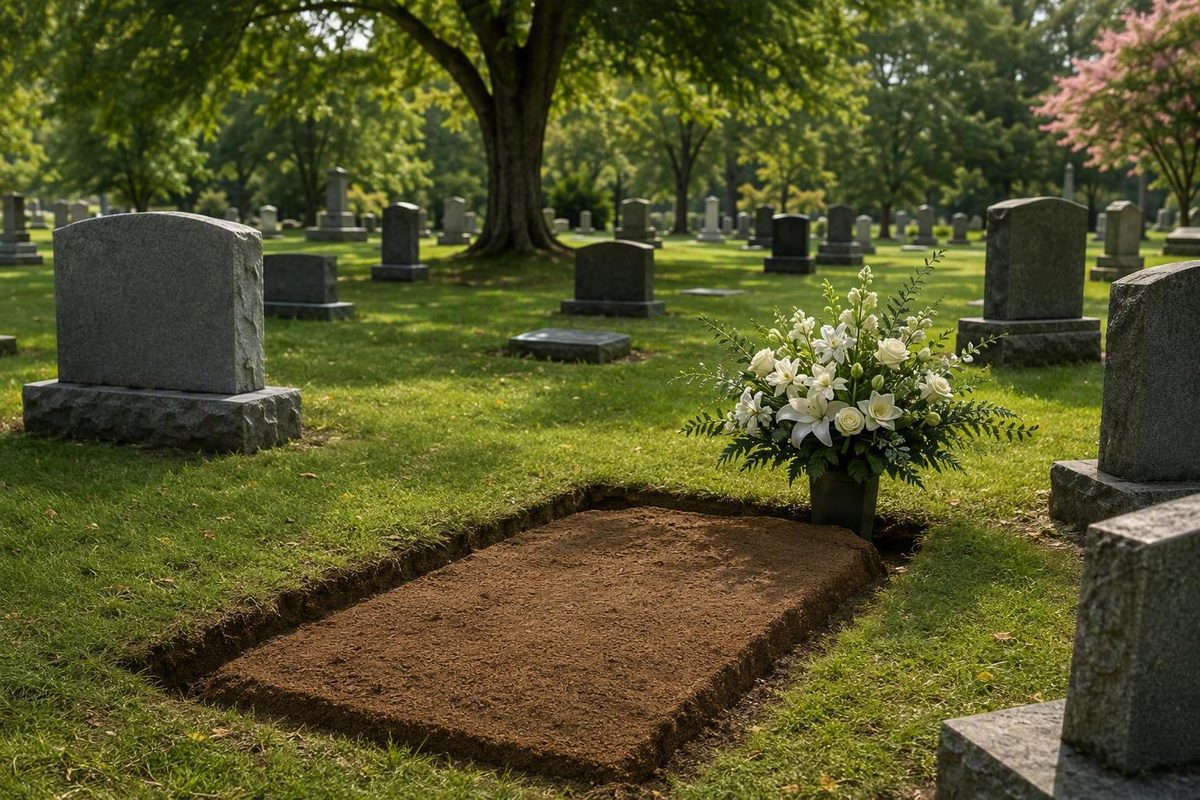
The short answer: a single grave plot commonly costs about $1,000–$5,000
Commercial U.S. guides commonly place a standard single grave plot at about $1,000–$5,000. This is a broad planning benchmark, not a statistically verified national average: the available guides do not disclose representative national datasets, and actual prices vary substantially by location, cemetery, space type, and package inclusions (Memorials.com cemetery plot cost guide).
The wider market is much broader. Some rural or municipal grave spaces may cost roughly $500, while some urban or for-profit cemeteries charge $5,000–$10,000 for a full-sized grave or mausoleum space (Funeral Consumers Alliance guide to cemetery purchases). Exceptional premium-city examples can exceed $20,000, but these are atypical posted or starting prices—not normal national costs.
| Market context | Broad plot-only guidance | Caution |
|---|---|---|
| Rural or municipal | Around $500 at the low end; often higher (Lincoln Heritage burial plot guide) | Residency rules, care charges, and interment fees may apply |
| Common single plot | About $1,000–$5,000 (commercial cemetery cost guide) | Directional commercial guidance, not a measured national average |
| Urban or private | Often several thousand dollars; $10,000 or more in some markets (2025 funeral-plot guide) | Demand, section, inventory, and cemetery model matter |
| Exceptional premium urban | Posted or starting prices may exceed $20,000 (major-city burial plot report) | Atypical examples, not representative U.S. pricing |
Three different totals are easy to confuse:
- The grave-space price buys specified burial or interment rights.
- The all-in cemetery bill adds cemetery services, required merchandise, and applicable surcharges.
- The complete funeral bill also includes funeral-home goods and services.
A $2,000 plot therefore does not mean the burial will cost only $2,000. The cemetery may separately charge for opening and closing the grave, care, a liner or vault, permits, a marker, installation, and services at premium times. The funeral home may separately charge for the casket, preparation, transportation, viewing, ceremony, and professional services.
What you are actually buying
Buying a cemetery plot generally does not mean buying the underlying land outright. You normally acquire a defined right of interment: the right to place specified human remains in a particular grave, crypt, or niche. The cemetery retains control of the grounds, while the deed, certificate, contract, and cemetery rules determine how the space may be used.
That right may be narrower than expected. A contract might permit one casket, two caskets in a double-depth arrangement, one casket and an urn, or multiple urns. It does not automatically provide unrestricted authority over landscaping, monuments, future interments, transfers, or resale.
Separate the purchase into three categories:
- Burial rights or space: The right to use a designated grave, crypt, or niche.
- Cemetery services and merchandise: Opening and closing, interment, a liner or vault, care contributions, permits, marker setting, tents, chairs, and administrative charges.
- Funeral-home goods and services: The casket, body preparation, embalming when selected or required for the circumstances, transportation, viewing, ceremony, and funeral-home service fees.
Cemetery and funeral-home expenses may appear in different contracts. A cemetery plot, burial container, and opening and closing are generally distinct from funeral-home charges.
Do not assume that a quoted plot includes opening and closing, permits, care, or the physical interment service. Published descriptions conflict because cemetery packages differ. One cemetery may include basic care and documentation; another may itemize them. Even “interment” can refer either to the right to use the space or to the service of placing the remains.
Before signing, obtain written answers to these questions:
- How many caskets or urns may be interred?
- Is the space single-depth, double-depth, side-by-side, or reserved for cremated remains?
- What care is included, and what maintenance remains the family’s responsibility?
- Which marker materials, sizes, designs, and vendors are permitted?
- Who may install the marker?
- Which charges are due now, at the first interment, or at a later interment?
- What do the contract and local rules say about cancellation, inheritance, transfer, or resale?
- What cemetery approval or documentation would be required if plans change?
The written contract and current cemetery rules matter more than a verbal description.
Plot prices by burial-space type
The following amounts are broad commercial guidance rather than guaranteed local prices. Configuration and included services can make apparently similar spaces difficult to compare.
| Space type | Broad commercial guidance | Important qualification |
|---|---|---|
| Standard single grave | About $1,000–$5,000 (Choice Mutual burial plot guide) | Usually the burial right only; inclusions vary |
| Cremation plot | Roughly $350–$2,500 (funeral-home burial plot guide) | Interment, care, an urn container, and a marker may be extra |
| Side-by-side companion spaces | Often near the cost of two single spaces | A multiple-space discount is possible but not assured |
| Double-depth companion grave | Often uses less cemetery space than two side-by-side graves | Reopening, reclosing, and additional-interment charges may apply later |
| Family lot | Some commercial reports start around $20,000 (2025 funeral-plot guide) | Capacity, layout, and memorial design vary too much for a universal range |
| Green-burial plot | Roughly $500–$5,000 across commercial guidance (Sky-View Memorial Park cost guide) | Container, vault, landscaping, and maintenance practices differ |
| Columbarium niche | Highly variable | Building, niche level, location, and capacity affect cost |
| Mausoleum crypt | Highly variable; commonly more than a basic ground space | Building, level, placement, and single or companion configuration matter |
Single and companion graves
Capacity is contractual; physical room alone does not authorize an additional interment.
Side-by-side companion arrangements use two adjoining spaces and may approach the price of two single graves. Double-depth graves place two caskets vertically in one footprint. That can reduce the initial land requirement, but the second burial may require reopening and reclosing a grave that already contains a casket.
Published companion estimates are especially inconsistent. Commercial guides report figures beginning around $2,000–$3,000, with some markets rising well above $10,000. These figures may describe two spaces, one double-depth right, or a premium location, so confirm the exact configuration.
Family lots
A family lot is a group of spaces purchased together, sometimes with a central monument or special landscaping rules. Some commercial guides report starting prices near $20,000, but a universal range would be misleading. A four-space row and a large private family estate are not comparable products.
Ask whether the quote includes every individual burial right, a shared monument foundation, care, access paths, and future opening and closing. The contract should also identify how unused rights may be handled after the original purchaser dies.
Cremation interment
Cremation plots are smaller and are commonly reported at roughly $350–$2,500. They can reduce the space cost, but they are not necessarily all-inclusive. Opening and closing, an urn vault or other container, care, a plaque or marker, and additional urn interments may be separate.
A full-size grave may also accept cremated remains, and some spaces permit more than one urn. Compare the capacity and complete cost of an urn garden, full-size grave, columbarium niche, and mausoleum placement rather than assuming the smallest advertised product is the best fit.
Green burial
Commercial guides place green-burial plots across a broad $500–$5,000 span. Green burial may use a biodegradable casket or shroud and may avoid a conventional vault, but practices differ among hybrid cemetery sections, natural burial grounds, and conservation cemeteries.
Confirm container rules, embalming restrictions, grave configuration, marker policy, landscaping, and long-term maintenance. Do not assume that every cemetery using the term “green burial” follows the same standards or includes the same services.
Crypts and niches
A mausoleum crypt is an above-ground or building-based space for a casket. A columbarium niche holds cremated remains. Prices can depend on eye-level versus lower placement, indoor versus outdoor location, building prestige, capacity, accessibility, and whether the space is single or companion.
Treat published crypt and niche figures as examples rather than national averages. Ask whether the price includes entombment or inurnment, inscription, a shutter or plaque, opening and sealing, and the future placement of a second person.
Why the same kind of grave can cost $500 or more than $20,000
Cemetery pricing reflects more than the dimensions of the grave. Major drivers include location, local land demand, cemetery ownership and operating model, placement within the grounds, remaining inventory, and the number and type of interments permitted.
Location and land demand
A rural cemetery with ample inventory may charge substantially less than a private cemetery in a dense metropolitan area. Urban cemeteries may have limited undeveloped land, strong demand, or mainly premium sections remaining. Geography does not guarantee a particular price, but it helps explain the broad market spread.
Reported examples illustrate rather than define that spread:
- Sioux City pricing was reported near $1,665 for a standard grave.
- Full-body grave prices at three named Seattle-area cemeteries were reported from $2,705 to $14,225.
- Certain posted Green-Wood Cemetery prices in New York were reported above $20,000 for a single grave.
These were described as posted prices, starting prices, or named-cemetery examples—not completed transactions or representative metropolitan averages (major-city cemetery price examples). Modeled medians and resale asking prices should not be treated as equivalent to actual purchase prices.
Cemetery ownership and operating model
Cemeteries may be municipal, county-operated, nonprofit, religious, fraternal, or private commercial organizations. Public and municipal cemeteries are generally described as less expensive, but that is not guaranteed. A municipal cemetery may charge nonresidents more, offer limited inventory, or bill major services separately.
Private cemeteries may offer everything from basic spaces to landscaped estates. Compare current written totals rather than assigning a universal premium to any ownership category.
Placement within the cemetery
Even within one cemetery, prices may differ by:
- Section or garden
- Roadside or interior placement
- Accessibility from parking
- View or landscaping
- Proximity to a path, tree, feature, or monument
- Marker type permitted
- Remaining inventory
- Single-depth or double-depth capacity
An accessible roadside space may cost more than an interior grave, while a premium garden may carry different care and monument rules.
A dated first-party example shows how much internal pricing can vary. In July 2019, the Nevada Cemetery District listed full-size spaces from $840 to $1,820, depending on the cemetery and section. Endowment care and burial services appeared as separate charges (Nevada Cemetery District’s July 2019 price list). Those figures are historical and local, not current national pricing.
Configuration, capacity, and eligibility
Single, side-by-side, double-depth, family, cremation, green-burial, niche, and crypt products use space differently and involve different operating requirements. A space permitting two interments may cost more initially but less than two separate spaces—or it may defer substantial charges until the second interment.
Municipal cemeteries may also impose residency requirements or nonresident charges. Ask what proves residency and whether the rule applies to the purchaser, the person being buried, or both.
The charges that can turn a plot price into a much larger cemetery bill
The advertised grave price may be only the first line of the cemetery invoice.
| Charge | What it generally covers | What to verify |
|---|---|---|
| Opening and closing | Preparing and restoring a grave, or placing remains in a crypt or niche | Weekday rate, grave type, equipment, seasonal conditions, and timing |
| Grave liner or burial vault | An outer container placed around the casket | Whether required, minimum specifications, installation, and outside-vendor rules |
| Perpetual or endowment care | A contribution toward long-term cemetery upkeep | Whether included, separately fixed, or calculated another way |
| Marker or headstone | Memorial merchandise and engraving | Material, size, design, inscription, foundation, and permitted vendor |
| Marker installation or setting | Foundation preparation and memorial placement | Whether separate from the marker and who may perform it |
| Permits | Local authorization or cemetery paperwork | Which permits apply and who obtains them |
| Recording or transfer fees | Documenting burial rights or processing a transfer | Required documents, current fee, and cemetery approval |
| Weekend or holiday surcharge | Service outside standard operating times | Saturday, Sunday, holiday, late-day, or expedited rates |
Opening and closing
Opening and closing pays for digging and preparing a grave, closing and restoring it, or opening and sealing a crypt or niche. Commercial estimates range from a few hundred dollars to about $3,000, reflecting different markets, burial types, labor, equipment, and service times (commercial opening-and-closing estimates).
Ask whether the rate includes setup, lowering equipment, staff, soil removal, restoration, and a tent or chairs. Cremation interment may have a lower opening charge than full-casket burial, but it should not be assumed to be included.
Grave liner versus burial vault
A basic grave liner supports the top and sides of the grave. A burial vault more fully surrounds the casket. Cemeteries may require one to reduce ground settlement and facilitate grounds maintenance.
Neither product should be understood as preserving remains indefinitely. Ask:
- Is an outer burial container required?
- Does the requirement come from applicable law or cemetery policy?
- Is a basic liner sufficient?
- Which product specifications are accepted?
- Is installation included?
- May an outside vendor supply a compliant product?
Legal requirements vary by jurisdiction and circumstance. Do not rely on a nationwide assumption; request the applicable rule and the cemetery’s written policy.
Care charges
Perpetual or endowment care may be:
- Included in the burial-right price
- Charged as a separate fixed contribution
- Calculated under a cemetery-specific formula
- Applied differently to graves, niches, crypts, and memorials
Do not assume a national percentage. Ask what the charge supports and what it excludes. General lawn care may be covered while monument cleaning, flower removal, repairs, or individual plantings remain restricted or chargeable.
Memorial and installation
The marker and its installation are commonly separate line items. Cemetery rules may control material, dimensions, finish, inscription, design, foundation, approved vendors, and installation methods. A low marker price is not useful if the cemetery will not approve the product or if foundation and setting charges are omitted.
Other possible charges include inspections, marker layout, vases, tents, chairs, additional interments, paperwork, transfer processing, seasonal preparation, and Saturday or holiday service.
The July 2019 Nevada Cemetery District list separately showed plot fees, endowment care, opening and closing, vaults, marker setting, and Saturday services. It is a useful illustration of itemization, but it is not a current quote or a national fee schedule.
Calculate the all-in cemetery cost before comparing quotes
Use the same formula for every cemetery:
Burial rights + mandatory care contribution + opening and closing + required liner or vault + marker and installation + permits or administration + timing or residency surcharges + applicable taxes = all-in cemetery cost
Then calculate funeral-home expenses separately:
Funeral-home service fee + casket + body preparation + transportation + viewing or ceremony + other selected funeral-home services = funeral-home total
Keeping the totals separate prevents double counting. Do not add a casket to the cemetery worksheet if it is already in the funeral-home contract. Conversely, do not assume a funeral-home burial package includes cemetery property or interment.
A historical itemization example
The Nevada Cemetery District price list effective July 2019 showed these separate amounts for one possible configuration:
- Plot: $840
- Endowment care: $220
- Full-body opening and closing: $795
- Listed concrete lawn vault: $600
Illustrative total: $2,455
That total excludes a marker, marker setting, funeral-home services, and any applicable taxes. It is not a current quote or a national scenario; it simply demonstrates how separate cemetery charges add up (July 2019 district price list).
Quote-normalization grid
Complete one grid for each cemetery:
| Cost row | Cemetery A | Cemetery B | Cemetery C |
|---|---|---|---|
| Burial space or interment rights | |||
| Endowment or perpetual care | |||
| Opening and closing/interment | |||
| Required liner, vault, or urn container | |||
| Marker or memorial | |||
| Foundation, setting, or installation | |||
| Permits and administration | |||
| Residency, weekend, holiday, or other surcharges | |||
| Applicable taxes | |||
| Current required cemetery total | |||
| Future reopening or additional-interment cost |
Record the quote date and label each amount as:
- Fixed current price
- Starting price
- Estimate
- Resale asking price
- Guaranteed pre-need amount
- Non-guaranteed future estimate
Also record the expiration date. A short-term quote should not be compared without qualification to a pre-need agreement that guarantees one item but leaves other services payable at future rates.
The lowest advertised plot may not produce the lowest total. A lower-priced space with separately billed care and interment can cost more than a higher-priced space that includes those services.
Ways to reduce the cost without overlooking contract risks
The safest cost-control measure is to compare current written quotes from several local cemeteries. Include municipal, nonprofit, religious, and private options where eligibility permits.
Ask for the lowest-cost qualifying section
Do not ask only for “a plot.” Ask for the lowest-cost space that meets the family’s requirements for burial type, location, accessibility, marker, and capacity. At a municipal cemetery, confirm residency eligibility and the nonresident price.
Compare cremation placement options
Cremation interment can reduce the cemetery space required. Compare an urn plot, columbarium niche, placement in an existing family grave, and a full-size new grave. Opening and closing, care, a container, a plaque or marker, and additional-interment fees may still apply.
Approach pre-owned rights carefully
A pre-owned cemetery space may have a lower asking price, but an asking price is not proof of a completed sale or a dependable discount. Before paying, ask the cemetery and seller to establish:
- The seller’s identity and authority to act.
- The deed, certificate, or other burial-right record.
- The exact cemetery, section, lot, and space.
- Whether cemetery approval is required.
- Which transfer or recording documents must be completed.
- Which care, administration, and future interment charges remain payable.
- Whether the space permits the intended burial.
Transfer rules and protections depend on the jurisdiction, contract, and cemetery rules. If the listed owner has died, determine what documentation the cemetery requires from the estate or heirs.
Review advance-purchase terms, not just the price
Advance purchase does not automatically save money or guarantee every future charge. Ask which prices are guaranteed and which will be charged at the rates in effect when burial occurs. Opening and closing, containers, marker installation, taxes, or premium-time charges may be treated differently under the contract.
Review the agreement’s provisions on cancellation, refunds, transfer, inheritance, portability, and missed payments. If a payment plan is offered, examine its term, fees, financing cost, default consequences, and treatment of prior payments.
Check veterans’ burial benefits
Eligible veterans and certain qualifying family members may receive burial benefits, but eligibility, covered services, documentation, availability, and cemetery type all matter. Commercial summaries describe potential national-cemetery benefits, but buyers should verify the current rules directly with the U.S. Department of Veterans Affairs or the relevant state veterans cemetery before purchasing private cemetery rights (burial plot and veterans-benefit overview).
Also weigh nonprice factors: ease of visitation, accessibility, maintenance standards, marker restrictions, operating hours, religious or cultural suitability, and the cemetery’s long-term stability. A cheaper space may be a poor fit if relatives cannot visit comfortably or the desired memorial is prohibited.
Frequently asked questions
Is a burial vault or grave liner required by law?
Requirements should be checked for the applicable state, locality, circumstances, and cemetery. A cemetery may require a liner or vault under its written rules even when the buyer is not subject to a comparable legal requirement.
California illustrates the distinction: a commercial state guide says California law does not require a burial vault, while an individual cemetery may impose its own requirement (California burial-plot guide). That state-specific example should not be treated as a conclusion about every jurisdiction.
Ask the cemetery to identify the source of the requirement in writing. Also ask whether a basic liner qualifies, whether a more expensive vault is optional, whether installation is included, and whether an outside supplier may provide a compliant product.
Can two people be buried in one cemetery plot?
Sometimes. A double-depth grave may hold two caskets, and some full-size or cremation plots permit multiple urns. Other cemeteries may allow one casket and one urn.
The physical capacity of the space does not itself authorize another interment. Confirm the number and type of permitted remains in the contract, along with the second-interment fee, reopening and reclosing charges, marker changes, and authorization requirements.
Can I transfer or resell a cemetery plot?
Possibly, but not automatically. The answer depends on the purchase contract, cemetery rules, and applicable state or local requirements. Ask whether the cemetery must approve the transaction, whether it has a repurchase process, and which transfer, recording, or care charges apply (Choice Mutual burial plot guide).
Before paying a private seller, verify the ownership documents and exact space directly with the cemetery. Obtain written confirmation of the required process and complete fee schedule. If the burial rights passed through an estate, establish what proof of authority the cemetery requires from the person signing.
Is buying a cemetery plot in advance always cheaper?
No. Advance purchase may protect the price of specifically guaranteed items, but it does not necessarily lock in every service, product, tax, or surcharge.
Ask which charges are guaranteed, where any prepaid money is held, and what happens after cancellation, nonpayment, relocation, or a change in burial plans. Review payment-plan costs and transferability rather than relying on a general promise that planning ahead will save money.
Can veterans or their family members receive a burial plot at no charge?
Some eligible veterans and qualifying family members may receive a burial space and specified services through a veterans cemetery program. Benefits are not identical across national cemeteries, state veterans cemeteries, and private cemeteries, and availability or documentation requirements may apply.
Verify current eligibility and covered services directly with the U.S. Department of Veterans Affairs or the relevant state veterans cemetery. Ask which expenses remain the family’s responsibility, including transportation, funeral-home services, and any private-cemetery charges.
A cemetery quote checklist and call script
Use this opening script:
“Please send me the current written price for your lowest-cost appropriate burial space and an itemized list of every mandatory charge needed to complete the interment. Please identify what is included, what is optional, and what may be payable later.”
Then ask:
- Does the space price include endowment or perpetual care?
- Is opening and closing included?
- Which permits, recording fees, or administrative charges apply?
- Is a grave liner or burial vault required by applicable law or cemetery policy?
- May an outside vendor provide the liner, vault, marker, or installation?
- Does the quote include the marker foundation and setting?
- Are taxes included?
- Are weekday, Saturday, Sunday, holiday, seasonal, or late-service prices different?
- Are there residency rules or nonresident charges?
- How many caskets or urns may be placed in the space?
- What will reopening, reclosing, or an additional interment cost?
- Which marker materials, dimensions, designs, and vendors are approved?
- Who maintains the grave, marker, flowers, and plantings?
- What are the visitation hours and accessibility arrangements?
- What does the contract say about cancellation, refunds, inheritance, resale, and transfer?
- Does a transfer require cemetery approval?
- For a pre-need agreement, which prices are guaranteed?
- What remains payable at future rates?
- Where are prepaid funds held?
- Is the agreement portable if the buyer moves?
Compare written totals rather than verbal starting prices. Retain the contract, cemetery rules, plot map, deed or certificate, receipts, price lists, and correspondence. Confirm that the plot identifier is consistent on every document.
Roughly $1,000–$5,000 is a useful commercial benchmark for many U.S. single grave plots, but it is not a local quote or a measured national average. The decision should rest on a dated written total that separates burial rights from care, opening and closing, required containers, memorial work, permits, surcharges, and funeral-home expenses.
Costs, contract protections, and legal requirements vary by state and locality. This article provides general information rather than legal, financial, or funeral-directing advice. Request the same itemized information from at least two or three local cemeteries, then compare the complete required cost and contract terms—not merely the advertised space price.