
7 min read ·
Plan Procession Routes and Brief Drivers Carefully
Give every driver written directions and a separation plan. Have the funeral director confirm local rules for markers, escorts and right-of-way.
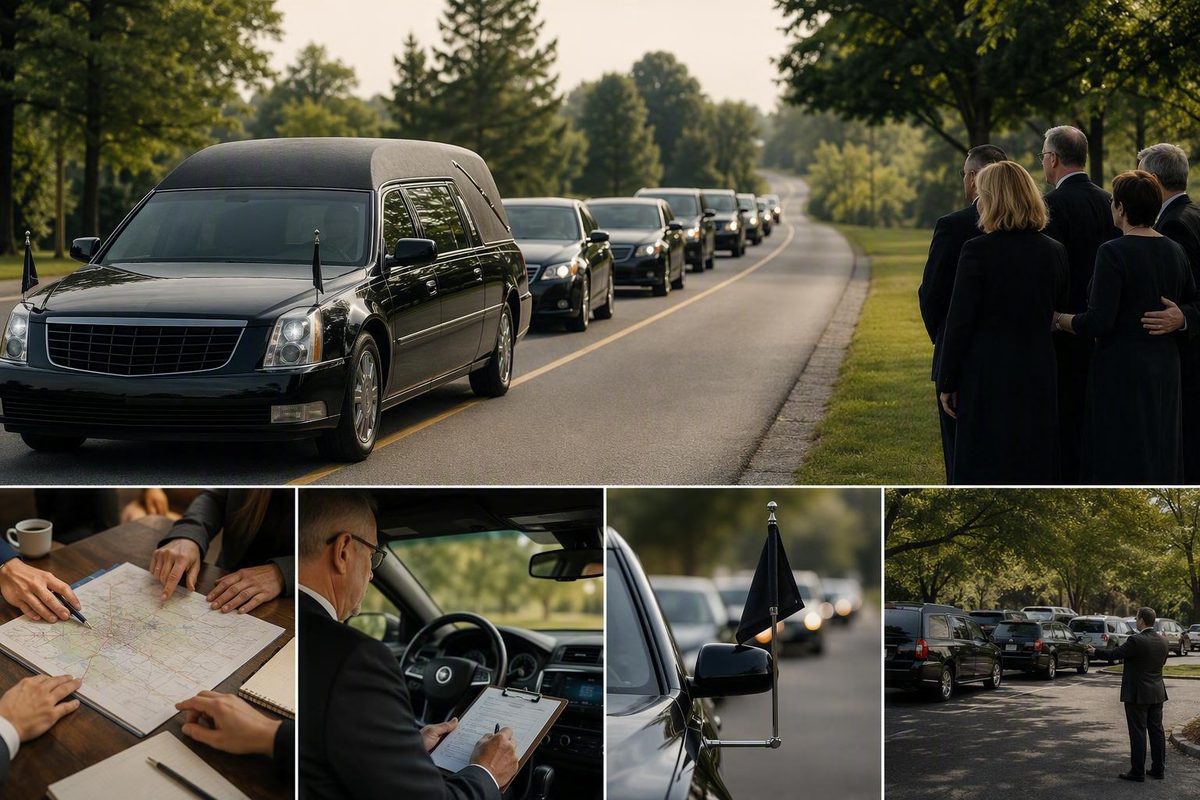
To prepare a funeral procession, ask the funeral director to coordinate one clear plan: who is participating, the order of vehicles, the route and destination, lawful vehicle markers, any approved escort, and parking on arrival. Give every driver the same written directions and a simple instruction for what to do if the group becomes separated. Most importantly, treat traffic signals, emergency vehicles, and directions from police as safety rules—not obstacles to keeping the procession together.
There is no single arrangement that suits every family. A procession may be a short motorcade, a walk between nearby locations, a small group of family cars, or no procession at all. Religious custom, cultural practice, mobility needs, weather, local law, and the family’s wishes should shape the plan.
1. Put one person in charge of coordination
The family should not have to manage traffic details while grieving. Ask the funeral director to act as the main coordinator, or name one family contact who will work directly with them. A funeral home may help choose the route, arrange authorized escorts, provide vehicle markers, and brief participants, as outlined in Tharp Funeral Home’s procession-planning guide.
Confirm these basics as early as practical:
- where the procession will form and the time vehicles must arrive;
- the service, cemetery, crematorium, or other destination address;
- an approximate vehicle count;
- who needs reserved transportation or accessible seating;
- whether the family wants a meaningful stop or route, and whether it is feasible;
- who may authorize last-minute route or timing changes; and
- one phone number participants can use before departure or after safely parking.
If an escort or traffic assistance may be needed, the funeral home should contact the appropriate authority or licensed provider. A relative should not attempt to stop traffic, block intersections, or imitate an emergency vehicle.
2. Choose a route that is simple and workable
Plan the route from the actual departure point to the exact entrance that the procession will use. Check construction, road closures, difficult turns, low-clearance restrictions, school traffic, and major events. For a large procession, ask the destination whether its entrance and parking area can accept all vehicles without backing traffic onto the road.
Keep a backup route, but avoid changing routes after drivers have been briefed unless the coordinator can notify everyone. Share the destination address and route in writing or by text before departure. Drivers should be able to reach the destination independently rather than taking risks to stay behind the car ahead. Dignity Funerals likewise advises drivers to check the route in advance and confirm parking.
If the route passes a family home, workplace, place of worship, or another meaningful location, discuss it with the funeral director. A tribute is only appropriate when it can be completed lawfully, safely, and without creating an unreasonable delay.
3. Confirm the vehicle order
The order is a planning tool, not a universal rule. A common motor-vehicle arrangement is:
- an authorized escort or funeral-home lead vehicle, if one is being used;
- the hearse or other vehicle carrying the deceased;
- vehicles carrying immediate family and close companions;
- other relatives and guests; and
- a funeral-home support vehicle, if provided.
Local practice can differ. Some processions are led directly by the hearse; others place a lead vehicle before it. A procession may also include a horse-drawn vehicle, motorcycles, bicycles, or a walking section. The funeral director should confirm the final order and explain it without assuming that every family follows the same faith or tradition.
Write the drivers’ names and mobile numbers beside the vehicle order. Place anyone who needs extra assistance where the funeral-home team can support them at departure and arrival. Carpooling can make a large group easier to coordinate, but no guest should feel pressured to drive or ride in the procession.
4. Check local law before choosing markers or an escort
Funeral-procession rules vary by jurisdiction, sometimes in very specific ways. For example, Florida Statute 316.1974 defines qualifying lead and escort vehicles, specifies lights, and sets conditions and exceptions for right-of-way. Michigan’s Vehicle Code, section 257.654 instead ties funeral-procession right-of-way to a particular fluorescent-orange flag and gives exceptions for emergency vehicles.
Those examples are not instructions for drivers elsewhere. They show why the funeral director or local traffic authority should answer these questions for the actual route:
- Does the procession receive any special right-of-way?
- Are an escort, permit, flag, placard, headlights, or other markers required?
- Which types or colors of flashing lights are permitted?
- What must drivers do at a red light or stop sign?
- Are there local restrictions on procession size, route, or time of day?
Do not buy or improvise warning lights based on a general online tip. In an official interpretation, the National Highway Traffic Safety Administration explains that supplemental funeral-procession lights remain subject to state or municipal law and notes that some places restrict flashing lights to police or emergency vehicles.
Even where a procession has a qualified right-of-way, drivers must follow the directions of police and yield to emergency vehicles. No special status makes unsafe driving acceptable.
5. Identify vehicles consistently
Use only the flags, placards, lamps, or other identifiers supplied or approved by the funeral home and permitted locally. Clear, consistent markers help the coordinator and other road users recognize the group. Riverdale-on-Hudson Funeral Home recommends announcing the procession and marking participating vehicles before departure.
Before lining up, count the vehicles and give each driver their position. If headlights or hazard lights are part of the lawful local plan, explain exactly when to turn them on and off. Do not assume that a marker gives a driver permission to ignore a signal, exceed the speed limit, or follow too closely.
6. Give every driver a two-minute safety briefing
Hold the briefing while vehicles are parked. Use plain language and repeat the most important points:
- Wear seat belts and keep phones put away while moving.
- Follow at a safe distance that allows time to brake.
- Obey police, emergency vehicles, and the instructions approved for the route.
- Do not speed, make abrupt lane changes, or block an intersection to close a gap.
- If separated, continue safely to the destination using the written route.
- If a vehicle has a problem, pull over only where safe and contact the coordinator after stopping.
- On arrival, remain in the vehicle until directed if the funeral-home team needs to stage parking.
Give each driver a small card or message containing the destination, route, coordinator’s number, and the separation plan. This is more useful than asking people to rely on the vehicle ahead.
7. Stage departure and arrival
Ask drivers to arrive early enough to receive markers, use restrooms, secure children, and line up without rushing. The funeral-home team can then confirm the count, order, and route before releasing vehicles.
At the destination, reserve enough space for the hearse and close-family vehicles near the appropriate entrance. Have someone who knows the parking plan meet the first vehicles. Other drivers should fill the designated area in order and leave access for emergency vehicles, mobility aids, cemetery staff, and later departures.
Weather may change the plan. Rain, snow, extreme heat, poor visibility, or unsafe walking conditions can justify shortening the route, reducing the number of vehicles, or moving a walking tribute to another part of the service. Dignity and safety matter more than preserving a complicated itinerary.
A day-of checklist
Before departure, confirm that:
- the funeral director and family contact agree on the route and timing;
- any required authority, permit, or lawful escort is confirmed;
- the vehicle order and participant count are current;
- every driver has the address, route, and separation plan;
- approved identifiers have been fitted correctly;
- accessible transportation and arrival assistance are ready;
- the destination knows the expected arrival time and parking needs; and
- drivers have received the safety briefing.
Common questions
What if a car becomes separated from the procession?
The driver should not speed, run a signal, or make an unsafe turn to catch up. Continue to the destination using the shared directions and rejoin only when it is safe and lawful. The procession plan should anticipate this possibility.
Should every driver use hazard lights?
Only if the funeral director confirms that doing so is permitted and appropriate on the route. Lighting and marking rules vary. Use the locally approved method rather than a universal online rule.
Who should ride in the procession?
That is the family’s choice. Immediate family often travels closest to the hearse, followed by other relatives and friends, but the order can reflect cultural customs, relationships, accessibility needs, and the family’s preferences. Guests may also travel independently and meet the family at the destination.
Is a police escort always necessary?
No. The need and availability depend on local rules, the route, traffic conditions, and the size of the procession. Ask the funeral home to determine whether an authorized escort or traffic-authority coordination is required; family members should never direct public traffic themselves.
A calm plan reduces decisions on an emotional day. Keep it simple, brief every driver, and let the funeral director and lawful local authorities manage the parts that require traffic expertise.