
7 min read ·
All Hail the Power of Jesus’ Name Lyrics: Six-Stanza Version and Hymnal Variations
The six-stanza sequence ends with "O that with yonder sacred throng." Hymnals may omit or reorder stanzas, modernize words or repeat lines.
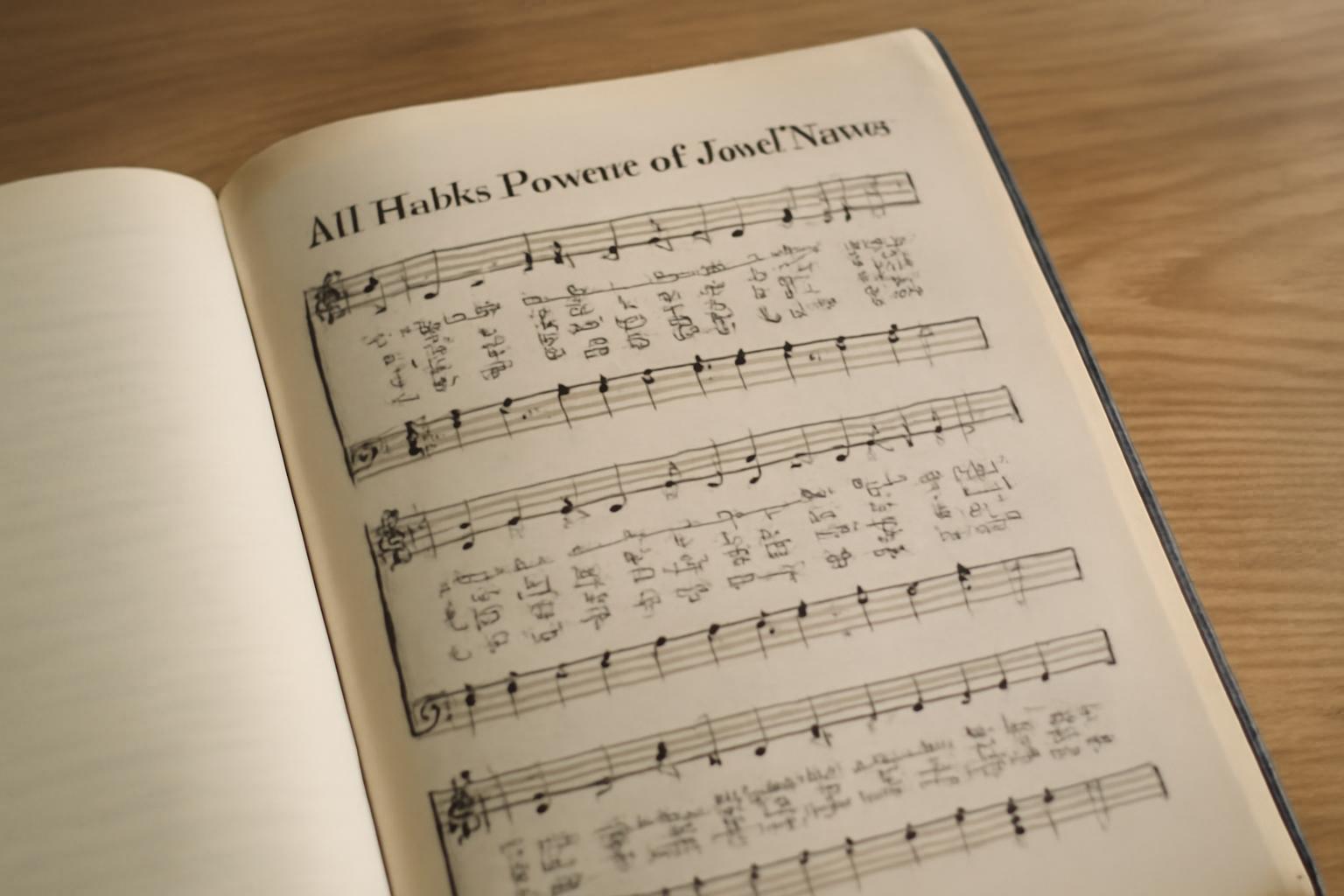
Overview
The lyrics below present a documented six-stanza arrangement of “All Hail the Power of Jesus’ Name.” It is a practical choice when no hymnal or tune has been specified, but it is not the only valid edition. Hymnals may omit stanzas, change their order, modernize words, or repeat lines to fit a musical setting.
The hymn text is identified as public domain by Hymnary, and a separate public-domain chord sheet credits the words to Edward Perronet and John Rippon. Public-domain status explains why the text appears in many hymnals and musical arrangements, but readers preparing a service should still check that the selected words match the version their congregation or musicians expect.
All Hail the Power of Jesus’ Name Lyrics: A Six-Stanza Version
This edition uses the familiar six-stanza sequence ending with “O that with yonder sacred throng.” Christian Web Resources identifies that closing text as verse 6, while a Selah score likewise presents a six-stanza form and associates its sixth stanza with John Rippon. Spelling and punctuation have been kept in a traditional form.
1.
All hail the power of Jesus’ name! Let angels prostrate fall; Bring forth the royal diadem, And crown Him Lord of all.
2.
Crown Him, ye martyrs of your God, Who from His altar call; Extol the Stem of Jesse’s rod, And crown Him Lord of all.
3.
Ye chosen seed of Israel’s race, Ye ransomed from the fall, Hail Him who saves you by His grace, And crown Him Lord of all.
4.
Sinners, whose love can ne’er forget The wormwood and the gall, Go spread your trophies at His feet, And crown Him Lord of all.
5.
Let every kindred, every tribe, On this terrestrial ball, To Him all majesty ascribe, And crown Him Lord of all.
6.
O that with yonder sacred throng We at His feet may fall! We’ll join the everlasting song, And crown Him Lord of all.
Readers may encounter small but noticeable differences elsewhere. For example, some editions use “Ye seed of Israel’s chosen race” instead of “Ye chosen seed of Israel’s race.” Older pages may contract “power” to “pow’r,” while other editions modernize “ye” or alter capitalization. The final stanza also appears as “O that with yonder sacred throng” or “Oh, that with all the sacred throng.” These differences should be resolved before lyrics are printed in a service document, especially when singers are using a separate hymnal or score.
Why the Lyrics Vary Between Hymnals
The hymn varies because its present forms draw from a long history of editing, omission, addition, and recombination. Hymnary explains that most modern versions combine material associated with Perronet and Rippon, with many different pairings of words and tunes. A four-stanza hymnal text and a six-stanza online text can therefore belong to the same hymn tradition without containing an identical sequence.
Editors may retain only the stanzas most suitable for a particular hymnal, alter older wording, or number the surviving verses consecutively. A stanza labeled “4” in a short edition may consequently be the same closing stanza labeled “6” in a longer one. The useful question is not simply which page has the “complete” lyrics, but which documented arrangement fits the intended hymnal, score, tune, and service.
Four-, Five-, and Six-Stanza Versions Compared
The following comparison reflects documented arrangements in the supplied sources. It does not establish one stanza count as universally authoritative.
| Arrangement | Documented example | Closing-stanza position | Practical use |
|---|---|---|---|
| Four stanzas | HymnSite’s Baptist hymnal page | Verse 4 | Suitable when following that hymnal or when a shorter established selection is needed |
| Five stanzas | Hymnal.net’s presentation | Final verse of its selected sequence | Useful when singers or musicians already use this musical presentation and its repeated phrases |
| Six stanzas | Christian Web Resources and the Selah score | Verse 6 | Provides a broader selection while retaining the familiar “sacred throng” conclusion |
For a funeral, memorial, or church service, the safest choice is usually the edition already connected to the chosen score or congregational hymnal. If no edition has been prescribed, the six-stanza text above offers a clearly identified starting point. Stanzas can then be selected deliberately, provided the printed lyrics and musical materials remain aligned.
Edward Perronet and John Rippon’s Contributions
Edward Perronet wrote the hymn in 1779. The historical account from the Hymnology Archive says it first appeared anonymously in a Canterbury booklet that year. Its first stanza was also printed in the November 1779 supplement to The Gospel Magazine, and the full text appeared in that magazine in April 1780. The early full version contained eight stanzas.
John Rippon substantially revised the text for his 1787 Selection of Hymns from the Best Authors. According to the same historical account, Rippon omitted Perronet’s original second, third, and sixth stanzas, altered much of the retained material, and wrote two new stanzas. The United Methodist Discipleship Ministries history identifies the familiar “O that with yonder sacred throng” conclusion as Rippon’s replacement for Perronet’s earlier final stanza.
Attribution can therefore vary with the edition. One four-stanza source assigns stanzas 1 and 2 to Perronet and stanzas 3 and 4 to Rippon, while the Selah arrangement describes its text as Perronet, altered, with stanza 6 by Rippon, also altered. These labels describe particular edited forms rather than every version in circulation.
The supplied biographical sources also conflict on Perronet’s birth year. The Hymnology Archive gives 1721, while Christian Web Resources gives 1726. Because the available evidence does not resolve that difference, neither date needs to be treated as settled when identifying the hymn’s authorship.
Textual Variants and Repeated Musical Lines
A changed word or selected stanza is a textual variant. A phrase sung several times within one stanza may instead be part of the musical presentation. The two should not automatically be treated as different editions.
For example, Hymnal.net prints “Let angels prostrate fall” twice and expands the closing declaration as “crown Him” several times before “And crown Him Lord of all.” Another lyric sheet repeats “Bring forth the royal diadem, And crown Him Lord of all.” Such repetition can show how a setting is performed, while the underlying four-line stanza remains recognizable.
The evidence does not establish one repetition rule for every tune. When preparing words for singing, readers should follow the repetitions printed in the selected score. For a reading or service booklet, the simpler stanza text may be preferable unless the congregation is expected to sing directly from that page.
The Meaning of “Crown Him Lord of All”
“Crown Him Lord of all” is the hymn’s central declaration. The royal diadem and crowning language present Jesus as sovereign, while successive stanzas call angels, martyrs, Israel’s people, sinners, every kindred, and every tribe to acknowledge that lordship. The movement is outward, from particular groups toward a universal act of recognition.
The verb “crown” is devotional rather than a claim that worshippers confer authority on Christ. In the hymn’s logic, they recognize and proclaim the majesty already associated with his name. Hymnary summarizes the words as both declaring Christ’s majesty and calling worshippers to make that majesty known.
Hymnary also identifies an allusion to Philippians 2:9–11, the passage concerning Jesus’ exalted name and the universal confession of his lordship. That connection helps explain the hymn’s language of every kindred and tribe. Perronet’s earlier conclusion similarly called on “every tribe and every tongue” to join a universal song, according to the United Methodist historical account.
The final stanza changes the viewpoint from proclamation to anticipation. The singers imagine joining the “sacred throng,” falling at Christ’s feet, and taking part in the everlasting song. In a funeral or memorial setting, that stanza may carry particular significance, but its plain textual meaning remains a shared hope of joining in lasting worship.
Tunes, Chords, Scores, and Audio Resources
Three principal tunes are associated with the hymn. Hymnary names CORONATION, DIADEM, and MILES LANE, noting that CORONATION is found in many American hymnals, while DIADEM and MILES LANE also appear in British hymnals. The selected tune affects the melody, pacing, and repeated lines, so musicians should identify it before finalizing a lyric sheet.
Several supplied sources offer practical materials:
- Christian Web Resources provides chords with a tool for transposing them into another key.
- HymnSite provides plain text, MIDI files for several instrument settings, a PDF piano score, and presentation slides.
- The iGraceMusic chord sheet combines lyrics and chords in a printable PDF and credits the music to Oliver Holden.
- The Selah score supplies a notated six-stanza arrangement.
A MIDI file can help confirm the melody and structure, but it should not be mistaken for the only possible setting. Before printing or rehearsing, the organizer and musician should agree on the tune, stanza selection, key, and any repeated lines, then use the same arrangement across the score, lyric sheet, and service document.