
20 min read ·
How to Fly With Cremated Remains Without an Airport Surprise
Security clearance, airline acceptance and international entry are separate approvals. TSA officers will not open the urn, even if you ask.
Last reviewed August 5, 2026. The central TSA guidance cited below was last updated July 10, 2018, so recheck official policies before traveling.
The short answer: Yes, but three sets of rules apply
Yes, you can generally carry cremated human remains—often called ashes—on a plane. In the United States, TSA permits cremated remains in both carry-on and checked bags, provided the container can be screened successfully. Some airlines do not accept cremated remains in checked baggage, however, and the final checkpoint decision rests with the TSA officer evaluating the item (TSA guidance for cremated remains).
A successful trip depends on three separate approvals:
- Security screening: The container must produce an X-ray image clear enough for airport security officers to assess its contents.
- Airline acceptance: The airline operating each flight must accept the remains in the baggage category you intend to use.
- Destination and transit rules: International destinations and transit countries may have their own entry, customs, documentation, burial, and scattering requirements.
Passing one check does not satisfy the other two. TSA permission does not override an airline’s baggage policy. An airline’s willingness to carry the container does not guarantee that a foreign authority will admit it.
This article primarily addresses screening at U.S. airports. Import, customs, burial, and scattering rules can also differ by country and locality.
The safest default plan is usually to:
- Ask the crematory or funeral director for a lightweight temporary container likely to be screenable.
- Carry the container in the cabin when the operating airline permits it.
- Bring relevant death, cremation, and disposition records.
- Verify every operating carrier, destination, connection, and transit country.
- Resolve concerns about the urn’s material before arriving at the airport.
These are risk-reduction measures, not universal legal requirements. The exact obligations depend on the itinerary, and security officers still must be able to clear the container at the checkpoint.
Carry-on or checked baggage: what TSA permits and what is usually safer
U.S. security rules permit cremated remains in either carry-on or checked baggage, but an airline may impose stricter conditions. A carrier might prohibit checked transport, direct passengers to keep ashes in the cabin, or apply its ordinary baggage rules. Commercial funeral-home guidance therefore also advises checking the airline and using carry-on transport when possible (guidance on flying with cremated remains).
Carry-on transport is usually the more cautious choice when the airline allows it. Keeping the container with you reduces its exposure to:
- Baggage loss or delay
- Rough handling
- Damage from other luggage
- Handling outside your presence
- A missed baggage transfer during a connection
This is practical advice, not a universal TSA requirement. Checked transport may be possible when both security rules and the airline permit it, but you will have less control over the container’s handling and location.
Ask the airline how it classifies the item. Depending on the carrier’s rules, the urn may count as a carry-on, personal item, checked bag, or another permitted item. Ordinary baggage dimensions, allowances, and fees may apply.
United offers one airline-specific example. It suggests carrying ashes in a carry-on bag and recommends bringing a death certificate and the Disposition Permit received with the ashes. United also states that fragile or valuable items count toward the applicable baggage allowance and may be subject to fees. This is United’s guidance, not a rule for other carriers (United’s fragile and valuable items policy).
When booking, identify the airline operating every segment, not just the airline that sold the ticket. A codeshare itinerary may include flights operated by different carriers, and each operating airline’s current policy should be checked directly.
Ask each operating carrier:
- May I bring a sealed container of cremated human remains in the cabin?
- Must it be inside another carry-on bag, or may it travel separately?
- Does it count as my carry-on or personal item?
- Is checked transport permitted or prohibited?
- What dimensions and weight limits apply?
- Will standard baggage fees apply?
- Is advance notice or special handling required?
- Are the requirements different for regional, codeshare, or international segments?
Do not rely on an undated third-party comparison chart. Airline rules can change, and summaries may blur the difference between a recommendation and a requirement. A current answer from the operating carrier is more useful than a general claim about what “most airlines” allow.
If both carry-on and checked transport are accepted, consider more than convenience. A decorative urn may be fragile, valuable, or irreplaceable. Keeping it in the cabin generally gives you better control over its location and handling.
Choose an urn that airport security can actually screen
The decisive issue at a U.S. checkpoint is screenability, not whether a retailer calls a product a “travel urn” or “TSA-approved urn.” The container must produce an X-ray image clear enough for officers to assess what is inside.
TSA suggests using a temporary or permanent lightweight crematory container made from a material such as wood or plastic. Funeral-service guidance also identifies paper, cardboard, plastic, softwood, fiberboard, and similar lightweight or biodegradable containers as practical options, while recognizing that no material guarantees clearance (container guidance for flying with ashes).
Dense or thick materials may make an X-ray image difficult to interpret. Potentially troublesome examples include some:
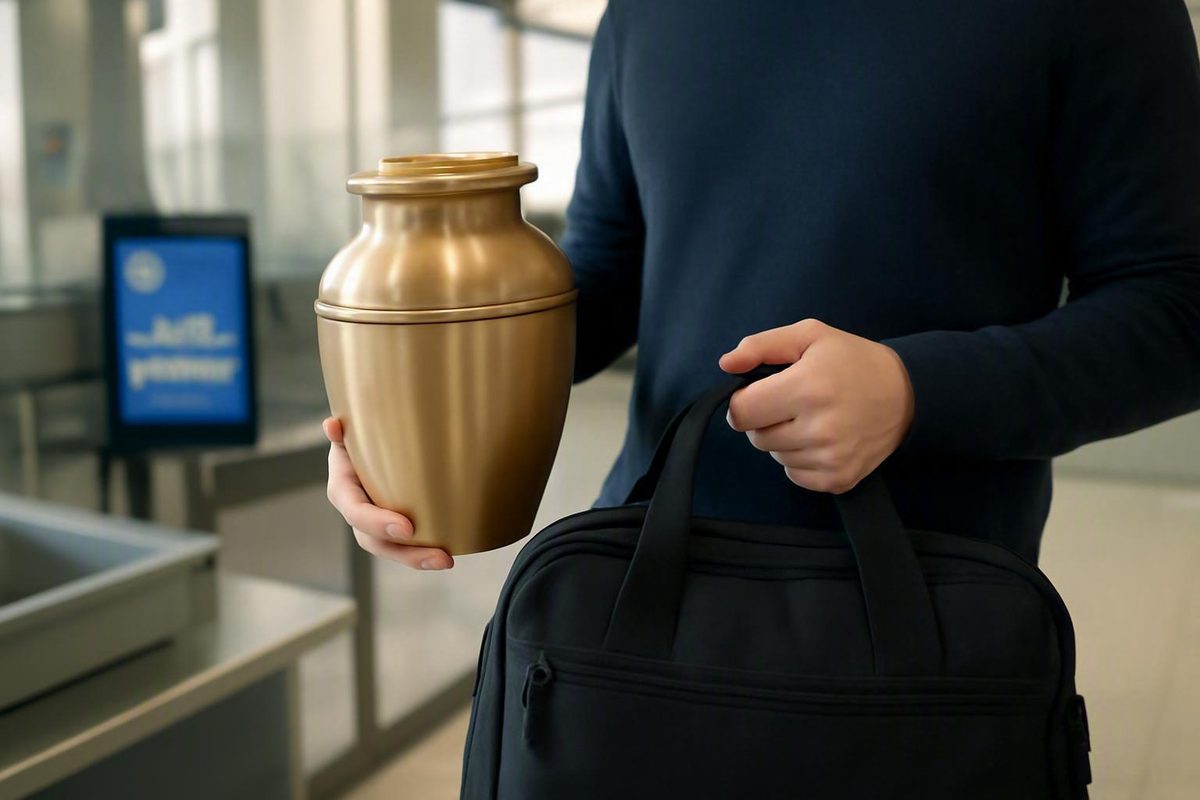
- Metal urns
- Stone or granite urns
- Thick ceramic or porcelain urns
- Dense hardwood urns
- Thick-glass containers
- Containers with heavy decorative fittings
- Urns placed inside dense outer cases
These materials are not all categorically prohibited. Whether a particular urn can be cleared depends on its construction, thickness, hardware, contents, and the image produced during screening. The practical question is not simply, “Is this urn metal?” It is, “Will security officers be able to obtain a sufficiently clear image?”
Treat the phrase “TSA-approved urn” cautiously. The available evidence does not establish a TSA certification or brand-approval program that guarantees clearance for particular urns. A manufacturer may design a container with screening in mind, but only the actual screening result determines whether it can proceed.
If the permanent urn is made from stone, metal, thick ceramic, dense hardwood, or another material that may obscure the image, arrange a lightweight temporary container before departure. The permanent urn can remain at home or, if the airline permits, travel separately without the remains.
A funeral director, crematory, or cremation provider can help you choose and prepare a temporary container. Ask whether the remains can be placed in that container from the outset so that you do not need to open the permanent urn or transfer the contents personally.
Useful questions for the provider include:
- Is the temporary container lightweight and free from dense internal components?
- Is it securely closed and sift-resistant?
- Can identifying information be attached without obscuring the container?
- Will it fit within the airline’s baggage dimensions?
- Can you provide the cremation certificate and any disposition permit issued with the remains?
- Can the container be protected in packaging that is easy to remove for screening?
Protective packing should cushion the container without turning it into a dense or complicated bundle. Avoid excessive layers, metal outer boxes, tightly packed surrounding objects, or elaborate wrapping that makes the urn difficult to isolate.
Keep the closure secure throughout the trip. If the urn has a removable lid, ask the funeral provider how to secure it without damaging the container or making screening more difficult. Do not make an improvised last-minute modification that could create a spill.
Identification is also prudent. Where applicable, make sure the name or other identifying information associated with the remains is consistent with the accompanying records. Keep sensitive original documents protected rather than attaching them permanently to the outside of the container.
What happens when the urn reaches the security checkpoint
At a U.S. airport checkpoint, the cremation container is subject to security screening. It must generate an image clear enough for TSA officers to determine what is inside.
TSA states that its officers will not open a crematory container, even if the passenger asks them to do so. If the container produces an opaque image and officers cannot clear it, it will not be allowed through the checkpoint. The final decision rests with the TSA officer (TSA’s special screening instructions).
This creates an important practical limit: paperwork cannot cure an unreadable X-ray. A death certificate, cremation certificate, disposition permit, or funeral-home letter may help identify the remains or meet an airline or destination requirement, but none substitutes for successful screening.
Do not arrive expecting that you will necessarily be permitted to:
- Open the urn for an officer
- Ask the officer to open it
- Transfer the remains into another container at the checkpoint
- Move an uncleared carry-on urn automatically into checked baggage
- Resolve an opaque scan solely by presenting documents
Those outcomes are not promised by official TSA guidance. Checked baggage is also screened, and the airline may not accept cremated remains in checked luggage.
The effective contingency plan therefore begins before the airport. If you have reasonable doubts about the permanent urn, ask the crematory or funeral director to provide a lightweight temporary container. Confirm separately that the airline accepts your intended packing method and baggage placement.
On travel day:
- Keep the urn readily accessible rather than at the bottom of an overfilled bag.
- Be prepared to identify the item calmly and directly.
- Follow instructions about removing it from the bag or positioning it for screening.
- Keep relevant records somewhere you can reach easily.
- Do not open or manipulate the container in the security line.
- Allow a reasonable time buffer for questions or additional screening.
There is no single extra-arrival period that applies at every airport. Airport size, staffing, passenger volume, and the complexity of the itinerary can all affect timing. The practical point is to avoid planning an unusually narrow period between arriving at the terminal and boarding.
If privacy is important, you may ask checkpoint personnel what arrangements are available, but do not assume a particular process is guaranteed. The central requirement remains unchanged: officers must be able to clear the container without opening it.
An unreadable urn can create a painful last-minute problem. Treat screenability as something to resolve with the funeral provider before departure, not something to test for the first time at the airport.
Documents to bring—and which ones TSA does not universally require
Security requirements and travel-document requirements are not the same.
The cited TSA guidance does not identify a death certificate or cremation certificate as a universal requirement for domestic U.S. checkpoint screening. Its stated focus is whether the container can be screened. That does not make documentation unimportant; it means prudent paperwork should not be misrepresented as a universal TSA rule.
For most trips, a sensible document pack may include:
- A copy of the death certificate
- The cremation certificate or certificate of cremation
- A disposition, burial-transit, or similar permit, if one was issued
- A receipt or identifying statement from the crematory or funeral home
- The operating airline’s written instructions or confirmation
- Any destination or transit-country approvals
- Certified translations, notarizations, or authentication documents when required
- Contact details for the crematory, funeral home, receiving relative, cemetery, or local funeral professional
National Cremation, a commercial cremation provider, recommends carrying cremation documentation and a certified copy of the death certificate as a precaution, while emphasizing that international requirements vary by destination (National Cremation’s travel guidance).
United’s current published guidance provides a bounded airline example: it recommends bringing a death certificate and the Disposition Permit received with the ashes. Another airline may request different records or use a different name for a similar document.
Document expectations may vary according to:
- The operating airline
- The origin and destination
- Whether the trip is domestic or international
- The transit countries
- The purpose of the journey
- Whether the ashes will be buried, scattered, divided, or transferred
- The jurisdiction that issued the original records
For international travel, build the document pack from current instructions supplied by the destination embassy or consulate, relevant customs authority, operating airlines, and any transit-country authority. If certified copies, translations, notarization, authentication, or an apostille are required, arrange them well before departure.
Carry duplicate paper copies and secure digital backups. Keep at least one paper set in the cabin. Confirm the accepted format rather than assuming a photograph on a phone will be sufficient.
Where applicable, check that names, dates, and identifying details are consistent across the container label, death certificate, cremation certificate, disposition permit, and airline booking. A difference may be legitimate, but it is easier to address before traveling. If a record contains a spelling variation or former legal name, ask the issuing provider whether supporting documentation is advisable.
Extra records are a precaution. They do not mean that every item listed here is legally required for every domestic flight. Conversely, a complete document pack cannot compensate for an urn that security cannot clear or an airline that will not accept the remains.
How to confirm the airline’s current policy
A general TSA answer is only the first part of planning. Airlines can establish their own conditions concerning baggage placement, dimensions, documentation, advance notice, labels, connections, and fees.
Start with the official website of the operating carrier. Search for terms such as “cremated remains,” “ashes,” “human remains,” “fragile items,” and “special baggage.” If the published information is incomplete, contact the carrier and ask for the department that handles special baggage or related customer-support questions.
Use this script:
“I will be traveling with cremated human remains. May I carry the sealed container in the cabin? Is checked transport prohibited? Does it count as my carry-on or personal item? Are documents, advance notice, dimensions, labels, or special arrangements required?”
Then ask follow-up questions tailored to your itinerary:
- Does the policy distinguish between human and pet remains?
- Is the urn accepted as a separate cabin item or only inside another bag?
- What size and weight limits apply?
- Will a fee apply under my fare type?
- Must I notify the airline before check-in?
- Are original documents required, or are copies acceptable?
- Does the airline request a death certificate, cremation certificate, disposition permit, or funeral-home letter?
- Does a regional or codeshare partner operate any segment?
- Do different rules apply on that partner-operated flight?
- Will I need to collect and recheck baggage during a connection?
- Are there special procedures for an international arrival or onward flight?
- What options are available if security cannot clear the container?
For a codeshare, ask the ticketing airline to identify every operating carrier. Then verify the policy with each of those carriers directly. Do not assume that the first airline’s answer covers the entire itinerary.
Record:
- The date you checked
- The official policy-page URL
- The representative’s name or identifier, if provided
- The department contacted
- The contact method
- The substance of the answer
- Any confirmation or case number
Save a screenshot or printout of the official policy. It will not bind staff to an outdated rule, but it creates a useful record of the instructions you followed.
Check again shortly before departure. Airline requirements may change, and a schedule change may replace an operating carrier or introduce a new connection.
United’s published policy supports carry-on transport and recommends certain records, but it establishes only United’s position. Travelers using another carrier need that airline’s current instructions. Third-party summaries of other airlines should not be treated as authoritative policy.
If a representative’s answer conflicts with the airline’s published page, request written clarification or escalation to the appropriate department. Do not wait until check-in to resolve a significant disagreement about whether the remains may travel.
International flights require a route-by-route check
For an international journey, TSA clearance and airline acceptance do not guarantee entry into another country. The destination may impose customs, import, documentary, or consular conditions. A transit country may also have relevant rules, including during a connection.
Contact the destination country’s embassy or consulate and ask which authority controls the import or transit of cremated human remains. Check every country where you will connect rather than assuming that remaining airside eliminates all requirements.
Depending on the route, authorities may request some combination of:
- A certified death certificate
- A certificate of cremation
- A crematorium or funeral-director letter
- A statement that the container is sealed
- A disposition or burial-transit permit
- Certified translations
- Notarization
- An apostille or other authentication
- A customs declaration
- Consular approval
- Proof of the traveler’s identity or relationship to the deceased
- Details for a receiving funeral home, cemetery, or responsible person
These are possible requirements, not a universal checklist. A commercial international travel guide illustrates how translations, apostilles, transit permits, declarations, and consular records can arise, but only the responsible government authorities can confirm what applies to a particular itinerary (commercial guidance on taking ashes abroad).
Ask precise questions:
- May cremated human remains enter in a passenger’s cabin baggage?
- Must the remains be declared to customs?
- Does the urn need to be sealed or labeled in a particular way?
- Which documents must be originals or certified copies?
- Must documents be translated, notarized, or authenticated?
- Is an apostille required?
- Do different requirements apply if I am only transiting?
- Is prior consular approval required?
- Are there separate conditions for burial or scattering?
- If I take only part of the ashes, may I bring the remainder home?
Check the operating airline’s international requirements separately. The airline may request documents as a condition of carriage, while customs or border officials may require different records for entry. Meeting one list does not necessarily satisfy the other.
Also distinguish permission to transport or import the ashes from permission to bury or scatter them. A country may admit cremated remains while regulating where and how they may be scattered.
If only some of the ashes will be scattered or interred, plan the return journey before leaving home:
- Will the remaining ashes still have matching documents?
- Will the container remain securely closed and screenable?
- Must the remainder be declared on departure or re-entry?
- Will the return airport use different screening procedures?
- Does the return airline accept the container in the same baggage category?
Retain printed or written copies of the official instructions used to prepare the trip. Record when you obtained them and which office supplied them. If the requirements remain unclear, consult a funeral director experienced with international transfers or an appropriately qualified professional in the destination country.
Avoid broad claims that ashes can move freely throughout a region. Requirements may depend on the countries involved, the airports used, the connection, the documentation, and the intended disposition. Route-specific confirmation is the safer approach.
A saveable preflight and travel-day checklist
Use this checklist to separate decisions that belong at the booking stage from tasks for travel day.
While booking
- Identify every flight segment and operating carrier.
- Check for codeshares and regional partners.
- List every destination and transit jurisdiction.
- Decide whether you intend to use cabin or checked transport.
- Choose an itinerary that allows time to handle questions during connections.
- Avoid relying on a carrier whose policy remains unclear.
Several days before travel
- Confirm cabin acceptance with every operating airline.
- Ask whether checked transport is permitted or prohibited.
- Confirm whether the urn counts as a carry-on, personal item, or other item.
- Check applicable dimensions, weight limits, and fees.
- Ask whether advance notice, a reservation note, labels, or special arrangements are required.
- Confirm exactly which documents the airline requests.
- Save the airline’s current policy and your contact notes.
- Check for schedule or operating-carrier changes.
For international travel
- Contact the destination country’s embassy or consulate.
- Check the requirements of every transit country.
- Ask whether a customs declaration or advance approval is required.
- Determine whether records must be certified, translated, notarized, or authenticated.
- Obtain any required apostille, disposition permit, transit permit, or consular authorization.
- Confirm whether a sealed-container statement or funeral-provider letter is needed.
- Research burial or scattering permission separately.
- Plan the return journey if any ashes will come home.
Container check
- Use a securely closed, identifiable, lightweight container likely to produce a clear X-ray image.
- Ask the funeral provider for a temporary travel container if the permanent urn is dense.
- Do not rely on a “TSA-approved” marketing label as a guarantee.
- Check for heavy decorative hardware or a dense outer case.
- Make sure the container fits the airline’s baggage limits.
- Confirm that identifying information is consistent with the records where applicable.
Document check
Pack the records required for the route, which may include:
- Death certificate
- Cremation certificate
- Disposition or burial-transit permit
- Crematory or funeral-home letter
- Airline confirmation
- Embassy, consular, or customs instructions
- Translations and authentication records
- Receiving-party or funeral-professional contact details
Carry duplicate paper copies and secure digital backups. Keep essential records accessible in the cabin rather than in checked luggage.
Packing check
- Cushion the container against movement and impact.
- Keep it upright when practical.
- Use outer packing that can be removed without disturbing the closure.
- Avoid dense exterior boxes and excessive layers.
- Keep the container readily accessible for screening.
- Verify that the closure remains secure.
- Protect original records from spills and damage.
At the airport
- Allow a reasonable time buffer.
- Keep the airline confirmation and document pack accessible.
- Identify the item clearly if asked.
- Follow officer instructions.
- Do not open or attempt to transfer the remains in the screening area.
- Remember that TSA officers will not open the cremation container.
- Do not assume an uncleared carry-on can automatically become checked baggage.
Contingency check
Before departure, decide what you will do if:
- The operating carrier changes.
- A connection introduces different baggage rules.
- The permanent urn appears unlikely to screen clearly.
- Required international documents do not arrive in time.
- The airline cannot confirm acceptance.
- Destination and transit instructions conflict.
- The return journey has different requirements.
An alternative plan might involve postponing the trip, using a different suitable container, selecting another itinerary, or arranging transport through an appropriate professional service. Make that decision before reaching the security line.
Mortuary Guide provides general information, not route-specific legal or professional advice. Its terms state that the material is not a substitute for guidance from a licensed funeral director, attorney, or other relevant professional (Mortuary Guide’s informational-use notice).
The calmest plan is also the simplest: choose a container that can be X-rayed clearly, keep it in carry-on baggage when the operating airline allows, bring relevant death and cremation records, and verify every carrier and jurisdiction before departure. Security clearance, airline acceptance, and international entry are separate approvals. Resolve container and paperwork questions at home rather than at the checkpoint.
Frequently asked questions
Can I take ashes through TSA in my carry-on bag?
Yes. TSA permits cremated remains in carry-on baggage subject to special screening instructions. The container must produce a sufficiently clear X-ray image, and the TSA officer makes the final checkpoint decision.
Carry-on is usually the safer practical choice because it keeps the container under your control and reduces exposure to loss, delay, damage, and rough baggage handling. You must still confirm that the operating airline accepts the remains in the cabin and ask whether the urn counts toward your normal baggage allowance.
Can cremated remains go in checked baggage?
TSA permits cremated remains in checked bags, but an airline may impose a stricter rule. Some carriers may prohibit checked transport or recommend that ashes remain in the cabin.
If checked transport is accepted, consider the risks of loss, delay, damage, and handling outside your presence. Confirm the policy with every operating carrier and ask whether ordinary checked-baggage limits, fees, and screening conditions apply.
Will TSA open an urn containing cremated remains?
No. TSA states that officers will not open a crematory container, even if the passenger requests it. The container must be cleared through screening without being opened.
If the X-ray image is too opaque for officers to determine what is inside, the container will not be allowed through the checkpoint. Paperwork does not replace successful screening, so arrange a lightweight temporary container before departure if the permanent urn may be difficult to X-ray.
Are a death certificate and cremation certificate required to fly with ashes?
The cited TSA guidance does not make either document a universal requirement for domestic checkpoint screening. TSA’s stated concern is whether the container can be screened successfully.
Nevertheless, carrying copies of the death certificate and cremation certificate is prudent. An airline, customs office, foreign authority, or other official may request them. A disposition permit, burial-transit permit, funeral-home letter, translation, or authenticated record may also be required for a particular route.
Ask the operating airline and relevant international authorities exactly which records are required. Carrying additional documents is a precaution; it does not mean every record is mandatory on every domestic flight.
What should I do if my permanent urn is metal, stone, or another dense material?
Do not assume it will pass screening. Some metal, stone, thick ceramic, dense hardwood, and thick-glass containers can produce an image that is difficult to interpret, although they are not categorically prohibited.
Ask the crematory or funeral director to prepare the remains in a lightweight temporary container made from a material such as wood or plastic. Paper, cardboard, fiberboard, and similar lightweight containers may also be practical, but no material guarantees clearance.
Use the screenable temporary container for the trip and transfer the remains to the permanent urn after arrival, preferably with help from a funeral professional if you do not want to handle them personally. Do not plan to open the urn or transfer its contents at the airport.