
20 min read ·
When a Shroud or Simple Container Can Replace a Conventional Casket
You may omit a conventional casket yet still face requirements for a shroud, board, biodegradable coffin, liner, vault or lowering equipment.
The short answer: a conventional casket may not be required, but approval is location-specific
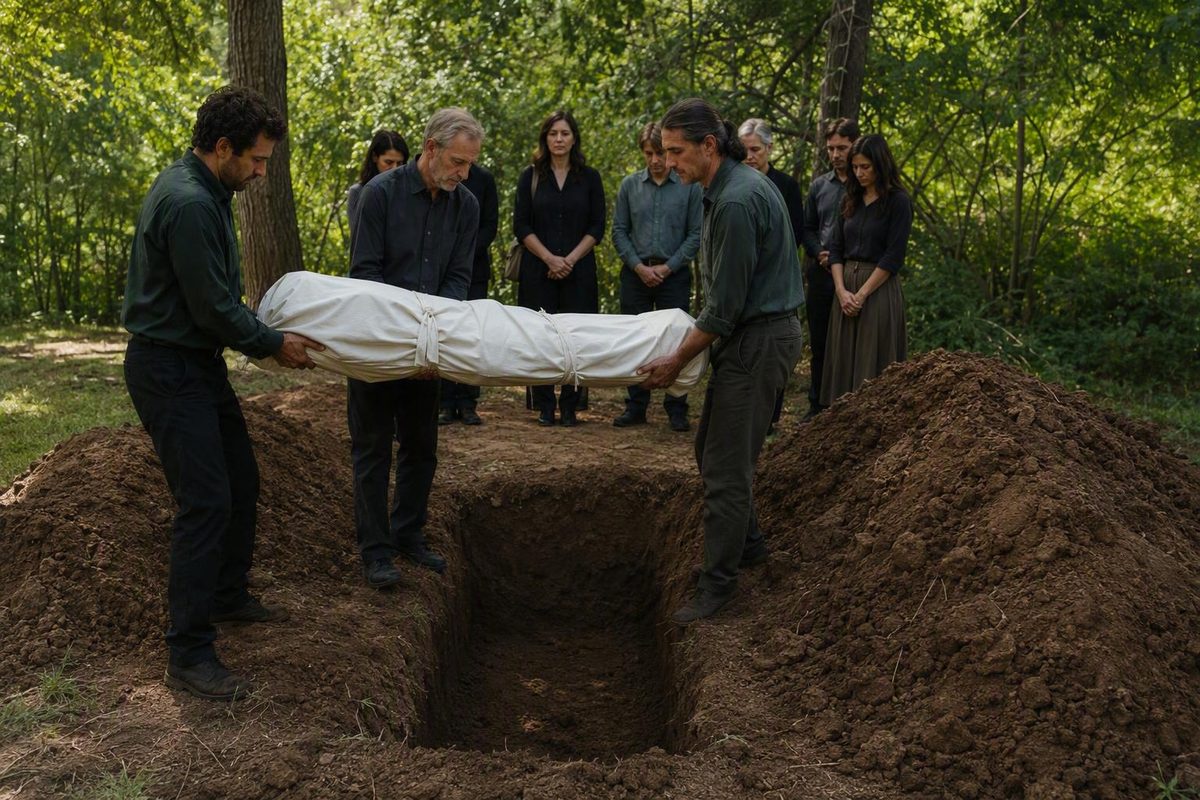
Yes—full-body burial without a conventional casket may be possible in the United States. Depending on the burial ground, the body may be wrapped in a biodegradable shroud or placed in a simple container made from materials such as untreated wood, wicker, bamboo, or cardboard.
That qualified “yes” is not permission for a particular burial. A funeral provider’s non-government overview states that no federal law mandates a casket for burial, but also emphasizes that state, local, and cemetery requirements vary. Because that source is not controlling law, families should use it as a planning starting point and verify the proposed arrangement with the appropriate authorities and burial site (overview of casket-free funeral requirements).
The practical distinction is between legal permission and local availability:
- State or local rules may govern final disposition, transportation, permits, land use, or the handling of human remains.
- A cemetery may decline shroud-only burial or accept it only under specified conditions, subject to applicable law and its contractual obligations.
- A cemetery may require a rigid support, biodegradable container, grave liner, or vault even when a conventional casket is omitted.
- A funeral home may not offer the arrangement, although another provider or burial ground might.
“Without a casket” therefore does not necessarily mean uncovered or unsupported. A burial ground might accept a cloth shroud but require a board beneath the body. Another might permit a biodegradable coffin but not shroud-only burial. A conventional cemetery might accept a shroud while still requiring an outer burial container.
The safest working answer is:
A conventional casket can sometimes be omitted, but the family must confirm what the jurisdiction requires and what the selected burial site will accept.
The Federal Trade Commission’s Funeral Rule does not establish a nationwide right to casket-free full-body burial. FTC guidance addresses funeral-purchase protections, embalming, and outer burial containers, but state and local rules and the burial site’s policies must still be checked for a proposed burial (FTC funeral pricing and container guidance).
This article is a U.S. planning overview, not a determination of the law in any state, county, municipality, or tribal jurisdiction. Mortuary Guide provides general information rather than a substitute for advice from a licensed funeral director, attorney, or estate professional. Laws and costs vary by location.
Casket, shroud, lowering board, grave liner, and vault are different things
Burial terminology can cause confusion because several separate items may be discussed as though they are interchangeable. Before asking whether a casket is required, identify which body covering, support, or outer container the cemetery or provider means.
A casket or coffin is the primary container that holds the body. The terms are often used interchangeably in ordinary conversation, but families should use the wording found in the applicable cemetery rules, contract, or local requirements. A conventional casket is commonly made from metal or finished wood; a simple biodegradable coffin can perform the same basic function while using different materials.
A burial shroud is a cloth wrapping placed around the body. Shrouds used for natural burial are commonly made from biodegradable cotton, linen, or wool. The burial ground may specify which materials or construction methods it accepts.
A simple biodegradable container holds the body without using a conventional metal or finished-wood casket. Possible cemetery-approved options include:
- An unfinished or untreated wooden coffin
- A wicker or willow container
- A bamboo or seagrass container
- A reinforced cardboard coffin
- Another biodegradable container approved by the burial ground
A regional natural-burial guide identifies cloth shrouds and containers made from unfinished pine, wicker, willow, bamboo, seagrass, or cardboard. It also cautions that individual cemetery policies determine what can be used (natural-burial container and lowering guidance).
A lowering board, tray, or shroud board is a rigid support placed beneath a shrouded body. Some cemeteries use one to support transfer, carrying, and controlled lowering. A cemetery that advertises shroud burial may still require such a support, so ask who supplies it, whether it must satisfy a written specification, and whether its cost is included.
A grave liner is an outer burial container placed in the grave around the primary container or supported body. A burial vault is another type of outer burial container. Designs vary, so the cemetery’s written product specification matters more than the label alone.
Neither a liner nor a vault is the same thing as a casket. Cemeteries may require an outer burial container to limit ground subsidence and facilitate grounds maintenance. The FTC states that state laws do not require burial vaults or grave liners, while also noting that many cemeteries require an outer burial container.
A family can therefore omit a conventional casket yet still face requirements for a shroud, board, biodegradable coffin, liner, vault, or specified lowering equipment.
Finally, green burial does not always mean casket-free burial. It may use a biodegradable shroud, but it can also involve a simple wooden, wicker, bamboo, or cardboard coffin. The useful question is not merely “Do you offer green burial?” It is:
“Which body covering, support, outer container, and lowering method do you approve for this grave?”
Three layers determine what is allowed
Whether a casket-free burial can proceed usually depends on three separate layers: government requirements, cemetery operating policies, and funeral-provider practices. Separating them helps identify who is imposing a condition and whether choosing another provider or burial setting could change it.
1. Government requirements
Rules governing final disposition and the handling of human remains vary by state. Local requirements may also address death registration, burial authorization, transportation, grave location, zoning, public health, water protection, or private burial sites. Non-government funeral guidance consistently warns that state and local requirements must be checked, but those summaries should not replace current statutes, regulations, or instructions from the responsible agency.
A statement that a casket is “not required by law” may describe only a particular jurisdiction. It may also leave unanswered whether some other covering, container, permit, or transportation method is required.
Confirm the arrangement directly with the relevant authorities when it involves:
- Burial on private property
- Transportation across jurisdictional boundaries
- A delayed burial
- An unusual public-health circumstance
- A location outside an established cemetery
- Uncertainty about who may file documents or transport the body
Ask the regulator to identify the controlling rule or written instructions whenever possible.
2. Cemetery operating policies
A cemetery may accept only certain burial arrangements on its property, subject to applicable law and its contracts. Its operating rules may address:
- Whether shroud-only burial is accepted
- Approved shroud and coffin materials
- Whether a rigid board or tray is required
- Whether a grave liner or vault is mandatory
- Grave dimensions and preparation
- Who may open and close the grave
- Which lowering equipment may be used
- Whether family members may participate
- Marker placement and specifications
- Service times or access restrictions
A cemetery’s answer is practically essential because the burial cannot proceed there unless the proposed arrangement is accepted. That does not make cemetery authority legally unlimited; policies remain subject to applicable laws, regulations, contracts, and consumer protections.
Ask for the current written rules rather than relying only on a general statement that the cemetery “offers natural burial.” Rules may also differ between sections of the same cemetery.
FTC guidance must be applied narrowly here. It says state laws do not require grave liners or burial vaults, but many cemeteries require an outer burial container. It also requires funeral providers to disclose an applicable legal, cemetery, or crematory requirement for a particular purchase on the itemized statement. It does not independently establish whether a shroud-only full-body burial is lawful or available in a particular location.
3. Funeral-provider practices or preferences
Another provider in the same area may offer the service.
A provider’s operating procedure is not necessarily a legal requirement. If someone says that embalming, a conventional casket, a board, or a vault is mandatory, ask:
“Is that required by state or local law, by the cemetery’s written policy, by a transportation provider, or by your own operating procedure?”
The answer may show whether changing the provider, cemetery, transportation method, timing, or ceremony would alter the requirement.
Before signing a contract or making a nonrefundable payment, obtain:
- The cemetery’s current rules.
- Written acceptance of the intended shroud or container.
- The stated basis for every allegedly mandatory item.
- An itemized estimate or statement showing its price.
- Confirmation of who supplies and operates required equipment.
Verbal guidance can help during preliminary planning, but written approvals, policies, and contracts provide a more reliable record of what the parties agreed to provide.
Where casket-free burial may take place
The best route depends on the intended setting. A conventional cemetery, natural burial ground, and private property present different operational and regulatory questions.
Conventional cemetery
Ask whether the cemetery accepts either:
- A body wrapped in a biodegradable shroud without a conventional casket
- A simple biodegradable coffin or other approved container
If the answer is yes, ask separately about a rigid board, tray, grave liner, burial vault, and lowering device. A conventional cemetery may accept natural materials while retaining an outer-container rule for grounds maintenance.
Also ask whether the option is available throughout the cemetery or only in a designated section. Policies can differ between sections operated by the same organization.
A conventional cemetery may be a practical choice when a family already owns a plot, wants burial near relatives, or prefers a familiar location. Its container and maintenance requirements, however, may limit how minimal the arrangement can be.
Natural, green, or conservation burial ground
“Natural” does not mean rule-free. A burial ground may regulate:
- Shroud or coffin materials
- Finishes, glues, fasteners, and hardware
- Clothing or objects placed in the grave
- Markers and floral tributes
- Vehicle and equipment access
- Family participation
- Grave opening, lowering, and closing
The Green Burial Council explains that cemetery policy is a central factor in whether shroud burial is accepted. Its guidance also notes that a shroud or other simple covering may serve as the burial container where local rules and cemetery policies allow it (Green Burial Council planning FAQ).
Certification may help a family identify stated environmental and operating standards, but certification alone does not determine what government requirements apply. Nor does a casket-free burial necessarily have to occur in a certified cemetery. Confirm the exact arrangement with the burial ground.
Private property
Private-property burial may offer more family control, but it often requires the broadest verification. Possible issues include:
- State burial or cemetery law
- County or municipal zoning
- Planning approval or special-use permission
- Ownership and landowner consent
- Setbacks from buildings or property boundaries
- Separation from wells or surface water
- Grave and soil-cover specifications
- Transportation and excavation access
- Cemetery designation or registration
- Death registration and burial authorization
- Mapping or recording the grave location
These are matters to investigate, not universal requirements. The rules for one parcel do not establish what applies to another.
Do not assume that owning land creates an unrestricted right to bury a body there. A non-government Virginia consumer resource, for example, says that a private-property burial in Virginia establishes a family cemetery that should be documented and registered with the locality. That illustrates why the exact local process must be confirmed rather than inferred from a national summary (Virginia disposition and home-burial guidance).
Before selecting private land, consider long-term practical consequences:
- Who will maintain the grave?
- How will relatives reach it?
- What records will identify its location?
- What happens if the property is divided or sold?
- Could the grave restrict future development or land use?
- Will future owners have obligations concerning access or preservation?
Published non-government summaries conflict about which states prohibit or substantially restrict home burial. A national list would therefore be unreliable here. Verify the specific property and proposed grave with the state and local authorities responsible for disposition, zoning, public health, and land records.
Permits and practical steps do not disappear with the casket
Casket-free burial remains a regulated final disposition. Omitting a conventional casket does not create an exemption from death registration, burial authorization, transportation requirements, cemetery approval, or burial records.
The exact documents and responsible parties vary. Matters commonly requiring confirmation include:
- Registration of the death
- Completion and filing of the death certificate
- A burial, disposition, or transit authorization
- Permission from the cemetery or property owner
- Responsibility for transporting the body
- Grave opening and closing
- Compliance with burial-site specifications
A California cemetery operator’s non-government summary, for example, describes county death registration and a burial-transit permit for final disposition in California. It also says private-land burial may involve planning approval, cemetery designation or special-use permission, and deed-related recording. These statements illustrate the potential complexity but should be verified with current California and local authorities before use (California natural-burial requirements overview).
For burial in a cemetery
Obtain written confirmation of:
- Accepted materials: Which shrouds, coffin materials, finishes, handles, fasteners, and interior materials are permitted?
- Support requirements: Is a board, tray, carrier, or other rigid support required?
- Outer-container rules: Is a grave liner or burial vault required?
- Lowering procedure: Who provides and operates the equipment?
- Grave specifications: What requirements govern preparation, dimensions, and family participation?
- Documentation: Which permits or authorizations must be received before the grave is opened?
- Fees: What is charged for the plot, opening and closing, equipment, labor, service timing, marker, and care?
Send the cemetery a description or product specification for the intended shroud or container. General acceptance of “biodegradable products” does not necessarily constitute approval of the particular product the family intends to use.
For burial on private land
In addition to ordinary final-disposition paperwork, ask the relevant offices about:
- Zoning or planning approval
- Cemetery designation or registration
- Setbacks from structures and boundaries
- Separation from wells and surface water
- Grave or soil-cover specifications
- Excavation and equipment access
- Surveying, mapping, or recording
- Deed notices or other land records
- Future access to the grave
- Requirements following property transfer
Do not begin excavation until the responsible authorities have confirmed that the proposed location is permitted and any required approvals have been obtained.
Who handles the paperwork?
A funeral director may register the death, secure permits, transport the body, coordinate with the cemetery, and schedule the grave. In some locations and circumstances, a family may be permitted to perform some tasks directly. Because the evidence does not establish one nationwide division of responsibility, ask each agency and provider to identify its role in writing.
Create a responsibility list covering:
- Who files the death certificate?
- Who obtains burial or transit authorization?
- Who receives the body from the place of death?
- Who shelters and cools the body?
- Who transports it?
- Who approves the shroud or container?
- Who opens and closes the grave?
- Who creates the permanent burial record?
A practical verification order is:
- The chosen cemetery or burial ground
- The relevant state funeral, cemetery, or health regulator
- The local registrar or health department
- The planning or zoning office, if private land is under consideration
Date your notes and retain emails, permits, policies, product specifications, contracts, and itemized statements. Rules, prices, and provider availability can change between pre-planning and the time of need.
Embalming, timing, transportation, and public-health rules are separate issues
Choosing not to use a conventional casket does not determine whether embalming or another preservation method is needed. Casket selection, body care, viewing, transportation, and burial timing are separate decisions.
The FTC says embalming generally is unnecessary or not legally required when burial or cremation occurs shortly after death. That general guidance does not decide every case, and a family should confirm the applicable rules and available cooling arrangements for the proposed timetable.
Treat the following as reasons to seek case-specific instructions rather than as proof that embalming or a particular container will be required:
- Burial will be delayed
- A public or private viewing is planned
- The body will cross a state or other jurisdictional boundary
- A common carrier will transport the body
- The receiving provider has stated containment requirements
- Refrigeration or another cooling method is unavailable
- The death involves special public-health controls
It is unreliable to say either that embalming is always required whenever a body crosses a state line or that it is never required. Requirements and provider conditions may depend on the origin, destination, method of transportation, timing, and circumstances of death.
Ask early:
- Who takes custody after the body is released?
- Where will the body be sheltered?
- Is refrigeration or another approved cooling method available?
- How soon can burial occur?
- Is identification or viewing planned?
- How will the shrouded body be moved safely?
- Does the transportation provider require rigid support or containment?
- Which documents must accompany the body?
- Does the receiving cemetery require additional records?
For unusual public-health circumstances, delayed disposition, or complicated transportation, confirm the complete plan with the relevant regulator and a licensed professional. A cemetery representative can explain the cemetery’s admission requirements but may not be responsible for every rule that applies before the body arrives.
Build the complete price instead of assuming casket-free means cheaper
Omitting a conventional casket removes or changes one merchandise category. It does not prove that the complete burial will cost less.
The total may still include funeral-provider services, transportation, refrigeration, cemetery charges, lowering equipment, labor, and a liner or vault. Private-property burial may add planning, recording, surveying, excavation, access, or site-maintenance expenses.
Use a complete worksheet rather than comparing package names:
| Cost category | What to confirm |
|---|---|
| Funeral-provider professional services | Planning, coordination, paperwork, sheltering, and overhead |
| Transfer and transportation | Removal, mileage, additional vehicles, or carrier charges |
| Sheltering and body care | Refrigeration, cooling, washing, dressing, or other preparation |
| Documents | Permits, certified death certificates, transit authorization, and filing charges |
| Burial property | Plot, natural-burial section, or private-land compliance work |
| Grave work | Opening, closing, excavation, soil handling, and timing surcharges |
| Shroud or container | Material, size, delivery, preparation, and approval |
| Support and lowering | Board, tray, carrier, straps, device, and operating labor |
| Outer burial container | Grave liner or vault, including delivery and installation |
| Ceremony | Facilities, staff, equipment, procession, chairs, or graveside service |
| Marker | Marker, engraving, installation, mapping, or recording |
| Private-land work | Planning applications, surveys, records, access, and maintenance |
Cemetery charges may be separate from funeral-home charges. A funeral-home package may exclude the plot, opening and closing, marker, and cemetery equipment.
Compare arrangements containing equivalent services. A natural burial without a viewing is not directly comparable to a conventional funeral that includes embalming, visitation, a ceremony, vehicles, and additional staff.
Under the Funeral Rule, a funeral provider may charge a basic services fee for common professional work such as planning, obtaining permits and death certificates, sheltering remains, and coordinating arrangements. Optional services and merchandise are separate. The provider must also identify on the itemized statement any applicable legal, cemetery, or crematory requirement that makes a particular purchase necessary (FTC Funeral Rule pricing checklist).
Before accepting a package, ask:
- Which charges come from the funeral home?
- Which come from the cemetery or another vendor?
- Which amounts are estimates or cash-advance items?
- Is refrigeration included, and for how long?
- Are the shroud, board, lowering device, liner, and vault included?
- Are opening and closing included?
- Are permits and certified death certificates included?
- Is the marker included?
- What events could trigger additional charges?
Where time permits, request itemized prices from more than one provider. Compare complete arrangements rather than advertised starting prices.
Questions to ask before committing to a casket-free burial
Begin with a direct call script:
“Do you accept full-body burial in a biodegradable shroud without a conventional casket?”
If the answer is yes, use the following questions to define exactly what is being approved.
Questions about the shroud or container
- Which shroud materials do you approve?
- Are cotton, linen, and wool accepted?
- Are any handles, fasteners, stitching, or other components prohibited?
- May the person be buried in clothing?
- Do you require a biodegradable coffin instead of a shroud?
- Will you approve the exact product in writing before it is purchased?
Questions about support and lowering
- Is a rigid board, tray, or carrier required?
- Who supplies it?
- Who transfers the body onto it?
- Which lowering equipment is used?
- Who operates that equipment?
- May family members participate in carrying, lowering, or closing the grave?
Questions about a liner or vault
- Do you require a grave liner?
- Do you require a burial vault?
- Is the requirement based on law, cemetery policy, or another party’s procedure?
- Does it apply in every section?
- Is there a section where an outer burial container is not required?
- Which products satisfy the rule, and what do they cost?
Ask about the casket, shroud, board, liner, and vault separately. “Do you allow green burial?” may not reveal each requirement.
Questions about permits and professional involvement
- Which permits or authorizations are required?
- Who obtains each document?
- Must a licensed funeral director participate?
- Who registers the death?
- Who transports the body?
- May the family provide the shroud?
- Which documents must the cemetery receive before opening the grave?
Questions for a private-property burial
Ask the local planning, zoning, health, registration, or land-records office as appropriate:
- Is burial permitted on this parcel?
- Must the site be designated or registered as a cemetery?
- Is planning approval or special-use permission required?
- What setbacks or water-source protections apply?
- What grave or soil-cover specifications apply?
- Must the grave be surveyed, mapped, or recorded?
- Is a deed notice or other land record required?
- How must future access be handled?
- What happens if the property is divided or sold?
Questions about timing and body care
- How soon can burial occur?
- Who will shelter and cool the body?
- Is refrigeration available?
- How would a viewing affect the plan?
- What changes if transportation crosses a jurisdictional boundary?
- Does the carrier require rigid support or another form of containment?
- Could the circumstances of death require additional public-health instructions?
Questions about the total price
Request a complete itemized estimate identifying whether it includes:
- Burial plot
- Opening and closing
- Transportation and mileage
- Permits and death certificates
- Refrigeration
- Shroud or biodegradable container
- Board or tray
- Lowering equipment and labor
- Grave liner or vault
- Graveside staff
- Timing surcharges
- Marker and installation
- Private-property compliance work
Before prepaying or making a nonrefundable commitment, confirm that you have:
- Written cemetery approval
- Current cemetery policies
- Approval of the exact shroud or container
- Board, liner, and vault requirements identified
- Required permits identified
- Responsible parties assigned
- Transportation confirmed
- A body-care and preservation plan
- Grave opening and closing arrangements
- A complete itemized price
Frequently asked questions
Can you be buried in only a biodegradable shroud?
Sometimes. Green Burial Council guidance describes shroud burial as an available form of green burial, but acceptance depends on local requirements and cemetery policy. A burial ground may specify the covering, require a rigid board, or require another approved container or outer burial container.
Obtain written approval of the exact shroud and lowering method. Permission for “green burial” does not automatically mean permission for burial in cloth alone.
Can a cemetery require a casket, grave liner, or burial vault even if the law does not?
A cemetery may impose operating requirements as a condition of accepting a burial on its property, subject to applicable law and contract terms. It may require an approved casket or biodegradable container, a board beneath a shroud, or an outer burial container.
The FTC specifically notes that state laws do not require burial vaults or grave liners, although many cemeteries require an outer burial container. Ask for the cemetery’s rule and the price in writing.
Can you be buried without a casket on private property?
It may be possible, but owning the land is not enough to establish permission. The proposed burial may be affected by state and local rules concerning disposition, zoning, permits, grave location, water sources, registration, and property records.
Published national summaries conflict, so verify the specific parcel and grave location with the responsible state and local authorities before excavation.
Is embalming required for a natural or casket-free burial?
Not necessarily. The FTC says embalming generally is unnecessary or not legally required when disposition occurs shortly after death, but casket use and preservation are separate questions.
Timing, viewing plans, transportation, available refrigeration, provider requirements, and special public-health circumstances may affect the plan. Confirm the full route and timetable with the responsible providers and regulators.
Does the FTC Funeral Rule prove that full-body burial without a casket is legal?
No. The Funeral Rule establishes consumer protections for funeral purchases. Its provisions concerning direct cremation do not determine whether casket-free full-body burial is lawful or available in every jurisdiction.
FTC guidance does establish that state laws do not require burial vaults or grave liners, while recognizing that cemeteries may require an outer burial container. It also requires funeral providers to disclose applicable legal, cemetery, or crematory requirements for particular goods or services on the itemized statement.
A conventional casket can sometimes be omitted, but successful planning starts with the burial setting. Ask separately about the shroud, lowering board, liner, and vault; verify permits, body care, and transportation with the appropriate authorities; and obtain the complete policy and price in writing before committing.