
20 min read ·
How to Order a Granite Headstone or Cemetery Marker: Rules, Sizes, Inscriptions, and Order Fields
Expect identity and date fields, with optional design, symbol, image and proof-approval fields depending on the vendor and cemetery.
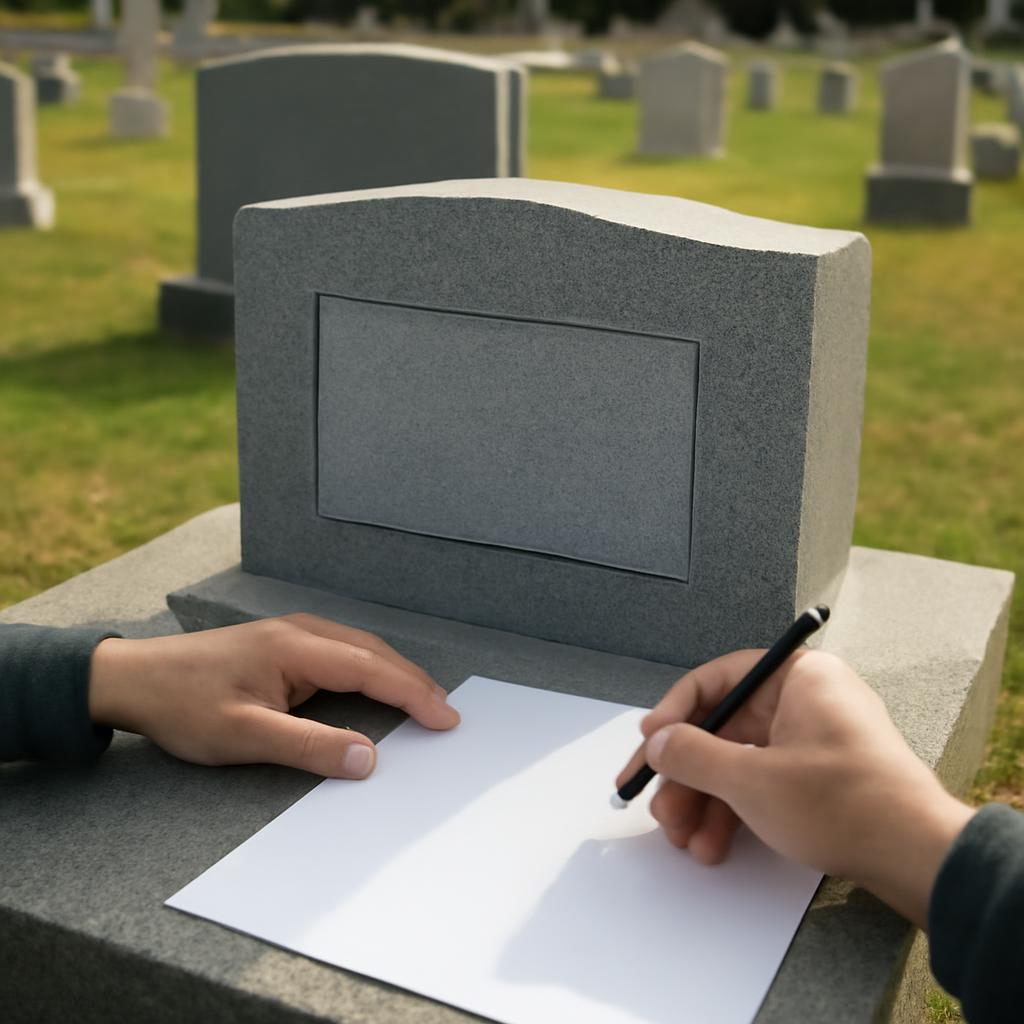
Ordering a cemetery monument is part memorial decision, part compliance exercise. The emotional part is obvious: you are choosing the permanent marker for a grave. The less obvious part is that a granite headstone or marker can be rejected if it does not match cemetery rules for type, size, material, color, base, foundation, placement, or installer. That is why the safest cemetery monument order process starts with the cemetery, not the catalog (US Funerals Online, Memorials.com, Express Monument).
One size benchmark does appear repeatedly in both government and private-market material: 24 x 12 x 4 inches for a flat granite marker. The VA National Cemetery Administration uses that exact specification for its granite and marble flat markers, and US Funerals Online lists 24 x 12 inches as a standard single grave marker size. But repeated is not the same as universal. Private cemeteries may impose their own maximums, minimums, approved colors, material restrictions, and installation rules, so no catalog dimension should be treated as automatically acceptable without cemetery approval (US Funerals Online, Memorials.com, Express Monument).
What follows is a practical guide to cemetery rules, monument styles, granite dimensions, inscription planning, VA options, costs, timelines, and the order details families are most likely to need before production begins.
Related: Funeral Home Pricing: What You Are Actually Paying For.
Check Cemetery Rules Before Ordering Any Monument
The first step is simple and easy to skip: ask the cemetery for its monument regulations sheet before you shop. Multiple guides agree that cemeteries can refuse monuments that do not meet their requirements for size, material, type, placement, foundation, or installer approval (US Funerals Online, Memorials.com, Express Monument, St. Charles Monuments).
Those rules may be narrower than what a monument company sells online. Commercial guides describe upright headstones as commonly 24 to 42 inches tall, but Express Monument says many private cemeteries cap headstone height closer to 18 to 36 inches. That is a good example of why a common catalog size is not the same as an approved plot size (Memorials.com, Express Monument).
Materials and colors can be regulated just as tightly. St. Charles Monuments gives concrete New York-area examples: Mount St. Mary requires a base for upright headstones, while Mount Ararat allows granite only and does not allow black granite (St. Charles Monuments). Those are local examples, not national rules, but they show how specific cemetery policies can become.
A useful first-call checklist looks like this:
| Ask the cemetery | Why it matters |
|---|---|
| What monument types are allowed in this section? | Some sections allow only flat markers, while others permit slants or uprights (US Funerals Online, Memorials.com). |
| What are the minimum and maximum dimensions? | Common sizes may still exceed section limits (Express Monument). |
| Which materials and colors are approved? | Some cemeteries require granite, bronze, or specific colors only (St. Charles Monuments, Lancaster Monument Company). |
| Is a separate base required? | Upright stones often sit on bases, and some cemeteries require them (Memorials.com, St. Charles Monuments). |
| Who may install the stone? | Some cemeteries install monuments themselves; others require approved or insured outside installers (Express Monument). |
| What paperwork is required for approval? | Some cemeteries require more than a simple order confirmation (Express Monument). |
That paperwork can be substantial. Express Monument says approval packages may require scaled drawings, material specifications, foundation details, permits, and sometimes proof of installer insurance before a monument is accepted for installation (Express Monument). If you order first and check second, the risk is not only delay. It can mean redesign charges, storage, return freight, or a second installation trip.
Local monument dealers can help here.
Rules also vary by section, religion, and grave type. Lawn sections, older upright sections, infant sections, and companion plots may all have different standards. On inscription freedom, even anecdotal reports show how wide the range can be: in a Quora discussion, one respondent described a Catholic cemetery with much less room for creative wording than a more free-form cemetery nearby. Treat that as anecdotal color, not policy—but it is one more reason to ask the cemetery what is permitted before approving any design.
Common Types and Styles of Headstones and Markers
Once you know what the cemetery allows, you can choose a style that fits both the plot and the budget. Across monument guides, the main categories are upright headstones, flat or flush markers, slants, bevels, ledgers, and benches (Memorials.com, Memorials.com, US Funerals Online).
Here is the simplest way to think about the main forms:
| Type | What it is | Useful dimension notes |
|---|---|---|
| Upright headstone | Traditional vertical memorial, usually mounted on a base | Commercial guides commonly place uprights around 24 to 42 inches tall and 12 to 36 inches wide (Memorials.com). |
| Flat or flush marker | Marker set level with the ground | A common single-marker benchmark is 24 x 12 inches, and Troost Monument shows flat markers generally ranging from 1 foot 6 inches to 4 feet in length and 4 inches thick (US Funerals Online, Troost Monument). |
| Slant marker | Angled face, lower than a full upright | Often chosen when families want more visibility than a flat marker without a full upright monument (Memorials.com, St. Charles Monuments). |
| Bevel marker | Low raised marker with a slight pitch | Common middle-ground style between flat and more prominent stones (Memorials.com). |
| Ledger | Large stone covering much of the grave surface | Memorials.com describes ledgers as typically 3 to 4 feet wide and 6 to 8 feet long (Memorials.com). |
| Bench memorial | Memorial bench used as both seating and marker | A recognized cemetery style, but permission depends on the section and cemetery rules (Memorials.com). |
These forms may be designed for single, companion, or family use. US Funerals Online and other monument guides distinguish between single markers for one grave and wider companion or family memorials for multiple adjoining plots (US Funerals Online, St. Charles Monuments).
For many families, the choice comes down to three practical factors:
- What the cemetery allows
- How visible the memorial should be
- What the total installed cost will be
Flat markers often fit lawn-section rules more easily because they sit flush with the ground. Troost Monument explicitly notes that some cemeteries require markers to lie flat (Troost Monument). Upright stones offer more visual presence, but they usually involve a base, greater weight, and more installation complexity (Memorials.com, Memorials.com).
As for materials, granite remains the dominant private-market option because it is durable, widely accepted, and available in many colors (Fram Monument, Memorials.com, St. Charles Monuments). Bronze is also common, especially for markers. Memorials.com notes that bronze markers are often mounted on granite bases in private-market memorials, while the VA specification for its flat bronze marker says no base is furnished. That difference matters if you are comparing a government veteran marker with a private monument quote.
Standard Dimensions for Granite Headstones and Markers
There is no single private-cemetery standard for monument dimensions, but there are useful benchmarks that help families compare quotes and understand scale.
Private-market size benchmarks
| Memorial type | Common benchmark dimensions | Notes |
|---|---|---|
| Single flat marker | 24 x 12 inches or 28 x 16 inches | US Funerals Online lists these as common single-grave sizes (US Funerals Online). |
| Flat granite marker thickness/range | Generally 4 inches thick; about 1‘6” to 4‘0” in length | Troost Monument’s flat granite marker range (Troost Monument). |
| Companion marker | 36 x 18 inches or 44 x 14 inches | Common companion examples from US Funerals Online (US Funerals Online). |
| Infant or small cremation marker | 16 x 8 inches | Common small-format example from US Funerals Online (US Funerals Online). |
| Upright headstone | Often 24 to 42 inches tall and 12 to 36 inches wide | Commercial guide range from Memorials.com (Memorials.com). |
| Ledger | Typically 3 to 4 feet wide and 6 to 8 feet long | Memorials.com overview (Memorials.com). |
The most repeated single flat-marker benchmark is still 24 x 12 x 4 inches. That footprint appears in the VA program and in private-market product examples, but it should be treated as a planning reference, not a universal cemetery rule (VA National Cemetery Administration, US Funerals Online).
VA specifications, clearly separated from private-market norms
The VA is useful as a source of exact measurements, but its dimensions are government program specifications, not default private-cemetery standards:
| VA memorial item | Exact VA specification |
|---|---|
| Upright granite or marble headstone | 42 x 13 x 4 inches, about 230 pounds (VA National Cemetery Administration) |
| Flat granite or marble marker | 24 x 12 x 4 inches, about 130 pounds (VA National Cemetery Administration) |
| Flat bronze marker | 24 x 12 inches with 3/4-inch rise, about 18 pounds (VA National Cemetery Administration) |
| Bronze niche marker | 8 1/2 x 5 1/2 inches (VA National Cemetery Administration) |
That separation matters. A VA flat granite marker may happen to match a common private-market size, but families should not assume that a VA specification equals a private-cemetery allowance.
Size affects more than appearance. Larger memorials use more material, typically cost more, may require more substantial foundations, and can trigger higher setting or delivery charges (Fram Monument, Memorials.com). Bigger stones also create more room for additional names, dates, artwork, bronze plaques, or companion layouts—but the cemetery’s approved maximum still controls.
The practical takeaway is straightforward: start with common benchmarks so you can compare options, then replace those rough assumptions with the cemetery’s written limits before production begins.
Granite Options: Colors, Finishes, and Engraving Methods
Granite is the default material in much of the private monument market because it balances durability, engravability, and cemetery acceptance. Several guides describe granite as the most common headstone material and contrast it with marble, which remains traditional but tends to weather more quickly over time (Fram Monument, St. Charles Monuments, Memorials.com).
Common granite colors
Memorials.com lists widely used granite colors such as gray, black, mahogany, blue pearl, imperial red, and emerald green (Memorials.com). Other commercial galleries show additional colors including rose, blue, red, pink, and multiple gray tones (Troost Monument, West Memorials).
Granite color is not just a style choice. It can affect:
- Letter contrast
- Suitability for laser-etched portraits
- Availability and lead time
- Price
- Cemetery approval
HeadstonesDesigner says laser etching is especially suited to black granite because it produces high-contrast grayscale portraits and fine detail (HeadstonesDesigner). At the same time, black granite is not always permitted; St. Charles Monuments gives a cemetery example where black granite is prohibited (St. Charles Monuments).
Common finishes
Monument guides commonly describe three broad finish categories:
- Polished
- Honed
- Thermal / rustic
St. Charles Monuments discusses polished, honed, and thermal finishes, while Memorials.com describes polished, honed, and rustic looks (St. Charles Monuments, Memorials.com). In practical terms, polished faces often provide the strongest contrast and the most formal appearance. Honed or rustic surfaces can create a softer look, but readability can vary depending on stone color and lettering style.
Engraving and image methods
Two methods dominate most granite headstone work:
Traditional engraved or sandblasted lettering. This is the classic cut-letter approach used on many granite monuments. US Funerals Online cites approximately 1/4 inch as a granite inscription depth in one consumer guide, but that figure should be treated only as an example from that source, not a universal standard for all shops or cemeteries (US Funerals Online).
Laser etching. This is commonly used for portraits, landscapes, and fine-detail artwork, especially on polished black granite. HeadstonesDesigner specifically presents laser-etched black granite as the preferred path for photo realism (HeadstonesDesigner).
There is one useful veteran-specific finishing note. The VA specifications page states that Lithichrome shading is used for inscriptions on private-cemetery headstones within that VA program context. That is helpful if you are ordering a VA-furnished marker for a private cemetery. It is not evidence that all private-market granite memorials use Lithichrome.
If you are comparing granite, marble, and bronze, the safest summary is:
- Granite is usually the broadest-acceptance, best all-around option for private cemeteries.
- Bronze is common for plaques and marker programs, especially in veteran contexts.
- Marble remains traditional but is more often described as weathering faster than granite (Fram Monument, St. Charles Monuments, Memorials.com).
Inscriptions: Content Rules, Order Fields, and Design Tips
Most headstone inscriptions begin with the same core information: the deceased’s name, birth date, and death date. Practical guides from US Funerals Online and OM Stone both describe those basics, with optional additions such as an epitaph, quote, scripture, emblem, portrait, or other imagery if the cemetery allows them (US Funerals Online, OM Stone).
A useful way to plan inscription content is to think in layers:
Core inscription content
- Full name as it should appear
- Birth date
- Death date
Optional wording
- Short epitaph
- Religious verse or scripture
- Family saying
- Relationship wording such as “Beloved Mother”
Optional visuals
- Religious emblem
- Decorative border or motif
- Portrait or photo-based image
- Scene, flowers, or other artwork
Those optional elements are widely offered, but approval still depends on the cemetery. OM Stone says cemeteries may set rules on size, material, finish, and sometimes design; HeadstonesDesigner notes that symbols may require cemetery approval; Express Monument says approval packages can involve drawings and specifications before installation is cleared (OM Stone, HeadstonesDesigner, Express Monument).
What order fields are actually evidenced?
This is one area where it helps to be precise. The strongest evidence does not show a single uniform industry order form. What it does show is a recurring set of fields from vendor examples.
A specific example comes from the Upstate Stone Works 24 x 12 x 4-inch granite marker listing on Amazon, which says the included engraving covers First, Middle Initial, Last plus birth and death dates, uses five text inputs, and provides a digital proof in about two business days. HeadstonesDesigner’s workflow adds choices for fonts, shapes, emblems, and photo uploads, while OM Stone describes a design rendering for approval before production (HeadstonesDesigner, OM Stone).
So the safest preparation checklist is not “every vendor asks for these exact fields,” but rather “be ready with these items because vendor examples repeatedly ask for some combination of them”:
| Prepare this before ordering | Why |
|---|---|
| Name exactly as it should be carved | Vendor examples consistently include the name field (Amazon / Upstate Stone Works). |
| Birth and death dates | Included in both consumer guides and vendor examples (US Funerals Online, Amazon / Upstate Stone Works). |
| Any extra wording | OM Stone and Lancaster both discuss epitaphs, sayings, quotes, or scripture (OM Stone, Lancaster Monument Company). |
| Font, shape, or design preference | Available in online design tools (HeadstonesDesigner). |
| Emblem, symbol, or image file | Offered by custom design platforms, subject to approval (HeadstonesDesigner, OM Stone). |
| Contact for proof approval | Many custom orders use a proof or rendering before production (Amazon / Upstate Stone Works, OM Stone). |
Design tips that are well supported
The strongest design advice in the evidence is less about fixed letter measurements and more about process:
- Keep the inscription simple enough to fit the approved stone size.
- Confirm whether the cemetery must approve symbols or artwork.
- Review a proof or rendering before the stone is cut.
- Read every line carefully before final approval.
That last step matters because custom stones are often non-returnable once approved. The Upstate Stone Works Amazon listing states that the customized marker is non-returnable except if damaged or defective (Amazon / Upstate Stone Works).
A practical proof-review checklist:
- Spelling of every name
- Suffixes or initials
- Date format
- Military rank or titles, if included
- Symbol selection
- Layout orientation
- Any omitted wording on companion or pre-need stones
In short, inscriptions are usually straightforward in content but unforgiving in execution. Final approval is the point where families should slow down the most.
VA Headstones, Markers, and Medallions for Private Cemeteries
Veteran memorials follow a separate track from ordinary private-market monument buying, and families should not assume the only option is to purchase a private stone.
The VA National Cemetery Administration lists several government-furnished memorial items, including:
- An upright granite or marble headstone measuring 42 x 13 x 4 inches and weighing about 230 pounds
- A flat granite or marble marker measuring 24 x 12 x 4 inches and weighing about 130 pounds
- A flat bronze marker measuring 24 x 12 inches with a 3/4-inch rise and weighing about 18 pounds
- A bronze niche marker measuring 8 1/2 x 5 1/2 inches
- Veteran medallions in small, medium, and large sizes for private headstones
For private cemeteries, two options matter most.
Government-furnished headstones or markers for unmarked private graves
The VA says it provides headstones or markers for eligible veterans buried in private cemeteries when the grave is unmarked (VA National Cemetery Administration).
Veteran medallions for privately purchased headstones
The VA also offers bronze medallions to affix to a privately purchased headstone or marker in a private cemetery for veterans who served on or after April 6, 1917 (VA National Cemetery Administration). This is often the best fit when a family wants a custom private granite memorial but still wants an official veteran identifier.
Important limits apply:
- The medallion is in lieu of a government headstone or marker, not in addition to both.
- Multiple medallions on one headstone may require local cemetery authorization.
- Certain historic VA headstone types have restricted inscriptions and do not allow an emblem of belief (VA National Cemetery Administration).
The VA also notes that Lithichrome is used for inscriptions on private-cemetery headstones in that program context (VA National Cemetery Administration).
If you are deciding between a private custom stone and a VA memorial benefit, the cleanest comparison is this:
| Option | Best for | Key limitation |
|---|---|---|
| VA government-furnished marker/headstone | Eligible veteran in an unmarked private grave | Must fit VA eligibility and cemetery acceptance rules (VA National Cemetery Administration). |
| Private monument with VA medallion | Family wants a custom stone plus official veteran identification | Medallion is in lieu of a government headstone or marker (VA National Cemetery Administration). |
| Private monument only | Fully custom family memorial | No built-in VA identifier unless a medallion is approved and added. |
The VA page directs families to its burial and memorial benefit application pathways. Even when the VA benefit is available, cemetery coordination still matters because the local cemetery controls installation rules.
Ordering Process, Timelines, Costs, and Installation
A clean monument order usually follows the same sequence across industry guides:
- Get cemetery rules
- Choose an allowed monument type and approved dimensions
- Choose granite color, finish, and design
- Prepare inscription text and any images
- Review and approve a proof or drawing
- Submit for cemetery approval
- Produce, deliver, and install
That general workflow appears across monument guidance from St. Charles Monuments, Lancaster Monument Company, OM Stone, and Express Monument).
A practical order checklist
| Stage | What to gather |
|---|---|
| Cemetery approval stage | Regulations sheet, plot/section details, approved dimensions, installer rules |
| Design stage | Monument type, granite color, finish, shape, emblem/artwork choices |
| Inscription stage | Name, dates, any epitaph or verse, image file if applicable |
| Proof stage | One person designated to approve spelling, dates, layout, and symbols |
| Installation stage | Delivery coordination, setting fee details, foundation responsibility, cemetery permit status |
Timelines: what the evidence supports
Timelines vary more than many families expect.
A simple stock-style flat marker can move relatively fast. The Upstate Stone Works 24 x 12 x 4-inch flat granite marker listing says it usually ships within 4 to 5 weeks, with a proof in about 2 business days (Amazon / Upstate Stone Works).
Express Monument says many outside-vendor orders take 4 to 6 weeks for the stone itself and about 6 to 8 weeks total once approvals and installation are included (Express Monument). Lancaster Monument Company gives a broader range of 6 weeks to 6 months, while noting that many popular colors and sizes can be delivered in 8 to 12 weeks if already in inventory (Lancaster Monument Company). HeadstonesDesigner says standard production often runs 8 to 16 weeks, with some custom work reaching 22 weeks (HeadstonesDesigner).
The most reasonable synthesis is:
- Simple stock flat marker: often around 4 to 5 weeks
- Many standard approved orders: around 6 to 8 weeks total
- Custom granite work: often 8 to 16 weeks
- Complex or unusual custom work: sometimes several months
Costs: stone price versus installed price
Headstone costs are easiest to understand in two layers:
- The memorial itself
- Everything required to set it
Fram Monument places common private-market price ranges at roughly $200 to $1,500 for flat markers and $1,500 to $6,000+ for upright headstones, with highly customized work exceeding $10,000 in some cases (Fram Monument). St. Charles Monuments gives similar broad guidance, placing flat markers around $500 to $1,500 and uprights around $1,500 to $5,000+ (St. Charles Monuments).
Then come the additional charges:
- Foundation work
- Setting fee
- Delivery
- Permit fee
- Inspection or approval fee
- Upright base charge
- Artwork or extra lettering
- Cemetery coordination
Memorials.com says cemeteries may charge $300 to $800 as a setting fee for outside suppliers (Memorials.com). Fram Monument likewise advises families to confirm whether a quote includes engraving, delivery, foundation, installation, and cemetery coordination (Fram Monument).
A single vendor example shows how quickly the total can rise: HeadstonesDesigner displays a 24 x 24-inch black granite upright example at $2,565.95, plus a separate base of $848, for an illustrated total of $3,563.95 including shipping in that example (HeadstonesDesigner). That is not a market average. It is simply a useful reminder that “stone price” and “installed price” are not the same number.
Installation logistics
Families do not usually handle the lifting or setting themselves, but it helps to know what installation may involve. Express Monument says granite installations can require crane trucks or vacuum lifters, and that concrete may need 24 to 48 hours of cure time depending on the foundation arrangement (Express Monument). The key coordination question is whether the cemetery or the monument company is responsible for the actual setting.
Budgeting beyond the monument
If you are working on the full burial budget, the monument is only one line item. Our guide to cremation vs. burial: a practical comparison notes that a conventional funeral with viewing, ceremony, casket, cemetery plot, vault, and opening/closing fees typically runs $7,000 to $12,000, with metropolitan cemetery plots often $2,000 to $6,000 and opening/closing fees another $1,000 to $2,000. For the separate funeral-home side of the budget, see our guide to funeral home pricing and what you are actually paying for.
Two final buying notes matter:
- Customized stones may be non-returnable once approved, as shown in the Upstate Stone Works listing on Amazon (Amazon / Upstate Stone Works).
- Insurance coverage is not automatic. US Funerals Online says a homeowner’s policy may cover accidental marker damage up to about $5,000, but that is policy-specific and should be verified with the insurer before anyone relies on it (US Funerals Online).
The safest summary is still the simplest one: start early, get cemetery approval in writing, approve the proof carefully, and ask for a quote that clearly separates the stone from the base, foundation, setting, delivery, and permit costs.
What are the most common dimensions for a single flat granite marker?
A widely repeated benchmark for a single flat granite marker is 24 x 12 x 4 inches. The VA National Cemetery Administration uses that exact size for its granite and marble flat markers, and US Funerals Online lists 24 x 12 inches as a standard single grave marker size, with 28 x 16 inches as a larger single-marker option. It is a common planning size, not a universal cemetery rule.
Do all cemeteries allow upright granite headstones?
No. Cemeteries often regulate monument type, height, material, color, base, foundation, and installer approval. Commercial guides describe upright stones as common, but Express Monument says many private cemeteries cap headstone heights at 18 to 36 inches, and St. Charles Monuments gives local examples of a cemetery requiring a base for upright stones and another allowing granite only while banning black granite (Express Monument, St. Charles Monuments, Memorials.com).
What fields are typically required on a headstone order form?
The clearest recurring fields in the evidence are the deceased’s name and birth and death dates. A specific vendor example, the Upstate Stone Works flat marker listing on Amazon, says its included engraving covers First, Middle Initial, Last plus dates and uses five text inputs. More customizable tools such as HeadstonesDesigner also allow font, shape, emblem, and photo choices, and OM Stone describes a proof-rendering approval step. So the safest answer is: expect basic identity and date fields, and be ready for optional design, symbol, image, and proof-approval fields depending on the vendor and cemetery.
How long does it take to get a custom granite headstone installed?
It depends on customization and cemetery approval. A relatively simple stock flat marker may ship in 4 to 5 weeks, according to the Upstate Stone Works Amazon listing. Express Monument says many orders take 4 to 6 weeks for production and about 6 to 8 weeks total including approval and installation (Express Monument). For custom work, HeadstonesDesigner says 8 to 16 weeks is common, with some orders reaching 22 weeks, and Lancaster Monument Company says some memorials can take 6 weeks to 6 months.
Are VA markers available for private cemetery graves?
Yes, for eligible veterans. The VA National Cemetery Administration says it provides government-furnished headstones or markers for eligible veterans buried in private cemeteries when the grave is unmarked. It also offers bronze medallions for privately purchased headstones or markers in private cemeteries for veterans who served on or after April 6, 1917. The medallion is in lieu of a government headstone or marker, not in addition to both.