
20 min read ·
A Preservation-First Guide to Caring for a Granite Memorial
First, obtain authorization, confirm that the marker is granite, and inspect it for damage. Then begin with abundant clean water and soft tools.
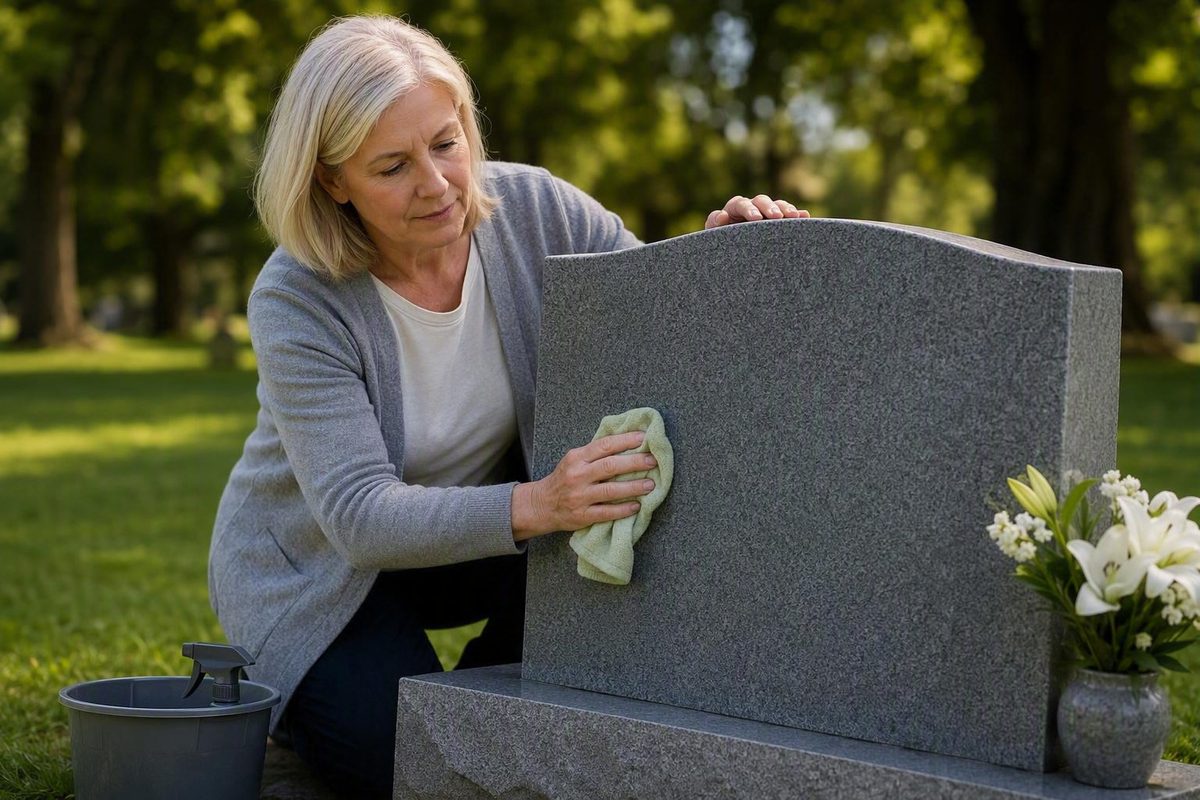
The safest answer to how to clean granite grave markers is straightforward: obtain authorization, confirm that the marker is granite, inspect it for damage, and begin with abundant clean water and soft tools. Do not proceed if the stone moves, sheds material, has significant cracks, or contains materials or finishes whose compatibility is uncertain.
The goal is not to make an old memorial look new. It is to improve legibility or remove justified deposits while preserving the stone, inscription, finish, and evidence of age.
Before You Clean: Permission, Stone Identity, and the Purpose of the Work
Contact the cemetery, church, burial-ground authority, or marker owner before bringing water or cleaning products onto the site. FamilySearch likewise advises obtaining permission and checking the marker’s condition before cleaning in its headstone-cleaning guidance.
This procedure applies only to a memorial known to be granite. It is not suitable for marble, limestone, sandstone, concrete, cast stone, bronze, or an unidentified material. If cemetery records, purchase documents, or a monument company cannot confirm the material, seek professional identification.
Even a confirmed granite memorial may not consist entirely of bare granite. Before cleaning, note every distinct surface and component:
- Polished, honed, and rough-textured granite
- Incised, sandblasted, raised, or recessed lettering
- Painted or gilded inscriptions
- Ceramic or photographic portraits
- Bronze plaques, pins, bolts, vases, or other metal attachments
- Mortar joints and seams
- Filled cracks and previous repairs
- Applied coatings or sealants
- Bases made from another stone or material
These areas may respond differently to water, brushes, and cleaners. If the compatibility of an attachment or decorative finish is unknown, leave it untreated and consult the cemetery, monument maker, or a stone conservator.
Next, decide why cleaning is necessary. Ordinary soil that obscures an inscription may justify limited work. So may biological growth that prevents a name or date from being read. Patina, mild color variation, old staining, and weathering are different: they may be stable evidence of age best left alone.
The National Park Service advises using the gentlest possible means and warns that even careful cleaning can roughen a surface, remove original material, accelerate deterioration, or erode inscription detail. The purpose should never be to make a marker look new (NPS cemetery-preservation guidance).
Set a narrow goal before beginning. Appropriate goals might include:
- Remove loose soil from the polished face.
- Make the surname easier to read.
- Determine whether water alone loosens a thin surface film.
- Remove detached debris without disturbing the finish.
Avoid goals such as whitening the stone, restoring its original shine, eliminating every stain, or producing a uniformly bright finish. Those objectives encourage excessive cleaning.
Take clear, dated photographs before treatment. Photograph the full memorial, every safely accessible side, the base, lettering, attachments, cracks, stains, repairs, and biological growth. Add a brief condition note recording:
- The date and weather
- The apparent type of soiling
- Existing damage or movement
- Areas intentionally left untreated
- Visible paint, gilding, repairs, joints, coatings, or attachments
This record provides a basis for comparison after the granite dries. It also helps future caretakers distinguish new deterioration from an old condition and decide whether another cleaning is necessary.
The Go-or-No-Go Inspection: When Not to Clean
Inspect the memorial from every safely accessible side without leaning on it, pushing it, pulling it, or trying to straighten it. Do not assume a large granite marker is secure merely because it is heavy. A failed foundation, shifted base, open joint, or loose pin can make it unstable.
Do not clean the marker yourself if you find any of these stop signs:
- Leaning, rocking, movement, or an insecure base
- Loose plaques, caps, vases, panels, or other components
- Large cracks or numerous smaller cracks
- Open joints or separated sections
- Flaking, spalling, or separating surface layers
- Powdery, crumbly, or “sugary” areas
- Grit or grains shedding from the surface
- Failed, loose, or discolored repairs
- Areas already known to be detached or hollow
- Lettering or decoration that is lifting, friable, or being lost
- Significant impact damage or missing structural pieces
Chicora Foundation’s preservation guidance says not to proceed with unstable stone and directs cleaners to stop if a marker flakes, spalls, produces grit, or otherwise appears unstable during treatment (Chicora cemetery-cleaning guidance).
Wetting can carry water and debris into cracks or open joints. Brushing may detach loose grains, flakes, paint, repair material, or inscription details. Working beside a leaning or moving marker can also create a tipping hazard. Do not attempt to stabilize the marker with your body or tools.
Do not tap a fragile memorial merely to test whether it sounds hollow. If damage or instability is already apparent, the inspection is complete: stop.
Age and significance also matter. Granite is generally durable, but a very old or historically important memorial requires an individualized assessment. A method suitable for an intact modern marker may be inappropriate for an older monument.
The no-go decision continues throughout cleaning. Stop work immediately if:
- Grit appears in the runoff or collects on a brush
- A flake or fragment loosens
- The marker shifts or rocks
- A crack becomes visible or appears to open
- Lettering, paint, gilding, coating, or repair material is affected
- The surface becomes rough, blotchy, sticky, unusually dull, or otherwise changes unexpectedly
- A joint begins releasing material
- An attachment becomes loose
Do not continue merely to finish a section. If gentle rinsing can be completed without disturbing the marker, rinse away loose material, document the change, and seek professional advice.
Damaged, unstable, unusually old, coated, painted, gilded, repaired, or mixed-material memorials should be assessed by a qualified stone conservator or monument professional familiar with cemetery preservation—not simply a general exterior-cleaning contractor. Ask specifically about experience with historic stone, inscriptions, attachments, repairs, and low-impact testing.
Cleaning is not restoration. Resetting a leaning marker, filling cracks, repointing joints, recoloring letters, replacing pins, removing coatings, polishing a face, reattaching fragments, and treating structural movement are outside this DIY procedure. These tasks require diagnosis and compatible repair materials, not a stronger cleaner.
Weather, Water, and a Minimal-Risk Supply List
For stable granite with ordinary dirt, clean potable water is the default cleaning liquid. Distilled water is an optional conservative choice where practical, but it is not the only water that can be used. The water must be clean and available in sufficient quantity to saturate the surface, rinse tools repeatedly, and remove all loosened material or cleaner.
Bring:
- Ample potable water in clean containers
- Clean buckets reserved for this work
- A hand-pump sprayer capable of producing a gentle mist
- Several soft-bristle brushes
- A small, soft brush for broad recessed lettering
- Soft, clean cloths
- Non-abrasive sponges
- Wooden craft sticks or plastic tools for limited use on demonstrably sound granite
- Gloves appropriate to any labeled product
- Eye protection
- A camera or phone
- A notebook or condition form
- Bags or containers for carrying soiled tools away
Choose brushes that flex readily and do not scratch the surface. A polished face deserves especially gentle handling because scratches and changes in gloss are more visible there. Do not use a metal dental tool, knife, screwdriver, wire brush, stiff masonry brush, or abrasive pad to clean lettering.
A pump sprayer set to mist can make initial wetting easier and help keep a working area damp. It is not a pressure washer and does not make high-pressure spraying acceptable. Apply water gently enough that it does not dislodge material, flood joints, or splash neighboring memorials.
Do not begin if you have enough water for brushing but not for complete rinsing. Postponing the work is safer than rationing the final rinse.
Check the forecast. Postpone wet cleaning if freezing is expected within the next 24 to 48 hours. Water retained in cracks, crevices, joints, or porous repairs can freeze and expand. FamilySearch also advises postponing cleaning during extreme temperatures or when freezing is possible.
Avoid cleaning when the granite is very hot or during other temperature extremes. Rapid evaporation makes it difficult to keep the surface continuously wet and can produce uneven results. It is prudent not to apply cold water abruptly to very hot granite, but that does not mean cold water will necessarily crack every hot, sound marker. Wait for a cooler, moderate period instead.
Plan for runoff before starting. Do not direct muddy water onto neighboring monuments. If a cleaner or biocide is used, keep runoff away from plants, drains, waterways, and adjacent graves as required by the current product label and cemetery rules. If adequate control is not possible, do not use the product.
Step by Step: The Water-First Method for Stable Granite
Use this procedure only when permission has been secured, the memorial is confirmed as granite, and the marker has passed the stability inspection.
1. Confirm the plan before unpacking
Review the cemetery’s permission, weather conditions, water supply, and specific cleaning goal. Photograph the marker and repeat the condition inspection. Changing light and close examination may reveal cracks or loose components that were not obvious earlier.
Identify which parts are safe to wet. Avoid painted lettering, gilding, portraits, failed repairs, coatings, open joints, and mixed-material attachments unless their treatment has been specifically approved.
2. Remove only loose debris
Pick up loose leaves and detached twigs by hand. Gently lift away soil resting against the base without digging beneath it or disturbing the foundation.
Do not dry-scrub the granite. Dry brushing can drag grit across a polished face or disturb a weathered surface. Do not pull vines, roots, moss, or other material attached to the memorial.
3. Saturate the granite with clean water
Wet the safe treatment area thoroughly with a gentle stream or mist. Allow the water to remain on the surface briefly before brushing. Pre-wetting helps loosen ordinary soil and reduces uneven absorption if a compatible cleaner is later found to be necessary.
A light spritz is not necessarily saturation. The surface should be evenly wet, including sound recessed letters and textured areas, without directing water into open joints or damaged features.
4. Keep the working area wet
Continue adding water as you work. Do not allow loosened soil to dry back onto the granite. If sun or wind makes the surface dry faster than you can clean and rinse it, stop and return under better conditions.
Work in manageable sections. The active section—and preferably the surrounding face—should remain wet throughout brushing.
5. Brush gently in small areas
Use a soft-bristle brush with light pressure. Begin at the bottom and work upward in small sections, a method described in both FamilySearch and Chicora guidance to help limit downward streaking. Use gentle circular or overlapping motions rather than forceful back-and-forth scrubbing.
Let water and repeated light passes do the work. If the brush bends sharply, catches on inscription edges, or requires substantial force, reduce the pressure. A very soft brush or cloth may be appropriate for a polished area, while a textured face may need a soft brush to reach shallow recesses.
Do not chase a sharp boundary between cleaned and aged areas. The aim is controlled soil removal, not a dramatic before-and-after contrast.
6. Rinse brushes frequently
Rinse the brush in clean water after each small area. Change the bucket water when it becomes cloudy or gritty, or switch to another clean brush.
Keep brush-rinsing water separate from the clean supply used on the marker. Never dip a dirty brush, sponge, or cloth into the final-rinse container.
7. Treat inscriptions cautiously
Use a small, soft brush for broad, sound recessed lettering. Apply minimal pressure and follow the shape loosely rather than forcing bristles into every narrow cut. Never use a metal pick or knife to excavate compacted material.
Leave stubborn deposits in place if removal would require levering, picking, or repeated hard scrubbing. Painted, gilded, friable, or heavily weathered letters must not be treated as bare granite.
8. Rinse completely from top to bottom
Rinse each section after cleaning it. When the safe treatment area is complete, rinse the full marker from top to bottom with abundant clean water. Continue until loosened soil is gone and the runoff no longer carries visible residue.
Pay particular attention to ledges, the tops of letters, shallow carvings, and the junction between the upright stone and base, where dirty water may collect. Do not direct water into an open joint in an attempt to flush it.
9. Allow the marker to dry before judging it
Let the granite dry naturally before evaluating the result.
Granite can look darker while wet because moisture changes how light interacts with the surface. Depending on the stone and conditions, it may take hours—and sometimes longer—to return to its dry appearance, as noted in Kulinski Memorials’ granite-cleaning guide.
Do not interpret temporary darkening as a stain requiring immediate retreatment. Wait until the marker is fully dry, compare it with the original photographs, and reassess.
If water and gentle brushing improve legibility but leave harmless discoloration, stop. A partly stained but undamaged marker is a better result than a uniformly bright one achieved through excessive pressure or chemical treatment.
When Water Is Not Enough: Testing a Stone-Compatible Cleaner
Cleaner use is an escalation, not the starting point. Water alone is often sufficient for loose soil and ordinary surface dirt. Introduce a product only when you can identify what remains and explain why further cleaning is justified.
If a cleaner is needed, look for a verified stone-compatible, neutral-pH non-ionic cleaner appropriate to the deposit and finish. At minimum, the product should have:
- Explicit directions for use on natural stone or granite
- Complete technical and safety documentation
- A stated application method and dilution, if dilution is required
- Directions for contact time, rinsing, and protective equipment
- Compatibility with the identified soil and surface finish
Terms such as “mild,” “natural,” “all-purpose,” or “safe for outdoor use” do not establish compatibility with a memorial. If the label and technical documentation do not clearly identify an appropriate use, do not apply the product.
Household dish soaps are not universally safe. Some commercial granite-marker guides recommend small amounts, while preservation-oriented guidance favors water or an identified non-ionic stone cleaner.
Advice about glass cleaner also conflicts. Some commercial sources permit it on polished granite, while other guidance warns against household chemicals or unspecified formulations. That disagreement is sufficient reason not to use glass cleaner as a preservation-first default.
Use this test-patch protocol for any proposed cleaner:
- Read the current label and safety documentation. Confirm that the product is intended for the substrate, finish, and type of soiling.
- Confirm cemetery permission. Verify that the product is allowed and that runoff can be controlled as directed.
- Choose a small, inconspicuous area. Do not start with the inscription, portrait, polished focal area, repair, or decorative finish.
- Pre-wet if directed.
- Use only the labeled dilution. Never improvise a stronger concentration.
- Observe the labeled contact time. Keep the area wet if directed and do not allow the cleaner to dry on the granite.
- Rinse completely.
- Allow the test area to dry fully.
- Inspect it in comparable light. Look for discoloration, residue, altered gloss, roughness, affected lettering, tide marks, or another unexpected change.
Testing, complete rinsing, and evaluation after drying are central precautions in preservation guidance. If any adverse change appears, do not use the product elsewhere. Photograph the result and seek professional advice if the alteration persists.
During broader treatment, continue working in small sections. Keep the surface wet as directed, prevent cleaner from reaching incompatible attachments, and rinse repeatedly until no residue remains. Wear the protective equipment specified on the label.
There is no universal soap-to-water ratio suitable for every product, finish, and memorial. Follow the current manufacturer’s directions rather than copying a dilution intended for another formulation.
A persistent stain is not permission to increase the concentration, extend contact time beyond the directions, scrub harder, or repeat treatments in rapid succession. Rust, mineral crusts, paint, sap, graffiti, hard-water deposits, and unidentified discoloration may require different chemistry and careful isolation. Stop and obtain a professional diagnosis.
Moss, Algae, Lichen, and Vines Require a Different Decision Path
Biological growth is not the same as loose soil. Algae may form a thin film, moss can retain substantial moisture, lichen may be tightly attached, and vines or rooted plants can enter joints or wrap around components. Although growth can obscure inscriptions, removing it from a weakened surface may pull away original material.
For vines and attached plants, do not pull. Cut the growth at or near its base without striking the marker, then cut long sections to reduce their weight. Allow the plant to die back. Remove remnants gradually and only when they release without levering against the stone. Do not excavate roots beneath a base or disturb the foundation.
On demonstrably sound bare granite, a small wooden or plastic tool softer than the stone may sometimes help lift growth already loosened by water. Keep the tool nearly parallel to the surface and use very little force.
Do not scrape:
- Across fragile or shallow inscriptions
- On painted or gilded lettering
- On flaking, spalling, powdery, or gritty areas
- Along cracks or open joints
- Across coatings or repairs
- Near portraits or metal attachments
- On material not confirmed as granite
If gentle water cleaning does not address biological growth, consider a compatible biocide as a separate treatment rather than scrubbing harder. Chicora Foundation and FamilySearch discuss D/2 Biological Solution for cemetery biological growth. This is an attributed recommendation, not proof that D/2 is the only acceptable product or that it is compatible with every memorial.
Before using any biocide, obtain cemetery approval and read the current product label and safety documentation. Follow the current requirements for dilution, protective equipment, application, contact time, keeping the surface wet, reapplication, rinsing, storage, and runoff. Do not substitute a fixed formula from an older web article for the current label.
Biological treatments may take days or weeks to show their full visual effect. Delayed change can be normal and is not, by itself, a reason for aggressive same-day retreatment.
Stop immediately if removal produces grit, stone grains, flakes, inscription material, paint, repair fragments, or another sign that growth is attached to an unstable surface. Heavy lichen, extensive rooted vegetation, historic memorials, and uncertain surfaces should be referred to a conservator.
Products and Methods to Avoid—and the Damage They Can Cause
Granite’s durability does not make it invulnerable. The National Park Service warns against bleach, strong acids and bases, wire brushes, pressure washing, sandblasting, sanders, grinders, and other harsh methods because cleaning can remove original material and erode inscriptions.
| Do not use | Principal risk |
|---|---|
| Bleach or chlorine cleaners | Discoloration, residue, alteration of stone or attached materials, and harm to nearby vegetation |
| Strong acids or bases | Etching, roughening, discoloration, and chemical alteration |
| Vinegar, lemon cleaner, or acidic stain removers | Etching or changes to the surface and finish |
| Ammonia or unspecified household cleaners | Variable formulations, uncertain compatibility, residue, and finish changes |
| Shaving cream | Residue entering pores and inscriptions; it is not an appropriate reading aid |
| Baking soda or abrasive powders | Scratching, roughening, and gradual loss of detail |
| Scouring pads, stiff brushes, or wire brushes | Visible scratches, altered polish, and erosion of inscriptions |
| Metal picks or scrapers | Gouging, chipped letter edges, and removal of original material |
| Sanders, grinders, drills, or rotary tools | Irreversible loss of the surface and carved detail |
| Pressure washers or high-pressure sprays | Erosion, detachment of weak material, water forced into joints, and movement of loose components |
| Sandblasting | Rapid removal of the original surface and inscription detail |
| Wax or polish | Uneven gloss, trapped dirt, residue, and difficult future removal |
| Impermeable coatings or unapproved sealants | Altered moisture behavior, staining, peeling, and concealed deterioration |
Do not interpret the absence of a stated pressure limit as permission to find a supposedly safe pressure-washer setting. Marker condition, nozzle type, distance, finish, joints, repairs, and attachments all affect the result. Pressure washing is not part of preservation-first DIY cleaning.
Rust, mineral crusts, hard-water marks, paint, graffiti, tree sap, deep discoloration, and unknown deposits should not be treated with a generic recipe. Photograph the condition, record its location and apparent source, and obtain advice from a conservator or monument specialist.
Likewise, do not use wax, polish, oil, or sealer to restore shine. Recarving, recoloring, or tracing faded letters with paint, chalk, marker, flour, shaving cream, or other material is not cleaning.
The safest response to a resistant deposit is often to leave it. Preservation work succeeds when it removes only what can be removed safely—not when it removes everything visible.
Aftercare, Cleaning Frequency, and When to Hire a Professional
Once the marker is dry, compare it with the initial photographs under similar lighting. Record:
- The cleaning date
- Weather and approximate surface conditions
- Areas treated and intentionally left untreated
- Tools used
- The complete product name, if any
- The labeled dilution and contact time used
- Changes observed during or after treatment
- Remaining stains or growth
- Any recommendation for professional assessment
Photograph the same full views and close-ups taken before treatment. This documentation is more useful than memory, especially when several relatives or volunteers care for the same burial ground.
Cleaning frequency should be condition-based. Do not adopt a quarterly, semiannual, annual, or multiyear schedule simply because a general or commercial guide recommends one. Clean only when visible need, marker condition, and cemetery permission justify intervention. Each cleaning involves contact and water, and repeated cosmetic cleaning can gradually roughen a surface or reduce inscription clarity.
For historic markers, the National Park Service says they should, when possible, not be cleaned more than once per year. Treat that as a maximum ceiling, not an annual appointment. A stable, legible memorial may need no cleaning for much longer (NPS guidance).
These variables do not support a precise climate-specific calendar. Monitor the marker through photographs and clean only when its condition supports intervention.
Seek professional assessment for:
- Leaning, rocking, or other movement
- Structural cracks or open joints
- Flaking, spalling, powdering, or grit loss
- Failed or unidentified repairs
- Uncertain stone identity
- Very old or historically significant markers
- Painted or gilded details
- Ceramic portraits
- Metal attachments or rust staining
- Coatings, sealants, or altered finishes
- Heavy lichen or rooted growth
- Persistent or unidentified stains
- Graffiti, paint, mineral crusts, or hard-water deposits
- Any work involving resetting, repair, polishing, or recoloring
When evaluating a professional, ask how the marker will be assessed before treatment. Request the names of proposed products, how dilution and contact time will be controlled, what tools or water pressure will be used, how adjacent materials and plants will be protected, and whether a small test area will be completed and allowed to dry first. Ask for examples of comparable cemetery work, particularly if the marker is historic or contains mixed materials.
Be cautious if the proposed plan begins with pressure washing, promises to make the memorial “like new,” or fails to distinguish cleaning from repair. A credible plan should account for the stone’s condition, finish, inscriptions, attachments, runoff, and the possibility that some discoloration should remain.
A safely cleaned marker may still show age, patina, color variation, or stubborn staining. That is not failure. Legibility and preservation take priority over brightness, gloss, and a new-looking surface.
The final decision rule is simple: proceed only when permission is secured, the material is confirmed as granite, the marker is stable, and weather conditions are suitable. Begin with water and soft tools. Use a tested, stone-compatible cleaner only for a defined need, and stop at the first sign of material loss or instability. An aged or mildly stained result can still be successful if the memorial remains intact.
Can I use dish soap to clean a granite grave marker?
Do not assume dish soap is universally safe. Commercial guidance varies, and household formulations may contain dyes, fragrances, oils, salts, moisturizers, or other additives. Water alone should be the first treatment for ordinary dirt.
If water is insufficient, select a stone-compatible, neutral-pH non-ionic cleaner with explicit directions for the identified stone, finish, and deposit. Test it in an inconspicuous area, follow the labeled dilution and contact time, rinse completely, and let the test dry before expanding treatment. Do not use a universal soap-to-water ratio copied from directions for another product.
Can I use bleach, vinegar, ammonia, baking soda, or glass cleaner on granite?
Avoid bleach, vinegar and other acids, ammonia, baking soda, and abrasive cleaners. They may discolor, etch, roughen, scratch, alter finishes, or leave residue on the memorial and its attached materials.
Glass cleaner belongs in a different category: guidance conflicts, with some commercial sources permitting it on polished granite and others warning against household formulations. Because ingredients and finishes vary, glass cleaner is not a preservation-first default. Use water for ordinary cleaning and an identified stone-compatible cleaner only for a defined need.
Is it safe to remove lichen with a wooden or plastic scraper?
Only in limited circumstances. On confirmed, structurally sound bare granite, a wooden or plastic tool may help lift growth already loosened by water. Keep the tool nearly parallel to the surface and use minimal force.
Do not scrape a weakened inscription, painted or gilded area, repair, coating, crack, flaking surface, or unidentified material. Stop if the tool produces grit, flakes, stone grains, paint, or inscription material. Heavy lichen or an uncertain surface requires professional assessment.
How often should a granite grave marker be cleaned?
Clean according to visible need and condition, not a fixed calendar. Use photographs to monitor the memorial and avoid cleaning automatically on every visit.
For historic markers, the National Park Service’s once-per-year limit is a ceiling rather than a recommendation to clean annually. A stable, legible marker may go much longer without treatment.
Why does granite look darker after it gets wet?
The effect can remain for hours while the marker dries; commercial granite-marker guidance notes that the natural dry appearance may not return immediately.
Wait until the granite is fully dry before judging the result or deciding whether another treatment is necessary. Temporary darkening is not a reason to apply a stronger cleaner.