
5 min read ·
Choose a Cremation Marker That Fits the Grave and Budget
Check cemetery rules before ordering a flat cremation marker. Compare ordinary and vessel-equipped designs, dimensions, approval steps and installed costs.
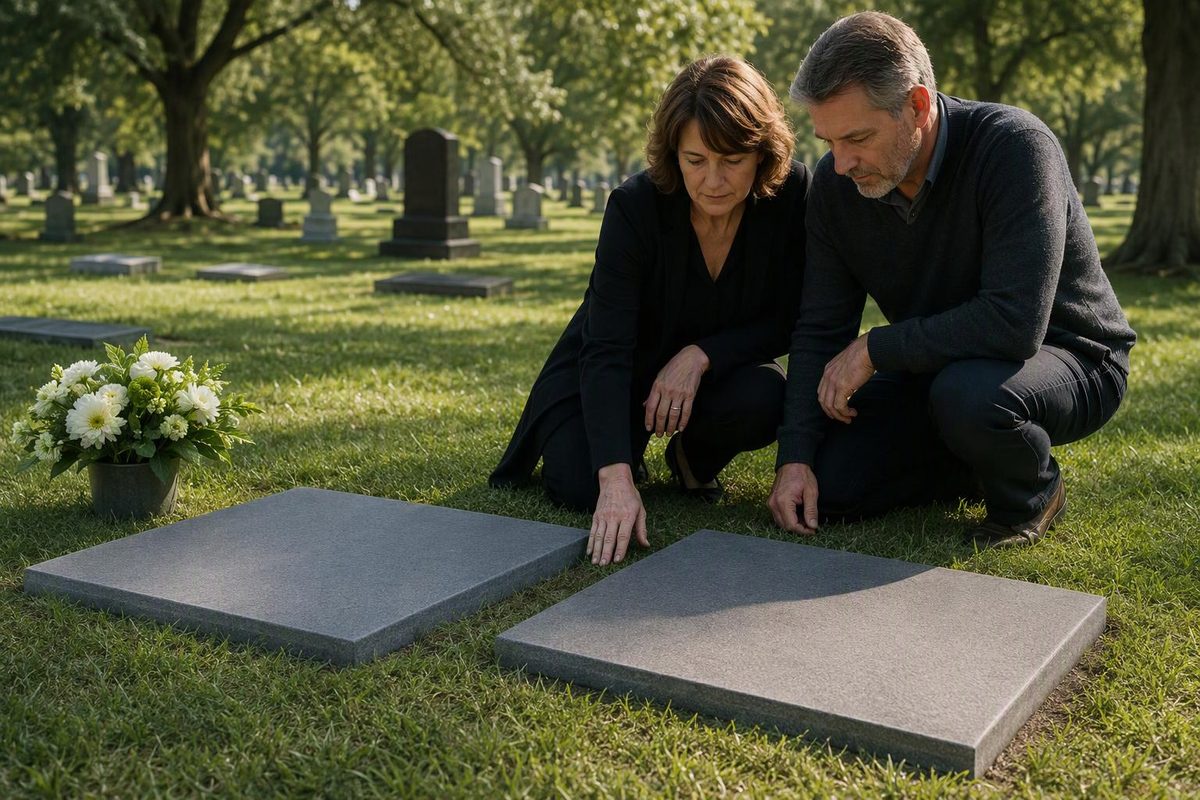
Cremated remains can be buried in a grave identified by an ordinary flat grave marker. You do not necessarily need a special “cremation headstone.” Most ordinary markers identify the burial location; they do not hold the ashes. Before paying, get approval for the marker’s design, dimensions and materials from the cemetery responsible for the exact section and grave.
Choose the placement, marker type and approval status to see your next step.
Marker Approval Check
An Ordinary Marker Can Identify the Grave
Ask for written approval of the dimensions, materials, base and installation arrangements for the exact section and grave.
The marker does not include an urn or burial container. Arrange an approved container separately.
Sources: VA marker types, Trigard cremation memorial descriptions, and the Taunton and Apopka cemetery rules cited in the article. This check does not grant cemetery approval.
Ordinary Markers Identify the Grave; Vessel Models Also Hold Remains
An ordinary flat grave marker carries the person’s name, dates and any approved inscription. Arrange the urn or other cemetery-approved burial container separately; do not assume the marker includes one.
A cremation memorial with an integrated vessel combines the memorial with a container for remains. Trigard, for example, sells bronze memorials with a sealed in-ground cremation vessel, including a companion model intended to hold two sets of remains. This is a feature of those specific products, not of every flat marker. Trigard’s product description explains the arrangement.
For a vessel-equipped memorial, ask the cemetery to approve the complete assembly—not just the visible plaque. Confirm the vessel’s capacity, installation method and how a later companion burial would be handled. A product advertised for cremated remains may still be unsuitable for that grave.
If the remains will be placed in a columbarium niche rather than buried in the ground, ask about the niche’s inscription or plaque requirements instead. The VA, for example, offers a separate bronze niche marker rather than using its standard flat grave marker. VA marker types show the distinction. Our guide to interment, burial and inurnment explains the placement terms.
The Cemetery Sets the Size and Material Rules
There is no single marker size to order simply because the remains were cremated. The specifications must fit the cemetery section and grave, including any required foundation.
A 24-by-12-inch marker is one established option: VA flat granite and marble markers measure 24 by 12 by 4 inches. Those are VA product dimensions, not a nationwide cemetery requirement.
Local rules differ. Taunton, Massachusetts, requires ordinary flat markers to be natural stone, 24 by 12 by 4 inches, and even with the sod, with stated exceptions. It also permits one flat marker to identify multiple people buried in the same grave, including cremation burials. Taunton’s marker rules apply there, not to every cemetery.
Apopka, Florida, restricts its cremation section to ground-level markers and publishes a maximum cremains marker size of 40 by 28 inches, along with other material and minimum-size requirements. These are local specifications, not dimensions to copy for another cemetery. Apopka’s rules give the section-specific requirements.
Request written answers for the exact grave:
| Requirement | What to Confirm |
|---|---|
| Marker specifications | Material, dimensions, thickness and finish |
| Placement | Whether the marker must sit flush with the ground |
| Base or foundation | Required construction and overall footprint |
| Added features | Permission for a vase, portrait, emblem or integrated vessel |
| Shared grave | Permitted burials, markers and names |
| Supplier and installer | Whether an outside seller is accepted and who may install |
For a shared grave, settle the number of permitted burials before choosing a single-name or companion design. Leave space for future names and dates only after confirming that those later placements are allowed. A marker with room for two names does not itself establish permission for two burials.
Compare the Installed Cost, Not Just the Marker Price
Rome Monument, a Pennsylvania-based seller, advertises basic flat markers at $300–$1,200 in October 2026, with price affected by size, granite color and design complexity. This is one seller’s advertised range—not a national average or a complete cemetery burial quote. Confirm the inclusions for your exact design and location. Rome Monument’s basic marker pricing supplies that range.
The cited pricing does not establish a typical total installed cost or a price for a vessel-equipped memorial. Request an itemized quote rather than treating the advertised marker price as the final bill.
| Charge | What to Clarify |
|---|---|
| Marker and inscription | Material, size, names, dates, artwork and included lettering |
| Base or foundation | Whether required and included |
| Shipping and delivery | Destination, unloading and responsibility for damage |
| Installation | Who sets the marker and what the cemetery charges |
| Permit or approval fees | Any separately billed cemetery requirements |
| Future inscription | Cost and method for adding a name or date later |
Keep the cemetery space, opening and closing of the grave, and any required urn container separate from the marker comparison. If a seller or cemetery offers a package, ask which of these charges it includes.
For an eligible veteran, check VA benefits before purchasing. The VA can provide a government headstone or marker at no charge under its eligibility rules, but private-cemetery placement costs remain the applicant’s responsibility. A VA bronze flat marker does not include its base. See the VA benefit terms and the marker specifications linked above.
Approve the Drawing Before Authorizing Production
Have the cemetery approve the seller’s drawing, dimensions and materials. For an integrated-vessel design, that approval should cover the vessel and installation arrangement as well as the plaque.
Then check every name, date and inscription on the final proof. Obtain the seller’s correction, cancellation and delivery terms in writing before authorizing production.
Ask for separate estimates for production, delivery and cemetery installation. A finished marker may not be installed immediately: Taunton, for example, publishes seasonal foundation-work restrictions in its marker rules. Do not treat the seller’s completion estimate as the cemetery’s installation date.
Send the cemetery the section and grave number with a request such as:
We are arranging a flat marker for cremated remains. Please send the permitted dimensions, materials, base requirements, approval process and installation charges for this grave. We are considering an outside supplier; please confirm whether that is allowed and whether the proposed marker can accommodate a future name.
Once you have those answers, ask two sellers to quote the same approved specifications. Compare the complete installed memorial, including any separately billed cemetery work, rather than two different products.