
13 min read ·
Dead Stretching: Readiness, Jewelry, Aftercare, and Risks
The stronger readiness signals are a comfortable lobe, loose current jewelry, no active inflammation, and very little resistance from the next size.
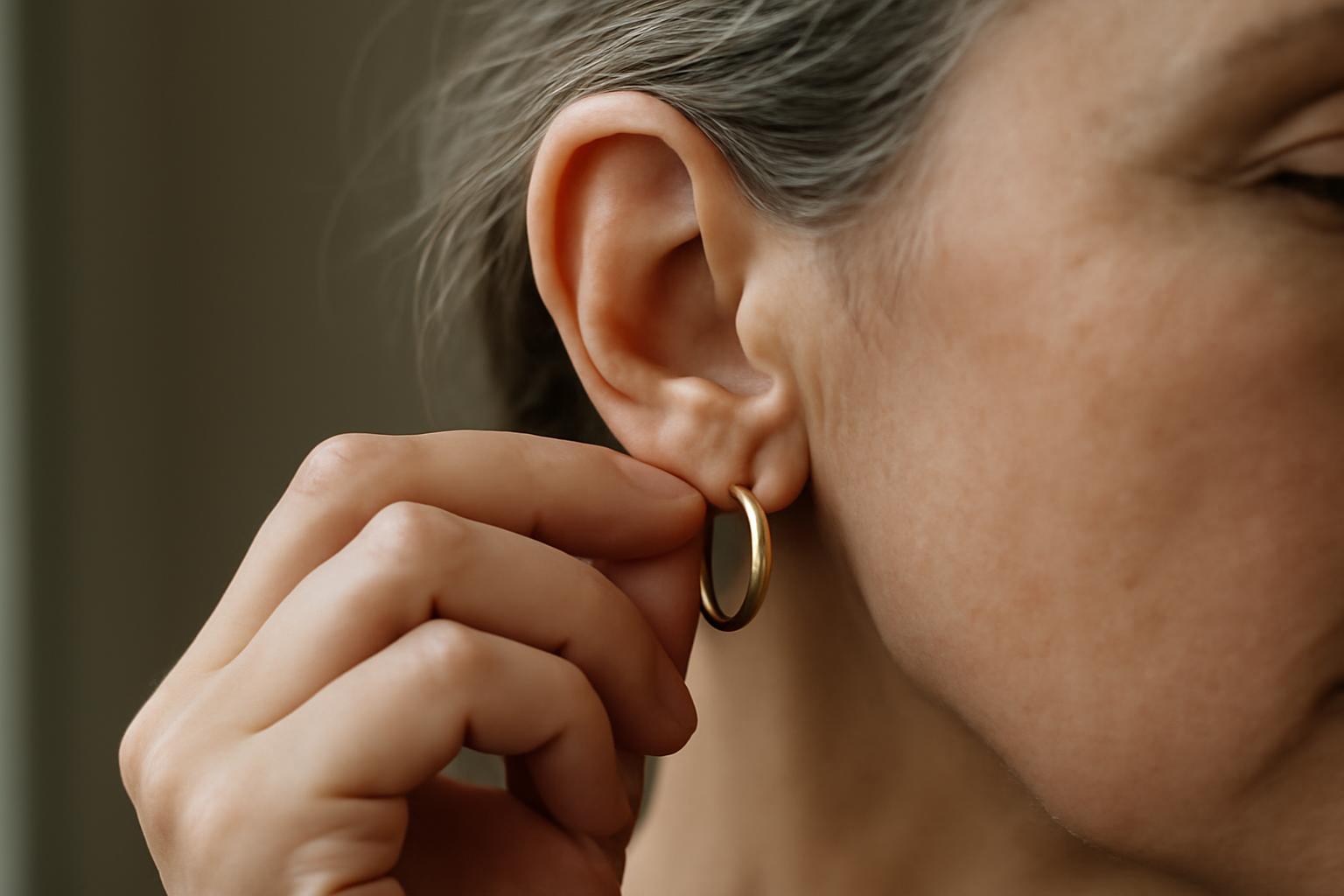
Overview
Dead stretching means placing slightly larger jewelry into a fully healed earlobe piercing without using an expansion tool. The deciding rule is simple: the next size should enter gently, with little resistance. If it requires hard pushing, aggressive twisting, or causes real pain or bleeding, stop and allow more healing time.
Unlike tapering, which uses a cone-shaped tool to guide a larger size through the piercing, dead stretching relies on the existing opening becoming loose enough to accept the next piece of jewelry. Taping gradually increases a plug’s diameter by wrapping layers of tape around it. These methods work differently, and the available evidence does not establish that one is universally safest for every person.
Dead stretching is gradual rather than forceful. BodyArtForms describes it as inserting jewelry slightly larger than the current size, while Pierced Owl defines it by the absence of tapers or other stretching tools. Both sources emphasize that the existing piercing should be healed before another size is attempted.
The calendar matters, but the condition of the lobe matters more. A cautious attempt depends on complete healing, comfortable and loose current jewelry, a small diameter increase, and an immediate willingness to stop if the new piece does not slide in easily.
When Your Earlobe Is Ready for the Next Size
Elapsed time is a minimum screen, not proof that an earlobe is ready. The stronger readiness signals are a comfortable lobe, loose current jewelry, no active inflammation, and very little resistance from the next size.
Published timelines vary. WebMD gives four to six weeks as a general rule of thumb, but it also says larger gauges can take longer to heal. Healthline likewise reports a commonly recommended four-to-six-week interval, while BodyArtForms advises at least three to six months between stretches at larger sizes. These figures cannot be combined into one universal schedule because they address different sizes and come from different forms of guidance.
Before sizing up, check the lobe itself:
- The current piercing is fully healed, rather than merely past a minimum number of weeks.
- The lobe feels relaxed and is not painful, swollen, unusually red, or irritated.
- The current jewelry sits comfortably and has become noticeably loose.
- The next small size meets little resistance during a gentle attempt.
- No hard pushing, aggressive twisting, or sustained pressure is needed.
These cues reflect the readiness guidance in the BodyArtForms ear-stretching guide, which identifies loose jewelry, relaxed ears, and smooth insertion as positive signs. The same guide says that pushing hard or twisting aggressively means the lobe needs more healing time.
Do not treat temporary looseness immediately after irritation or injury as permission to stretch. WebMD advises leaving each size in place until the skin has completely healed before inserting the next one. Its overview also identifies infection, irritation, pain, torn skin, and permanent tissue changes as possible consequences of poorly managed stretching.
A stubborn lobe is a reason to wait, not a problem to overcome with more pressure. Larger sizes may take longer, and individual progress varies. If the jewelry continues to resist after additional healing time, Pierced Owl recommends consulting a professional piercer for individual guidance rather than forcing the transition.
How to Dead Stretch a Healed Earlobe
A cautious dead stretch is one controlled attempt to move from a healed size to a slightly larger piece of clean, suitable jewelry. It is not a process of pushing until the tissue gives way. BodyArtForms says properly performed stretching may feel like mild pressure, while sharp pain, bleeding, or force are stop signs rather than normal stages to work through.
Use this pre-insertion checklist and sequence:
- Confirm complete healing. Do not attempt a stretch while the piercing is sore, swollen, inflamed, discharging fluid, or recovering from a previous difficult attempt.
- Check readiness, not just elapsed time. The current jewelry should feel loose, and the lobe should feel comfortable and relaxed. If the next size meets obvious resistance, postpone the attempt.
- Wash and dry the hands. BodyArtForms identifies handwashing as the first step before handling a newly stretched piercing.
- Prepare clean jewelry one small size larger. Verify the actual diameter, material, finish, and flare style before insertion. Do not assume every consecutive gauge label represents the same millimeter increase.
- Attempt gentle, even insertion. The larger jewelry should slide through with little resistance. A warm or tight sensation is described by Custom Plugs, but BodyArtForms limits the expected sensation to mild pressure rather than real pain.
- Stop immediately if force is needed. Do not push hard, twist aggressively, or continue through sharp pain or bleeding. Return to a comfortable size and allow more time.
- Monitor the lobe afterward. Watch for increasing pain, redness, swelling, pus, bleeding, unusual tissue changes, or a ring of tissue behind the jewelry.
This sequence is intentionally conservative because the supplied sources do not provide one independent, dead-stretch-specific clinical protocol. They agree on the central points of complete healing, cleanliness, a small increase, gentle insertion, and stopping for pain or resistance. They do not resolve every detail of product preparation, lubrication, or cleaning.
A failed attempt does not need to become an injury. If a correctly measured piece will not enter with minimal pressure, remove it rather than repeatedly testing the tissue. Waiting preserves the basic mechanism of dead stretching: the lobe accepts the next size after natural loosening, not after the jewelry is used to force an opening.
Lubrication: What the Evidence Does and Does Not Resolve
The supplied evidence does not establish a universal lubrication protocol for dead stretching. Some retailer guides describe dead stretching without lubricant, while other stretching guidance recommends oil or lubricant to reduce friction and keep the tissue moisturized.
Healthline discusses commercial ear-stretching lubricants and plant oils, including coconut and jojoba oil, in general blowout-prevention guidance. Custom Plugs describes gentle insertion with steady, even pressure. Other dead-stretching explanations define the method chiefly by waiting for natural loosening and do not make lubrication an essential step.
That disagreement should not be converted into a universal product recommendation. The evidence pack does not determine which lubricant, if any, is appropriate for every person or material, nor does it distinguish reliably between lubrication during insertion and moisturizing a healed lobe between stretches. A professional piercer can assess the jewelry, tissue condition, and any allergy history when lubrication is an important concern.
Choosing Jewelry for a Fresh Stretch
Choose jewelry by documented material, smooth finish, flare style, exact diameter, and the smallest practical increase. A kit’s marketing label is less useful than knowing what each piece is made from and how large it actually is.
BodyArtForms identifies glass and implant-grade titanium as top-tier choices in its stretching guide and recommends single-flare plugs while a person is still sizing up. Pierced Owl also lists titanium and glass among its suggested materials, although it uses the broader term “surgical steel,” which does not by itself identify a certified alloy.
The evidence does not prove that material standards written for initial piercings transfer unchanged to every fresh stretch. They are still useful benchmarks for evaluating whether a seller provides a verifiable specification instead of a general material name.
Implant-Grade Materials and Marketing Labels
“Titanium,” “stainless steel,” and “surgical steel” are categories or marketing descriptions. They do not, on their own, confirm an implant specification. The material should be traceable to a named standard when a seller claims that it is implant grade.
A summary of Association of Professional Piercers material guidance identifies implant-certified Ti-6Al-4V ELI titanium meeting ASTM F136 or ISO 5832-3, titanium meeting ASTM F1295, and commercially pure titanium meeting ASTM F67. For steel, it lists ASTM F138 or ISO 5832-1 among the relevant standards and notes that only specific steel grades have established biocompatibility for initial piercing jewelry.
This distinction matters because “surgical steel” can describe multiple alloys. A product carrying that phrase without a grade, standard, or supporting documentation has not provided the same information as jewelry identified as ASTM F138-compliant steel. The broad label should not be treated as proof of implant-grade composition.
The same material summary identifies fused quartz, lead-free borosilicate glass, and lead-free soda-lime glass as glass types supported by the APP for initial piercings. It also says wood, bone, and silicone are generally intended only for fully healed piercings. That does not establish an exhaustive fresh-stretch materials list, but it helps separate documented glass types from an unspecified “glass” claim.
For a fresh stretch, prioritize a verifiable specification and a smooth, well-finished wearable surface. If a seller does not identify the alloy, standard, or glass type, the material remains uncertain. A professional piercer can help assess documentation when the product listing is unclear.
Flare Style, Gauge Labels, and Smaller Increments
Single-flare plugs are the directly supported choice in the supplied stretching guidance. BodyArtForms recommends them during the stretching process because they are easier to insert and less likely to cause irritation or damage than jewelry that must pass a larger flared end through the opening.
Diameter matters as much as the gauge name. Commercial kits show that intermediate sizes are available: Stretch It Body Jewellery lists plugs in 0.5 mm increments, and an Amazon category result describes a glass kit with single-flare plugs and 0.5 mm increments. Those listings establish availability, not that every kit is suitable or that a 0.5 mm increase will always be painless.
Before buying a single plug or a kit, verify:
- The exact millimeter diameter currently worn
- The exact diameter of the next piece
- Whether an intermediate 0.5 mm option is available
- The documented material or implant standard
- A single-flare design suitable for easy insertion
- The number of matching pieces needed for one or both lobes
Smaller diameter jumps can make it easier to size up without force, as BodyArtForms notes, but no increment guarantees a comfortable result. A complete gauge-to-millimeter conversion chart is not included because the supplied evidence does not validate every standard and intermediate size. Measuring and buying in millimeters avoids relying on an assumed conversion.
Aftercare and Complication Response
After a stretch, limit unnecessary handling, keep the hands and items contacting the ear clean, and monitor the lobe closely. Increasing pain, bleeding, marked swelling, discharge, or tissue pushed behind the jewelry requires a response, not another attempt to size up.
Aftercare advice differs across the supplied sources, particularly on cleaning frequency, jewelry removal, saline use, and moisturizing. The most defensible approach is to use gentle care and avoid turning disputed retailer instructions into a rigid universal routine.
Routine Aftercare and Monitoring
Routine monitoring should be simple and consistent. BodyArtForms advises washing the hands before touching the piercing and checking for redness, swelling, pus, or unusual pain. Custom Plugs similarly recommends watching for irritation, infection, or excessive swelling after a stretch.
Practical monitoring includes:
- Wash and dry the hands before touching the lobe or jewelry.
- Handle the fresh stretch only when necessary.
- Use gentle cleaning rather than harsh or repeated manipulation.
- Keep frequently contacting items, including phones, headphones, and hats, clean.
- Check for worsening redness, swelling, discharge, heat, bleeding, or unusual pain.
Healthline specifically recommends cleaning objects that frequently touch the ears as one way to reduce infection risk. WebMD also advises keeping stretched ears clean and drying them completely after showering.
The sources do not support one uncontested cleaning frequency or chemical method. One retailer suggests periodically removing and cleaning jewelry, while other guidance emphasizes leaving healing tissue undisturbed. Healthline discusses saline care, whereas WebMD mentions alcohol for jewelry and tapers. Because these instructions differ, this article does not prescribe a fixed schedule or harsh chemical treatment.
Pain, Bleeding, Tears, and Blowouts
Mild pressure may occur during a successful size increase, but sharp pain, bleeding, or the need for force means the attempt should stop. WebMD says stretched ears may be temporarily sore but should not be painful or stressed. Healthline identifies sharp pain and bleeding as signs that stretching is happening too quickly.
A blowout is not simply ordinary tightness. Healthline describes it as a ring of scar tissue behind the jewelry, often with a red, irritated, painful appearance that can make the piercing look as though it is turning inside out. WebMD describes related microtears as red, irritated, and lumpy tissue caused when the inner ring of skin is stretched too far.
If pain, bleeding, tearing, or a suspected blowout occurs:
- Stop inserting the larger jewelry.
- Do not keep twisting or pushing through resistance.
- Replace the larger piece with a smaller, comfortable size if this can be done without further force.
- Rest the lobe and monitor whether pain, swelling, and tissue irritation improve.
- Consult a professional piercer or healthcare provider if the problem is severe, persistent, or worsening.
The supplied BodyArtForms catalog does not establish a complete blowout first-aid protocol. Stop stretching and consult a professional piercer or healthcare provider if symptoms are severe, persistent, or worsening. The evidence does not provide a complete first-aid protocol for an acute tear, so deep, continuing, or otherwise concerning bleeding should not be managed as routine irritation.
A ring of tissue can coexist with infection, and pain alone does not identify the cause. Avoid diagnosing an allergy, infection, or tear solely by appearance. The next action should reflect severity and progression rather than an assumption that every red lobe is a blowout.
When Suspected Infection Needs Medical Care
Fever, oozing, increasing pain, redness, swelling, burning, tenderness, or yellow pus can indicate infection or another reaction that needs assessment. WebMD advises medical attention for fever, itching, lumpy skin, oozing, pain, redness, or swelling, and notes that redness or itching can also occur with a material allergy.
Healthline advises contacting a healthcare provider if a suspected infection spreads or does not improve within two days. That threshold should not delay care for rapidly worsening symptoms, fever, severe pain, or extensive swelling.
The available sources do not fully distinguish irritation, contact allergy, a minor infection, acute tearing, and a blowout in every presentation. That uncertainty matters because the correct response may differ. Downsizing and monitoring may be appropriate for a mechanical overstretch, but they are not substitutes for medical assessment when infection signs spread, persist, or occur with fever.
Dead Stretching Compared With Tapers, Tape, Silicone, and Weights
Dead stretching differs from other methods primarily in mechanism. It uses slightly larger jewelry after the piercing has naturally loosened. The supplied evidence supports several cautions about alternatives, but it does not prove that dead stretching is universally safer for every anatomy, jewelry size, or level of experience.
- Tapers are cone-shaped tools used to guide a piercing toward a larger diameter. Pierced Owl notes that tapering requires this tool, while also reporting that tapers remain one of several methods used by stretchers.
- Tape is wrapped around existing jewelry in layers to increase its diameter gradually. Plug Your Holes presents taping as a gradual method, but the broader source set does not supply an independent protocol resolving material, cleanliness, or consistency concerns.
- Silicone can expand after insertion rather than waiting for the lobe to accept rigid jewelry. BodyArtForms advises against using silicone to stretch because it describes the expansion as unpredictable and identifies possible tissue damage.
- Weights apply downward load to the lobe. BodyArtForms warns that deliberate weight stretching can produce uneven expansion or thinning at the bottom when the load is not well managed.
Natural loosening while wearing ordinary plugs should not be treated as identical to deliberate weight stretching. Some dead-stretching explanations attribute gradual looseness partly to the jewelry already being worn, but concentrated downward weight can distribute force unevenly. The evidence supports that practical distinction without establishing one universal mechanical rule.
Sources also disagree about tapers and tape. Pierced Owl says many professional piercers recommend dead stretching, yet acknowledges the continued use of tapers and tape. Another comparison source states that method choice depends on the person and that some people combine approaches. These retailer statements are not enough to declare a universal winner.
The responsible conclusion is narrower: dead stretching avoids a separate expansion tool and gives resistance a clear meaning. If the next size will not enter gently, the process stops. That feature can discourage force, but safety still depends on healing, increment size, jewelry quality, anatomy, and technique.
Can Stretched Earlobes Shrink Back?
Stretched earlobes may shrink after jewelry is removed or replaced with smaller jewelry, but complete reversal is never guaranteed at any size. The outcome varies, and the supplied evidence does not establish a diameter below which every lobe will close fully.
Custom Plugs says downsizing or leaving jewelry out can allow a piercing to shrink naturally over time. BodyArtForms gives the necessary qualification: there is no guarantee that stretching can be reversed at any size. These claims are compatible when shrinkage is understood as a possibility rather than a promised result.
Prior stretching history, tissue changes, and the final opening can affect what remains, but the evidence pack does not quantify those relationships. A person considering dead stretching should therefore make the decision without relying on a supposed “point of no return” that guarantees closure below it.
Where a larger opening persists, BodyArtForms notes that surgical repair may be needed to close it. Downsizing can be a practical step for someone who wants a smaller opening or needs to rest an irritated lobe, but it should not be presented as assurance that the ear will return to its original appearance.