
4 min read ·
A Reverend Is a Title; a Pastor Is a Role
“Reverend” is generally a clergy title, while “pastor” describes responsibility for a congregation. Learn whom to contact when planning a funeral.
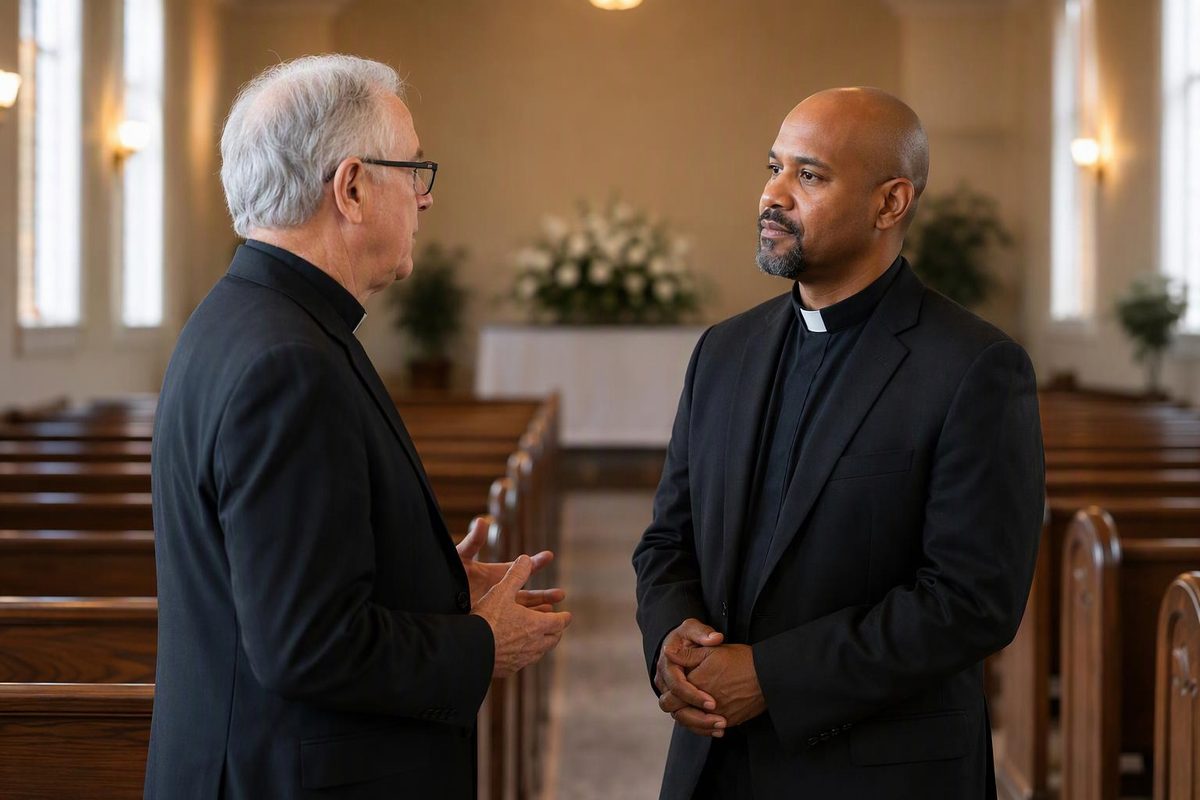
A reverend is generally a clergy member’s title or formal style. A pastor is a person responsible for the spiritual care and leadership of a congregation.
One person can be both: The Rev. Jordan Lee may be the pastor of First Community Church. In that example, “The Rev.” is the formal style used with the name, while “pastor” identifies the person’s role.
| Term | What it usually indicates | Example |
|---|---|---|
| Reverend | A title or formal style associated with clergy | The Rev. Jordan Lee |
| Pastor | A role leading and caring for a church or parish | Jordan Lee is the church’s pastor |
These are general distinctions, not rules shared by every Christian tradition. Merriam-Webster defines reverend as a title used for a member of the clergy, while its definition of pastor is a spiritual overseer, especially a clergy member serving a local church or parish.
A reverend is not necessarily a pastor
Seeing “The Rev.” before a name does not establish that the person currently leads a congregation. For example, the Episcopal Church’s official style guide applies “The Rev.” to both priests and deacons, although those are distinct offices.
For funeral planning, the title alone does not tell you whether someone:
- currently serves the deceased’s congregation;
- is available to officiate;
- has approval to lead a service in a particular church;
- can conduct every rite the family wants; or
- will lead both the main service and the committal.
Ask about the person’s current role and the rules of the church where the service would be held.
A pastor is not necessarily ordained
Many pastors are ordained, but denominational requirements differ. United Methodist local pastors, for example, are licensed rather than ordained. They may preach, lead worship and perform burials within their appointed setting, but their authority does not extend beyond that appointment, according to the denomination’s explanation of local pastoral ministry. The United Methodist Church’s current disciplinary provisions also assign elders and licensed pastors duties that include conducting funerals and memorial services.
In Roman Catholic usage, “pastor” is a specific parish office rather than a general name for every priest. Canon law describes a pastor as the person entrusted with a parish’s pastoral care, requires the officeholder to be a priest and lists funeral rites among the functions especially entrusted to the pastor. See Canons 519–530.
The practical point is that neither title, by itself, tells you everything about a person’s responsibilities or authority.
Whom should you contact for a funeral?
If the person who died belonged to a church, contact the church or parish office first. Ask for the pastor, priest or staff member who handles funerals. Check availability before confirming the service time with the funeral home, cemetery or crematory.
The person who leads the ceremony may be called a pastor, priest, minister, chaplain, celebrant or officiant. Ask:
- Can you lead the service at the intended place and time?
- Does the church require its own pastor or clergy member to approve or lead it?
- Will you meet with the family before the service?
- Will you also lead the graveside or committal service?
- Are any prayers, readings, music or sacraments required or restricted?
- Is there a fee or customary honorarium, and whom should it be paid to?
Rules vary. United Methodist worship guidance says that someone other than a congregation’s pastor should lead a funeral in its church only at that pastor’s invitation. It also says plans are made with the family subject to the pastor’s approval and notes a tradition of pastors not accepting an honorarium when the deceased was a parish member. Local practice may differ; see the denomination’s Service of Death and Resurrection guidance.
For a Catholic funeral, canon law generally places the funeral in the deceased’s parish church. Another church may be selected with the consent of the person governing it and notice to the deceased’s pastor, as explained in Canons 1176–1182.
If the deceased had no congregation, the funeral home may be able to suggest local clergy or celebrants. Speak with the proposed officiant before agreeing. Confirm the person’s approach, what they will do and the complete charge. A secular celebrant may be a better fit if the family does not want a religious service.
Once an officiant is chosen, plan the ceremony with that person rather than treating a generic template as fixed. Our funeral order-of-service guide shows how the sequence can differ between Christian and secular ceremonies.
How should you address the person?
Use the name and title shown by the church, or simply ask, “How would you like to be addressed and listed in the program?” That is more reliable than guessing from the denomination.
Depending on the person and tradition, the answer might be:
- The Rev. Jordan Lee in formal written material;
- Pastor Lee for someone serving in that role;
- Father Lee for a priest who uses that form; or
- a first name, if invited.
Before printing a funeral program, confirm the officiant’s exact name, title and role. A clear role line might read “Officiant: The Rev. Jordan Lee” or “Service led by Pastor Jordan Lee,” according to the person’s preference.
The shortest useful distinction is: reverend is generally a title; pastor is a role. For a funeral, verify the person’s actual responsibilities instead of relying on either word alone.