
17 min read ·
Catholic Cremation Rules: What Families Need to Know
Catholics may be cremated, but burial remains preferred. Ashes should be treated like the body and ordinarily placed in a permanent sacred resting place.
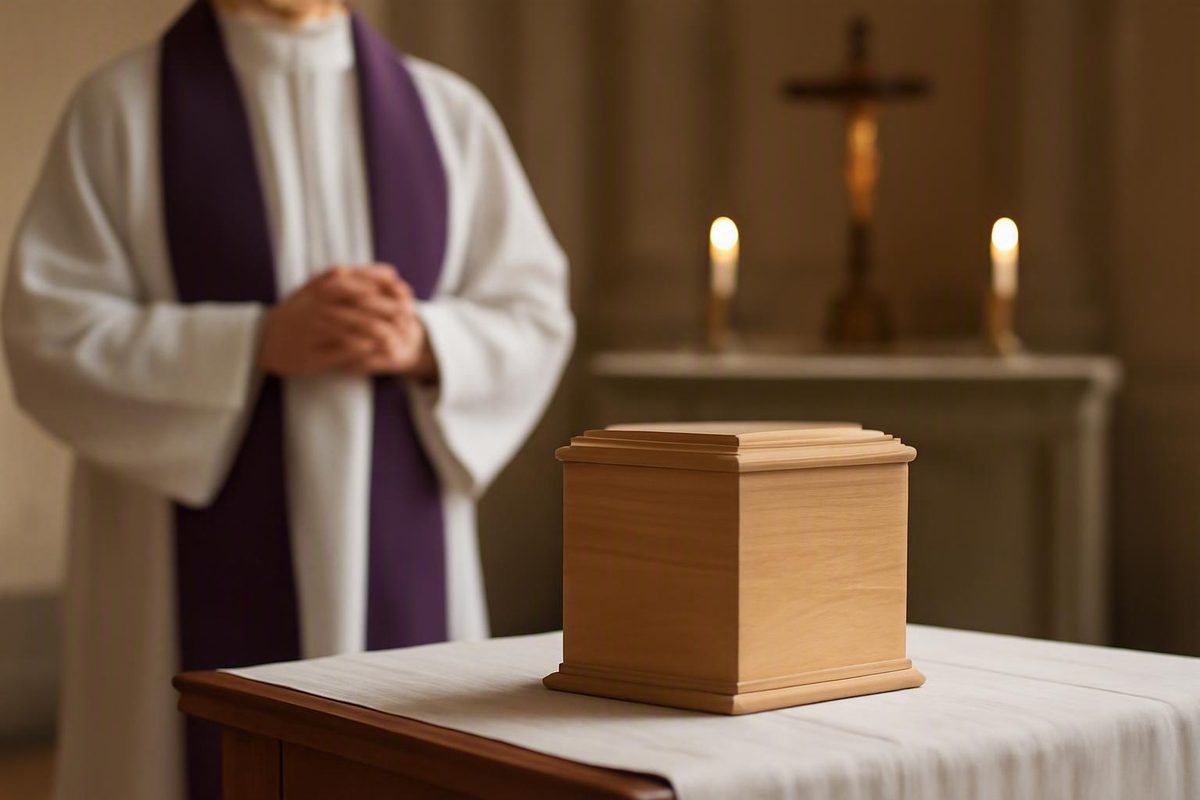
The short answer: Catholics may choose cremation
Yes. The Catholic Church permits a practicing Catholic to be cremated.
Permission does not mean that the Church considers cremation and burial equally preferable. Burial or entombment of the intact body remains the recommended practice because it more fully expresses Catholic respect for the body and hope in the resurrection.
Canon 1176 captures this distinction: the Church recommends the pious custom of burying the dead but does not forbid cremation unless it was chosen for reasons contrary to Christian teaching. The former prohibition on Catholic cremation was lifted in 1963, but the change represented permission rather than an endorsement of cremation over burial. Catholic Cemeteries of the Archdiocese of Washington explains the canon and the significance of the 1963 change.
The Catholic position can be summarized in three principles:
- Cremation is allowed. A Catholic may choose it for a reason consistent with Christian faith.
- Burial of the body is preferred. The Church considers bodily burial or entombment the more fitting expression of Christian belief about death and resurrection.
- Reverent permanent disposition is ordinarily required. Cremated remains should be treated with the respect given to a body and placed in a grave, mausoleum, columbarium, or another sacred resting place approved by the proper Church authority.
This distinction matters when someone asks, “Does the Catholic Church believe in cremation?” The Church accepts cremation as a permissible form of disposition. It does not teach that cremation has the same symbolic or liturgical value as burial of the body.
Choosing cremation also does not end the Catholic funeral process when the crematory returns the urn. The Vigil, Funeral Liturgy, and Rite of Committal remain important. Final placement of the remains is part of the Church’s care for the deceased, not merely a private decision about what to do with ashes.
Families should therefore plan the funeral rites and permanent interment together. Calling the parish before authorizing dates can prevent conflicts among the crematory schedule, the Funeral Mass, and cemetery or columbarium arrangements.
Why the Church still prefers burial
Catholic funeral practice treats the human body as more than an empty container that becomes irrelevant at death. The body belonged to a particular person, participated in that person’s relationships and acts of faith, and was marked by the person’s Christian life. It is therefore handled with prayer, dignity, and hope.
Bodily burial also recalls the death, burial, and resurrection of Christ. Placing the body in the earth or in a tomb expresses the Christian expectation that death is not the final destruction of the person. For this reason, the Church considers burial the more fitting visible sign of faith and hope in bodily resurrection.
That preference does not mean that an intact corpse is physically necessary for resurrection. It does not imply that cremation harms the soul or makes resurrection more difficult. The Vatican’s 2016 instruction states that cremation does not affect the soul or prevent God from raising the deceased to new life. The same instruction describes burial as the most fitting expression of faith and hope in the resurrection of the body. The Vatican instruction explains both the permissibility of cremation and the Church’s preference for burial.
Two ideas must therefore be kept distinct:
- Resurrection does not depend on physical preservation. Cremation does not place the deceased beyond God’s power.
- Funeral signs still matter. How Catholics care for the dead communicates what the Church believes about the person, the body, death, and resurrection.
Burial of the body expresses those beliefs in a particularly direct way. The body may be received at the church, sprinkled with holy water, covered with the funeral pall, honored with incense, and committed to a permanent resting place. These actions connect the deceased’s baptism, earthly life, death, and Christian hope.
A permanent grave, crypt, or niche also gives the deceased an identifiable resting place. Relatives, friends, and members of the faith community can visit, pray, remember anniversaries, and continue to honor the deceased. Sacred interment also helps preserve the person’s identity within a community of prayer after immediate relatives have died or moved away.
Cremation can be reconciled with these values when the remains are treated as the remains of a human person rather than as a possession, decoration, or raw material. This is why Catholic rules concern more than whether cremation may occur. The motive, funeral rites, handling of the urn, and final disposition all matter.
For a Catholic family choosing between burial and cremation, the practical questions are:
- Is the decision consistent with Christian belief?
- Does it respect the dignity of the deceased?
- Can the Catholic funeral rites be celebrated appropriately?
- Will the remains receive reverent permanent interment?
If those conditions can be met, cremation may be chosen even though bodily burial remains the Church’s preference.
When choosing cremation conflicts with Catholic teaching
Cremation is not contrary to Catholic belief in itself. The decisive issue is why it is chosen and what the choice is intended to express.
The clearest impermissible motive is choosing cremation as a deliberate denial of bodily resurrection. A person who requests cremation to proclaim that the body has no future significance, or that Christian teaching about resurrection is false, is using the act to reject the faith under which cremation is permitted.
A deliberate rejection of the dignity or sacredness of the human body would create a similar conflict. Cremation should not be selected to express contempt for the body or the belief that bodily existence is worthless.
The Vatican’s 2016 instruction also rejects funeral practices based on ideas incompatible with Christian teaching, including the definitive annihilation of the person, fusion with nature, reincarnation, or liberation from the body as though the body were merely a prison. These concerns address the meaning assigned to the funeral practice, not the physical process of cremation by itself.
Economic, sanitary, social, or other practical considerations can be compatible with Catholic teaching. That does not mean cremation will always cost less or produce a particular environmental result. Actual consequences depend on the services, merchandise, location, cemetery arrangements, and type of interment selected.
The difference between compatible and incompatible motives can be summarized this way:
| Generally compatible with Catholic teaching | Contrary to Catholic teaching |
|---|---|
| A practical need that does not reject the faith | Denial of bodily resurrection |
| Sanitary, economic, or social considerations | Contempt for the body or rejection of its dignity |
| Limited local disposition options | A ritual intended to express annihilation of the person |
| Personal preference joined to reverent interment | A belief that death means fusion with nature or reincarnation |
| Cremation followed by Catholic rites and permanent placement | Treating liberation from the body as the meaning of death |
The Church’s concern with motive should not become an invitation to speculate about another person’s private beliefs. A family may know that the deceased requested cremation without knowing the precise reasoning. In that situation, relatives should tell the priest what they know rather than attempting to make a canonical judgment themselves.
Questions about the deceased’s motive, a family’s actions, and any pastoral or canonical consequences belong with the priest and, when necessary, the diocese.
When pre-planning, a Catholic can reduce uncertainty by writing something more complete than “I want to be cremated.” The instructions can state that:
- Cremation is being chosen consistently with Catholic faith.
- Catholic funeral rites are desired.
- The body should be present for the funeral rites if reasonably possible.
- The cremated remains are to be permanently interred in an approved place.
Clear instructions help relatives understand both the decision and the religious conditions attached to it.
Cremation before or after the Catholic funeral
A Catholic funeral ordinarily unfolds in three principal stages:
- The Vigil and related rites: Family and friends gather to pray for the deceased, console one another, and remember the person’s Christian life.
- The Funeral Liturgy: This is frequently celebrated as a Funeral Mass, although a Funeral Liturgy outside Mass may be appropriate in some circumstances.
- The Rite of Committal: The Church gives its final farewell and commits the deceased to a permanent resting place.
These stages and the available adaptations for cremation are outlined in Catholic burial guidance from the University of Notre Dame. Its overview explains the Vigil, Funeral Liturgy, Rite of Committal, and adaptations for cremation.
The Church ideally prefers the body to be present for the Vigil and Funeral Liturgy, with cremation taking place afterward. The body’s presence allows the funeral rites to use their customary signs of reverence, including sprinkling with holy water, placing the funeral pall, and honoring the body with incense. The USCCB describes cremation after the Funeral Mass as the ideal sequence.
Under that preferred arrangement:
- The body is present for the Vigil.
- The Funeral Mass or Funeral Liturgy is celebrated with the body present.
- Cremation occurs afterward.
- The cremated remains are placed in a worthy vessel.
- The Rite of Committal is celebrated when the remains are buried or entombed.
This sequence permits cremation while preserving the fullest use of the Church’s customary funeral signs.
Prior cremation does not ordinarily prevent a Catholic funeral. Adapted texts and ritual directions are available when cremated remains are present.
The urn is not treated exactly like a casket in every ceremonial detail. Authorized ritual adaptations govern how particular prayers and actions are used. Families should not assume that every sign associated with the body will be transferred unchanged to the urn.
Whether cremated remains may be present at a Funeral Mass can also depend on the procedures applicable in the country and diocese. In the United States, adapted texts and directives have been authorized for this situation, but local procedures may still affect permission, placement of the urn, the procession, and what happens after the liturgy.
This is why the parish should be one of the family’s first calls. Before fixing the cremation date, service location, or Funeral Mass schedule, ask:
- Can the body remain available for the Vigil and Funeral Mass?
- If cremation must happen first, may the urn be present at the Funeral Mass?
- Is advance diocesan or parish permission required?
- Which adapted rites will be used?
- When and where will the Rite of Committal occur?
- Who will coordinate with the funeral home, crematory, and cemetery?
Early coordination allows the church, funeral home, crematory, and place of interment to build one workable schedule.
What Catholics may and may not do with cremated remains
Cremated remains are to receive the reverence given to the body. They should be kept together in a worthy, secure vessel and handled carefully during transportation, funeral rites, and final placement.
Interment means the permanent placement of remains in a grave, niche, crypt, or another approved resting place. A columbarium is a structure containing niches designed to hold urns.
The ordinary rules can be summarized as follows:
| Allowed or ordinarily appropriate | Not ordinarily allowed |
|---|---|
| Burial of the urn in an approved cemetery grave | Scattering ashes on the ground |
| Placement in a mausoleum crypt | Releasing ashes into the air |
| Placement in a columbarium niche | Scattering ashes directly at sea |
| Placement in another sacred location designated by competent Church authority | Routine division of ashes among relatives |
| Use of a worthy, secure vessel | Incorporating ashes into jewelry |
| Reverent transportation and handling | Turning ashes into artwork or decorative objects |
| Celebration of the Rite of Committal at final placement | Preserving ashes in keepsakes or mementos |
| Maintaining the remains together | Treating permanent home retention as the ordinary final disposition |
The USCCB identifies a grave, mausoleum, or columbarium as appropriate forms of final placement and states that scattering or keeping the remains in a relative’s home does not meet the Church’s expectation for reverent disposition.
A Catholic cemetery is often a natural choice because it provides a sacred setting, an identifiable place of remembrance, and continuing care. It is not accurate, however, to say that cremated remains must universally be placed in a specifically Catholic cemetery. Another sacred place may qualify when it has been designated for that purpose by competent Church authority.
Families should not assume that an ordinary parish church, church building, or church property is automatically available for interment. Church-property and other non-cemetery arrangements require specific confirmation and may be restricted by local rules. Likewise, placement in a non-Catholic cemetery should be discussed with the parish so the family can confirm that the proposed location and religious arrangements are acceptable.
It also provides a place where the deceased can be remembered by name and included in the prayers of relatives and the wider Christian community.
Scattering does not satisfy the ordinary rule because it disperses the remains and prevents them from being interred together. This applies to scattering on land, into the air, or directly into the sea. Burial at sea involving an enclosed vessel is a separate question and should be presented to the parish or diocesan office before arrangements are made.
Routine division among children, siblings, or other relatives is also not ordinary Catholic practice. The desire to keep a loved one close is understandable, but Catholic practice directs that desire toward prayer, memorialization, and visits to a permanent resting place rather than distribution of the remains.
The same concern applies to placing ashes in necklaces, rings, glass objects, paintings, sculptures, tattoos, or other keepsakes. Under the ordinary rule, the remains are kept together and interred rather than incorporated into possessions.
Permanent retention of the urn at home is likewise not the ordinary Catholic disposition. A mantel, closet, or private memorial shelf does not provide the enduring sacred placement envisioned by Church teaching. This does not resolve every question about temporary custody while interment is being arranged; a family facing that situation should ask the parish for guidance.
The vessel itself should be suited to the funeral and intended form of interment. The vessel should be secure, dignified, and manageable during transportation and the Rite of Committal.
Current guidance, exceptions, and local Church rules
Catholic cremation planning involves both universal principles and local procedures.
The stable principles include:
- Respect for the dignity of the human body
- Hope in the resurrection of the body
- The requirement that cremation not be chosen against Christian doctrine
- Reverent handling of cremated remains
- Permanent placement in a sacred or ecclesially approved resting place as the ordinary practice
- Rejection of scattering and casual use of remains as personal objects
Funeral logistics can vary. National ritual books, diocesan policies, the bishop’s directives, cemetery rules, and parish practice may affect whether an urn may be present at Mass, where a service is held, how the urn is received, and when the committal occurs.
Older diocesan documents can help explain the Church’s principles, but they should not automatically be treated as complete statements of current universal practice. For example, guidelines reissued by the Diocese of Fort Wayne–South Bend in 2005 treated a funeral liturgy with cremated remains as an extraordinary situation under that diocese’s procedures at the time. Those guidelines illustrate why local documents must be read in their date and jurisdictional context.
If an older local document appears to conflict with a newer summary, families should not simply adopt the broadest interpretation. The parish or diocesan worship office can identify the current rule for that location.
A commercial memorial provider has reported that a December 2023 Vatican clarification may allow a family to request that a small portion of ashes be preserved in a place significant to the deceased while the majority remains in a sacred place. The same secondary account reports a possible communal arrangement in which the identity of each deceased person is recorded. The report describes these as limited developments rather than ordinary permission to divide ashes.
Because the supplied report is not the official Vatican response and does not establish the complete conditions, approval process, or responsible authority, families should not rely on it as permission to act. It does not support freely dividing ashes among relatives, creating keepsakes, retaining portions wherever the family chooses, or replacing sacred interment with permanent home storage.
Until the diocese confirms that a proposed arrangement is permitted, keeping the remains together and arranging permanent sacred interment remains the prudent planning standard.
Other unusual requests also require advance guidance, including:
- Burial at sea
- Retention of a small portion
- A communal urn
- Interment on church property
- Placement in a non-cemetery location
- Transfer of an urn from a home to a permanent resting place
- A situation in which remains have already been divided
The practical rule is simple: ask before acting. It is easier to obtain a current decision while the remains are together than after they have been scattered, divided, incorporated into objects, or placed somewhere without permanent care.
A practical Catholic cremation planning checklist
A family can avoid many conflicts by coordinating the religious and disposition arrangements from the beginning.
-
Contact the parish before authorizing the final schedule. Call the deceased’s parish or the parish expected to conduct the funeral before fixing the cremation date, church service, or interment appointment.
-
Tell the priest that cremation is planned. Ask whether the body can be present for the Vigil and Funeral Mass, with cremation afterward. This is the Church’s preferred sequence.
-
If cremation must happen first, confirm the authorized rites. Ask whether the cremated remains may be present at the funeral, whether local permission is needed, and which adapted ritual procedures the parish follows.
-
Choose a worthy, secure vessel. Select a dignified vessel appropriate for the liturgy, transportation, and committal. Verify cemetery, crypt, or niche requirements before buying it.
-
Arrange permanent interment. Select an approved cemetery grave, mausoleum, columbarium, or another sacred location authorized by the appropriate Church authority. Confirm documentation, interment rights, and continuing care.
-
Schedule the Rite of Committal. Receipt of the urn is not the end of the Catholic funeral process. Arrange the final prayer and placement rather than leaving interment indefinitely undecided.
-
Put the wishes in writing. State that cremation is desired in accordance with Catholic teaching, identify the preferred parish and funeral rites, and record the intended place of interment. Give copies to the person responsible for the arrangements.
-
Ask before planning anything unusual. Contact the parish or diocese before arranging scattering, burial at sea, retention of a portion, a communal urn, church-property interment, or another nonstandard disposition.
-
Coordinate every organization involved. Confirm transportation, authorizations, service times, vessel requirements, and the transfer of the remains among the parish, funeral home, crematory, and place of interment.
-
Designate a responsible person. Choose someone who understands the Catholic instructions and can carry them out without leaving relatives to infer the deceased’s wishes.
If ashes have already been scattered, divided, retained at home, or placed in keepsakes, the family should not assume that no respectful Catholic response remains possible. Gather accurate information about what happened and speak privately with a priest or diocesan office. Specific pastoral or canonical next steps must come from the appropriate Church authority rather than a general article.
This checklist provides general planning information, not a decision about an individual religious case. Mortuary Guide is not a substitute for guidance from a priest or diocese or for professional advice from a licensed funeral director, attorney, or estate professional. Its terms explain the limits of the site’s general information.
Frequently asked questions
Can someone who is cremated still have a Catholic Funeral Mass?
Yes. Cremation does not ordinarily prevent a Catholic Funeral Mass.
The Church prefers the body to be present and cremation to occur afterward. If cremation has already taken place, adapted Catholic funeral rites may be used, and the urn may be present when applicable Church procedures permit it. The parish should approve the schedule and liturgical arrangements in advance. The Archdiocese of Philadelphia confirms that a cremated Catholic may still receive a Catholic funeral.
The family should also arrange the Rite of Committal and permanent interment rather than treating the Funeral Mass as a substitute for final placement.
Does cremation conflict with the Catholic belief in bodily resurrection?
Not by itself. Catholic teaching does not make resurrection dependent on preserving the corpse intact. Cremation does not affect the soul or limit God’s power to raise the deceased.
A conflict arises when cremation is chosen specifically to deny bodily resurrection or reject the dignity of the body. Burial remains preferred because it more fully expresses Christian hope, not because cremation makes resurrection physically less possible.
Do Catholic ashes have to be buried in a Catholic cemetery?
Not necessarily. A Catholic cemetery is an appropriate and often preferred option, but it is not the only possible resting place.
Cremated remains may be placed in an approved cemetery grave, mausoleum, or columbarium. Another sacred place may qualify when competent Church authority has designated or approved it for that purpose.
A family should not assume that a parish church, church property, private site, or non-Catholic cemetery automatically qualifies. The proposed location should be confirmed with the parish or diocese.
Can Catholics scatter ashes, divide them among relatives, or place them in jewelry?
Under the ordinary Catholic rule, no.
Ashes should not be scattered on land, into the air, or directly at sea. They should not routinely be divided among relatives or incorporated into jewelry, artwork, mementos, or similar objects. The ordinary practice is to keep the remains together in a worthy vessel and arrange permanent interment.
If scattering or division has already occurred, the family should explain the situation to a priest rather than assuming either that nothing can be done or that a particular remedy automatically applies.
Can a Catholic family keep a small portion of ashes under the reported 2023 guidance?
A family should not assume that it may do so without specific Church approval.
A secondary commercial source reports a narrowly framed possibility of requesting preservation of a small portion in a place significant to the deceased while the majority remains in a sacred place. The available evidence does not establish the complete conditions, approval process, or authority responsible for deciding an individual request.
Do not divide the ashes first and ask later. Present the proposal to the parish or diocesan office while the remains are still together.
The practical distinction is straightforward: a Catholic may be cremated, but the Church still prefers bodily burial and expects cremated remains to be treated as a body would be—with prayer, dignity, and ordinarily a permanent sacred resting place. Contact the parish before scheduling cremation or choosing the final disposition, especially if the plan involves an urn at Mass, retention of a portion, burial at sea, or another unusual arrangement.