
9 min read ·
Write Genuine Sympathy in Two Simple Sentences
Close family can write directly to the person who died, while friends, colleagues and neighbors often address the bereaved family, with examples for both.
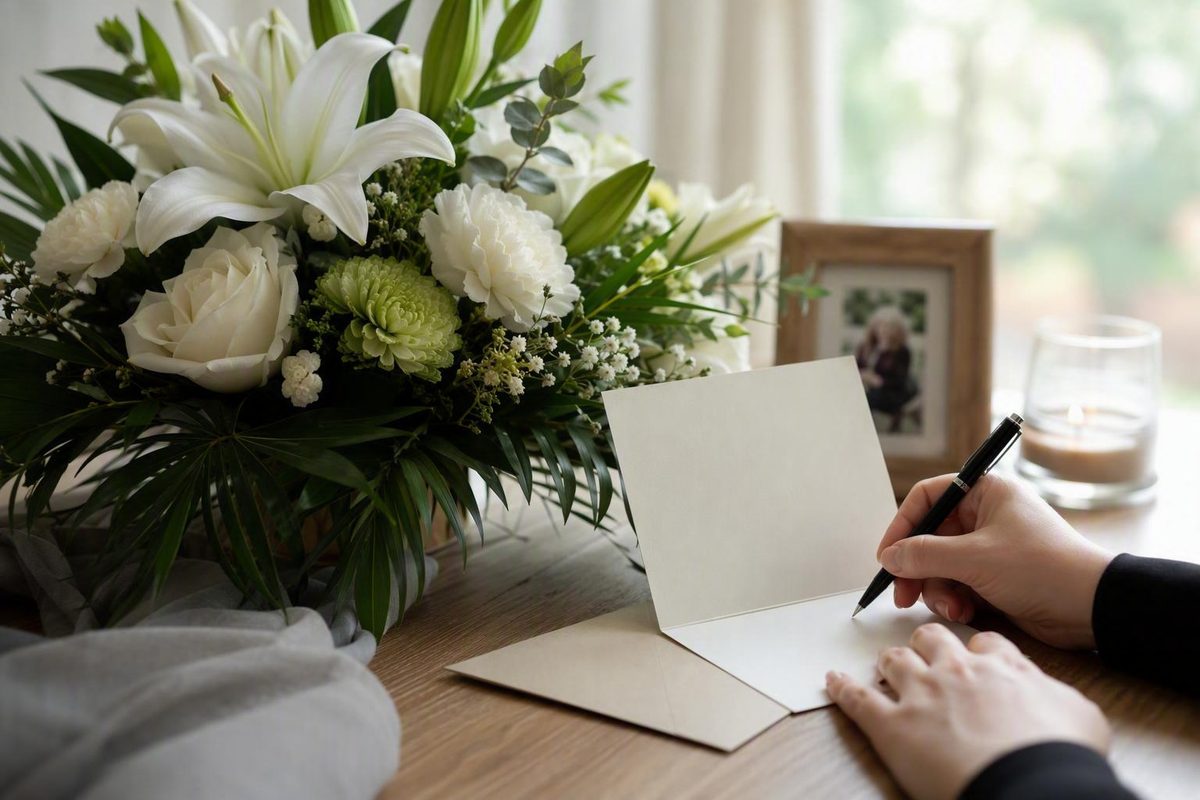
The best funeral flower card messages are brief, sincere, and suited to your relationship with the person who died or the family receiving the flowers. A safe starting point is: acknowledge the loss, name one quality or memory if you can, offer care, and sign clearly. Two or three honest lines are enough.
There is no single perfect phrase. A small card has limited space, and Funeral Partners notes that a few simple words can still show care. Choose an example below, then change a word or add a name so it sounds like you.
A simple formula when you do not know what to write
Build the note from up to four parts:
- Opening: “With sympathy” or “We are so sorry for your loss.”
- Personal detail: “Her warmth made every visit brighter.”
- Support or remembrance: “We are thinking of you” or “We will remember him with great affection.”
- Signature: Your name, household, family, team, or organization.
For example: “We are so sorry for your loss. Daniel’s kindness to everyone on our street will stay with us. With care, the Rivera family.”
Shorter is usually better when the florist’s enclosure card is small. A longer memory belongs in a separate sympathy card or letter. Alterna Cremation’s guidance similarly recommends adjusting the length and detail to how well you knew the person or the grieving family.
Short funeral flower card messages
These compact notes work when space is tight or when you did not know the person well:
- With heartfelt sympathy.
- Thinking of you with care.
- With love and remembrance.
- Remembering a life that mattered.
- Holding your family in our thoughts.
- Wishing you comfort in the days ahead.
- With sincere condolences from all of us.
- Remembered with warmth and gratitude.
- Sending strength and gentle thoughts.
- Honoring a wonderful life.
- May loving memories bring you comfort.
- We are beside you in sorrow.
- With care during this difficult time.
- Your loss is felt by so many.
- In memory of someone deeply valued.
Messages by relationship
The relationship should guide the point of view. Flowers sent by close family can speak directly to the person who died; flowers from friends, colleagues, or neighbors often address the bereaved family instead.
For a mother
- Mom, your love shaped our lives and will remain with us always.
- In memory of a beautiful mother whose care could be felt in everything she did.
- Your patience, humor, and love made home a place we will always carry with us.
- With endless love for Mum, and gratitude for every day we shared.
- Her love lives on in the family she nurtured.
For a father
- Dad, your steady love and guidance will never leave us.
- Remembering a devoted father with love, pride, and gratitude.
- Your stories and laughter will be part of every family gathering.
- In honor of a father who gave us strength and made us feel safe.
- His example will continue to guide everyone who loved him.
For a spouse or partner
- You were my home, my closest friend, and my greatest love.
- Every chapter was better because I shared it with you.
- With all my love, now and always.
- I will carry your kindness and laughter through all my days.
- Thank you for a life of ordinary moments made extraordinary together.
For a sibling
- I will miss the history, laughter, and understanding only we shared.
- My first friend and forever part of me.
- Your courage and humor will stay with our family.
- In loving memory of a wonderful sister and a generous friend.
- Brother, every good memory of growing up has you in it.
For a grandparent
- Your stories, traditions, and love will keep bringing us together.
- Remembering a treasured grandmother whose welcome was always warm.
- Grandpa, thank you for the lessons and laughter we will pass on.
- Your gentle influence reaches across generations.
- With gratitude for a long life filled with care.
For a friend
- Your friendship was a gift I will always value.
- I will miss your honesty, your laugh, and the way you showed up.
- Thank you for the adventures and the quiet conversations alike.
- The world feels different without you, dear friend.
- Remembered with affection by everyone lucky enough to know you.
For a colleague, neighbor, or community member
- With sincere sympathy from your friends at [workplace or group].
- We will remember [Name]’s generosity and the care shown to our community.
- Thinking of your family from all of us on the [team name] team.
- A respected colleague and a kind presence—[Name] will be missed.
- Your neighbors are holding you close in thought.
When you did not know the person who died
- I am so sorry for the loss of someone so important to you.
- Thinking of you and your family as you remember [Name].
- Your love for [Name] was always clear. I am holding you in my thoughts.
- Wishing you moments of comfort as you honor a life deeply loved.
- With sympathy and care from [your name].
Secular and faith-based messages
Use spiritual language only when you know it reflects the family’s beliefs. If you are unsure, choose a secular message centered on memory, love, and support. Customs and rituals differ among families, cultures, and faith communities, so a familiar phrase from your own tradition is not automatically right for the recipient.
Secular messages
- May the memories you shared bring warmth amid the sorrow.
- [Name] made a lasting difference and will be remembered with gratitude.
- Sending love as you celebrate [Name]’s life and mourn this loss.
- We will keep telling the stories that made [Name] unforgettable.
- With care for your family and respect for a life well lived.
- May you feel surrounded by the people who care for you.
Christian messages
- May God hold [Name] in peace and comfort all who mourn.
- Keeping your family in prayer and sending our deepest sympathy.
- May the hope of Christ bring strength in the days ahead.
- With prayerful remembrance of [Name] and love for your family.
- May God’s mercy and peace be with you.
- Giving thanks for [Name]’s life and praying for your comfort.
For a Catholic funeral, prayer, commendation, and hope are more fitting than a generic borrowed verse. The U.S. Conference of Catholic Bishops’ overview of Catholic funeral rites describes the funeral liturgy as worship as well as an expression of grief. Keep the flower note personal; do not present it as part of the liturgy or assume that every Christian family uses the same language.
For another faith or spiritual tradition
Use wording you know the family uses, ideally a short greeting or prayer they have shared themselves. If you are not certain, write a respectful secular note rather than guessing at beliefs. A funeral director, faith leader, or close family contact can confirm what is appropriate.
Longer personalized funeral flower messages
If the card allows more room, add one specific quality, memory, or effect the person had. Send Smiles’ writing guide emphasizes sympathy, support, and presence rather than trying to explain the loss. These templates leave room for a detail of your own:
- “We are deeply sorry for your loss. [Name] had a gift for making new people feel welcome, and I will always remember [brief moment]. We are thinking of your family.”
- “With love as you remember [Name]. Their [kindness/humor/courage] changed our lives in ways we will continue to notice. We are here beside you.”
- “I will always be grateful for [Name]’s friendship, especially [specific memory]. Their warmth will be missed and remembered.”
- “Our whole team is saddened by [Name]’s death. Their patience and generosity shaped our workplace, and we send sincere sympathy to everyone who loved them.”
- “Although we cannot attend the service, we are remembering [Name] from afar and sending love to your family. May the stories you share bring comfort.”
Do not force a memory if you do not have one. A plain, honest condolence is kinder than a vague claim about someone you barely knew.
How to personalize the message
A small change can turn a stock line into a meaningful note:
- Use the person’s name. Confirm the spelling first.
- Name one real quality. “Patient with every new volunteer” is warmer than “an amazing person.”
- Add a compact memory. One sentence about a garden, weekly call, shared project, or family tradition is enough.
- Match the recipient. Address close relatives when the flowers are for the home; address the person who died when the arrangement is a direct tribute from close family.
- Make support concrete only if you mean it. “I will bring dinner on Thursday” is more useful than an open-ended promise.
- Keep private details private. A flower card may be read by many people at the service.
How to sign a funeral flower card
Sign in a way the family can identify without having to guess:
- One person: “With care, Maya Chen”
- A couple or household: “With love, Maya and Theo”
- A family: “The Chen family” or “Maya, Theo, Ava, and Leo Chen”
- A workplace: “Your friends on the Northside Clinic team”
- A group: “With sympathy from the members of Lakeside Book Club”
- A distant branch of the family: “The Toronto cousins—Maya, Theo, and family”
Avoid signing only “Love, us” or using a nickname the recipient may not recognize. If several households contributed, list the group name and one contact person rather than crowding the card.
What to avoid writing
Grief does not need to be solved. Dignity Funerals advises against phrases that minimize the death or claim to know exactly how someone feels. Leave out:
- explanations such as “everything happens for a reason”;
- comparisons with your own loss;
- advice about how or how long the recipient should grieve;
- details about the death that the family has not made public;
- humor unless you know it will be welcomed;
- religious certainty when you do not know the family’s beliefs;
- promises of help you cannot keep;
- copied song lyrics, long poems, or readings you do not have permission to reproduce.
Instead of “They are in a better place,” try “I am so sorry. I will remember [Name] with great affection.” Instead of “Be strong,” try “You do not have to go through this alone.”
Before the flowers are sent
Read the obituary or family notice first. Some families request charitable donations or another tribute instead of flowers. Confirm the recipient’s name, service location, delivery window, and card length with the florist or funeral home. Timing, dress, procession customs, and ritual practices vary by family, jurisdiction, and faith community; follow the family’s stated plans rather than assuming a universal rule.
Finally, read the message aloud. If it sounds like something you would genuinely say, names the loss without trying to fix it, and makes clear who sent the flowers, it is ready.