
19 min read ·
Honorary Pallbearer Guide: Symbolic Honor Without the Physical Lift
They do not lift the casket and may walk in the procession, sit in reserved seating or be named publicly. Some families also name a deceased friend or relative.
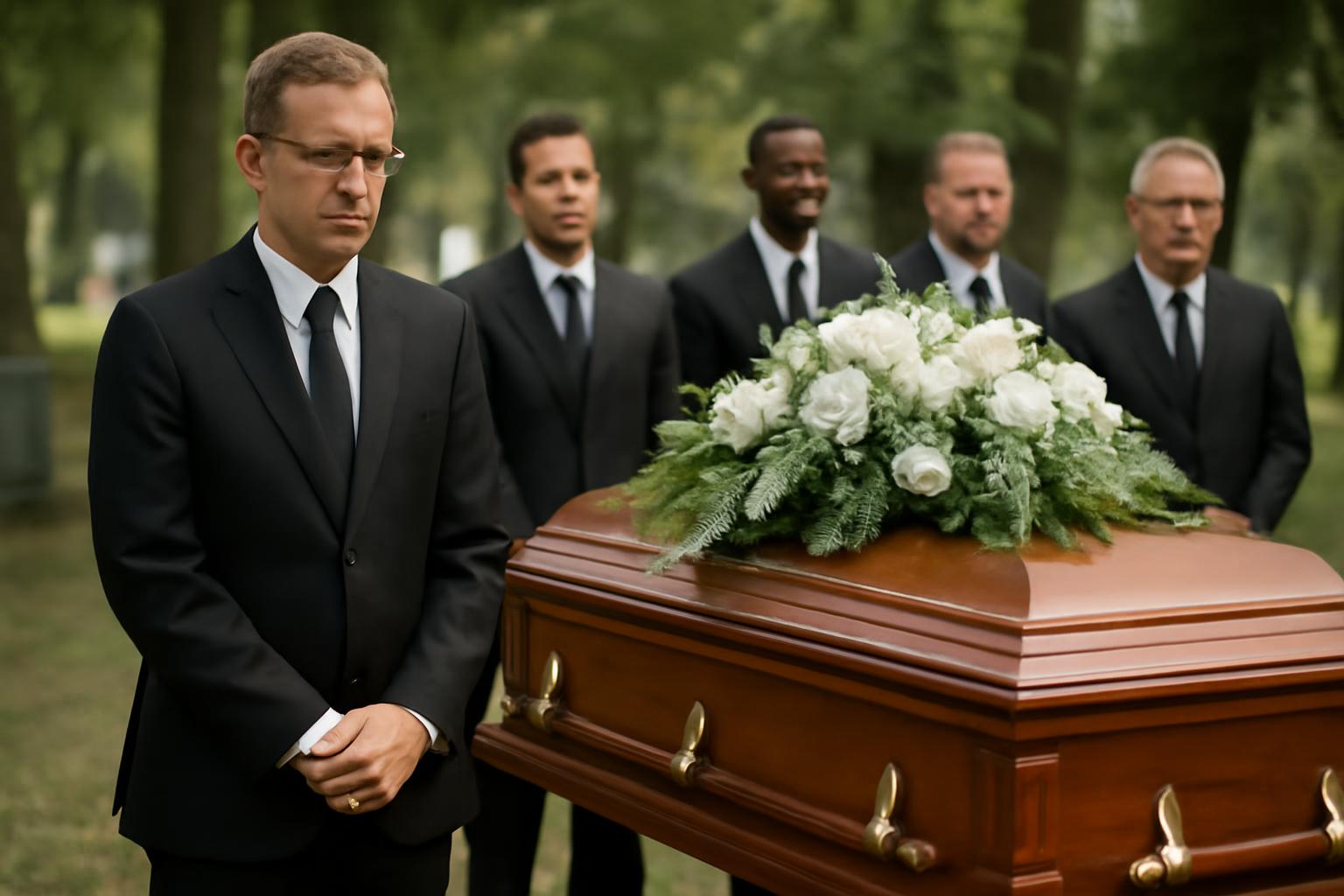
When a family wants to recognize someone important at a funeral but that person will not be lifting the casket, the role they often use is honorary pallbearer. It is a practical and compassionate way to include people who matter deeply to the deceased or the family without adding physical strain or logistical problems.
That makes the role especially useful when someone is elderly, injured, disabled, very young, emotionally overwhelmed, or simply one of several loved ones the family wants to honor beyond the available active pallbearer spots. Depending on the service, an honorary pallbearer may walk near the casket or urn, be listed in the program, be seated in a place of distinction, or be recognized verbally.
The key point is simple: an honorary pallbearer is part of the funeral’s circle of honor, but not part of the physical lifting team.
What Is an Honorary Pallbearer?
An honorary pallbearer is a person recognized during a funeral service without physically carrying the casket. The role is ceremonial rather than manual.
In a traditional funeral, active pallbearers are the people who carry or help escort the casket during major transitions, such as moving it into the service, back to the hearse, or to the graveside. An honorary pallbearer participates differently. The person may walk nearby in the procession, stand as the casket passes, accompany the group in another visible way, or simply be named in the printed program.
That distinction matters because families often want to honor someone’s relationship to the deceased even when carrying the casket would be difficult or inappropriate. Common examples include:
- an older relative
- a close friend with limited strength or mobility
- someone recovering from an injury
- a person with a disability
- someone whose grief may make lifting too hard
- a child or young teen the family wants to include symbolically
- additional loved ones beyond the six or eight active pallbearer positions
In many families, being named an honorary pallbearer is still a meaningful sign of trust and respect. It is not the same job as being an active pallbearer, but it is often intended as an important recognition of closeness, loyalty, or significance in the deceased’s life.
What honorary pallbearers actually do is less standardized than the basic definition. Some funeral homes describe the role as walking alongside the casket. Others place honorary pallbearers ahead of it, behind it, or nearby. In some services they do not join a procession at all and are instead acknowledged through seating or printed recognition. That variation is normal.
So if you are asking, “What exactly does honorary pallbearer mean?” the most reliable answer is this:
An honorary pallbearer is someone the family chooses to recognize as part of the funeral honor guard without asking that person to physically carry the casket.
Everything beyond that depends on the family’s wishes, the funeral director’s plan, the venue, and the kind of service being held.
Active Pallbearers vs. Honorary Pallbearers: Key Differences
The easiest way to understand the honorary pallbearer role is to compare it with the active role.
| Role | Main function | Physical lifting | Typical number | Usual considerations |
|---|---|---|---|---|
| Active pallbearer | Carries or escorts the casket during key moments | Yes | Often 6 to 8 | Strength, coordination, emotional steadiness, ability to follow direction |
| Honorary pallbearer | Participates symbolically and is recognized by the family | No | No fixed universal number | Relationship to the deceased, inclusion, accessibility, service format |
What active pallbearers do
Active pallbearers are the people assigned to the casket itself. In many traditional services, that means helping move the casket from one location to another at specific points in the funeral. Sources describing common practice often note that caskets have six or eight handles, so active pallbearers are frequently chosen one per handle.
The active role has genuine physical demands. Several funeral-planning sources describe empty caskets commonly weighing around 150 to 250 pounds, before adding the weight of the body. Exact total weight varies by casket material, the person’s size, and whether the casket is being fully carried or partly maneuvered with equipment such as a church truck or bier. Even when lifting happens only for short stretches, it requires coordination, stability, and the ability to move carefully over ramps, aisles, steps, curbs, or uneven cemetery ground.
That is why families often think about more than sentiment when choosing active pallbearers. Reliability matters, but so do physical capacity and emotional control.
What honorary pallbearers do
Honorary pallbearers do not lift the casket. Their participation is symbolic. They may:
- walk near the casket during a procession
- stand in recognition
- accompany the service group
- be acknowledged in the program
- sit in reserved seating
- be mentioned by the officiant or funeral director
Some services use the role to include people who would otherwise be left out because there are more loved ones than carrying positions. Others use it to accommodate age, disability, injury, or grief.
Why families use both roles
A family may need six or eight active pallbearers, but they may also want to honor twelve, fifteen, or more people who were central to the deceased’s life. The honorary pallbearer role helps solve that problem without turning the casket movement itself into a logistical risk.
It also gives families a more inclusive option. Someone can take part meaningfully without being asked to manage the physical realities of the active role.
Is honorary “lesser” than active?
There is no universal rule on how families view the two roles. Some funeral guidance describes them as equal honors; other advice treats honorary service more as an accommodation. The safest way to put it is this: both roles are usually intended as marks of respect, but they involve different responsibilities.
If you are planning a service, it helps to explain that distinction clearly so no one mistakes “honorary” for “unimportant.” The honor is real. The participation is simply different.
Who to Choose as an Honorary Pallbearer
Families usually choose honorary pallbearers from the people who had a meaningful relationship with the person who died. There is no official formula, but the most common choices include:
- close friends
- relatives
- coworkers or former colleagues
- neighbors
- fellow church or community members
- mentors or protégés
- members of a club, team, unit, or organization important to the deceased
The unifying idea is not status. It is connection.
Good candidates for the role
An honorary pallbearer is often the best choice for someone who clearly belongs in the funeral’s circle of honor but is not a good fit for active lifting. That may include:
- elderly relatives or friends
- people with limited mobility
- people who use wheelchairs or other mobility aids
- someone recovering from surgery or injury
- anyone with back, heart, or balance concerns
- a person whose grief may make carrying too difficult
- children or younger family members the family wants to include symbolically
- extra loved ones when active pallbearer slots are already filled
That last reason is common and easy to overlook. Even if a person is physically capable, a family may still name them an honorary pallbearer simply because the casket only requires a limited number of active bearers.
Choose for relationship first, practicality second
The best honorary pallbearers are usually people whose inclusion will feel obvious and meaningful to those attending the service. If mourners hear the names and immediately think, “Of course,” the family has probably chosen well.
After relationship, think about practicalities:
- Will this person be able to arrive on time?
- Can they follow simple instructions from the funeral director?
- Are they emotionally comfortable being publicly visible?
- If there is a procession element, can they manage the walking or standing involved?
- Would they prefer symbolic recognition only rather than movement during the service?
Honorary pallbearers are not doing the heavy lifting, but they still need to be dependable. A family should not have to chase people on the day of the funeral.
What about immediate family?
Advice here varies. Some funeral-planning guidance suggests choosing close friends rather than immediate family because close relatives may be seated together, greeting guests, or carrying more emotional strain. Other families do choose immediate relatives, including siblings, adult children, or grandchildren, whether in active or honorary roles.
So there is no fixed rule. A better question is: What will help this specific family and service run smoothly while honoring the right people?
If a close relative would be better seated with the family, an honorary mention in the program may be more appropriate than placing them in the procession. If they want active involvement and can manage it, that can work too.
No gender restriction
There is no reliable basis for saying only men should serve. Funeral-planning guidance commonly notes that men or women may be pallbearers. The same practical standard applies to honorary participation: choose the people who matter and whose participation suits the service.
Have backups when possible
Even honorary roles are easier when there is a backup plan. Travel delays, illness, or sudden emotional difficulty can happen. If your service depends on a visible procession arrangement, ask one or two extra people whether they would be willing to step in if needed.
That does not mean formalizing a long alternate list. It just means not leaving the day’s coordination to chance.
Duties and Participation for Honorary Pallbearers
One reason families ask what an honorary pallbearer does is that the answer can look very different from one funeral to the next.
There is no single universal script, but several types of participation show up repeatedly in funeral guidance.
Common ways honorary pallbearers take part
An honorary pallbearer may:
- walk alongside the casket
- walk ahead of it
- walk behind it
- flank it as it moves into or out of the service
- stand near the casket at a designated point
- follow in the formal procession
- accompany the person carrying an urn at a cremation service
- be recognized without any movement duty at all
Because funeral customs vary, the exact placement is usually set by the family in consultation with the funeral director.
Procession involvement
In many traditional services, honorary pallbearers are visible in the procession but do not touch the casket. They might enter the chapel just before or just after the casket, or they may walk nearby when the casket is moved to the hearse or graveside.
This is often the most natural format when the family wants an honorary pallbearer to be publicly included while still keeping active carrying limited to those physically prepared for it.
Standing or seating recognition
Not every service uses a walking role. Some honorary pallbearers are honored by being:
- listed in the printed order of service
- seated in a reserved section
- asked to stand when acknowledged
- given a badge or ribbon in traditions that use them
This approach can be especially appropriate when the service includes elderly participants, children, or anyone with mobility limitations.
Arrival and day-of coordination
Even though the role is symbolic, honorary pallbearers should still plan to arrive early. Funeral directors often give short instructions before the service begins, including:
- where to gather
- when to stand
- whether to join a procession
- whether to ride in a designated vehicle or travel separately
- where to sit after the casket or urn has been placed
If a motor procession is part of the funeral, some funeral homes may ask pallbearers to travel in a designated vehicle behind the hearse. In other cases, honorary pallbearers may drive themselves or sit with family. The right answer is not generic; it depends on the plan for that service.
Do honorary pallbearers greet guests?
Sometimes, but not always. Some guidance mentions greeting the family or mourners before the service, while other descriptions never include that duty. It is safer to treat greeting as an optional family preference, not a built-in requirement of the title.
If the family wants honorary pallbearers to help welcome guests, that should be stated clearly ahead of time. Otherwise, no one should assume it is part of the role.
The simplest working definition of the duty
If you want a practical summary, this is it:
Honorary pallbearers are present to honor the deceased visibly and respectfully, but without the physical work of carrying the casket.
That visibility may take the form of walking, standing, sitting in a reserved place, or being named publicly.
Honorary Pallbearer Etiquette Essentials
The etiquette for an honorary pallbearer is mostly the etiquette of respectful funeral participation, with a little extra emphasis on punctuality, appearance, and following direction.
Arrive early
Being early matters because funeral timing is tight. The funeral director may need a few minutes to explain where you should stand, when you move, and whether you are part of the procession. If you arrive late, you may miss the briefing and add stress for the family.
A good rule is to assume that “on time” means early enough to receive instructions calmly, not walking in at the posted service hour.
Dress conservatively
Traditional guidance for pallbearers generally recommends conservative funeral attire in dark or subdued colors. For honorary pallbearers, that usually means:
- a dark suit or jacket and tie
- a conservative dress
- a pantsuit or similarly formal outfit
- plain, respectful accessories
- shoes suitable for standing and walking
Footwear matters more than people expect. Even if you are not lifting the casket, you may be walking through parking lots, church aisles, funeral home corridors, or cemetery grounds. Shoes should be stable and comfortable rather than decorative.
If the family has requested a less formal dress code or specific colors, follow their wishes. Otherwise, understated is the safest choice.
Maintain composure
Tears are normal at funerals. No one expects honorary pallbearers to be emotionless. But because the role is visible, it helps to be honest with yourself beforehand.
If you think standing or walking in that position may become overwhelming, it is fine to discuss a modified role. For example, you might prefer to be listed in the program and seated rather than walking in procession. That can still honor the deceased while protecting your own well-being and keeping the service smooth.
Follow the funeral director’s cues
Honorary pallbearers should not improvise. If you have been told to walk behind the casket, do that. If you have been told to remain seated until a certain point, do that. If the director places you on one side of an aisle or in a reserved row, assume there is a logistical reason.
Funeral staff coordinate timing, spacing, safety, and visibility. Following cues is part of showing respect.
Plan transportation ahead of time
Do not assume you know where to go next. Ask:
- Am I meeting at the funeral home, the church, or the cemetery?
- Should I ride in a designated vehicle or drive myself?
- Am I joining the cemetery portion?
- Where should I park?
This is especially important if the service has more than one location.
It is acceptable to decline
If you are asked to serve as an honorary pallbearer but do not feel able to do it, a polite decline is acceptable. That may be because of health, travel, emotional strain, or discomfort with the visibility of the role.
A kind response can be brief: thank the family for thinking of you, explain that you are honored, and say that you do not want to risk being unable to fulfill what is needed. In many cases, families will understand immediately and may offer another way to include you.
Thank-you notes are a courtesy, not a rule
Some families send thank-you notes to pallbearers after the funeral. If they do, that is a thoughtful courtesy. If they do not, it should not be taken as a slight. During a period of grief, many normal social niceties become optional.
How Honorary Pallbearers Are Recognized and Listed
Recognition is where the honorary pallbearer role becomes most flexible.
Because the role does not depend on physical lifting, the family has several ways to honor people meaningfully without changing the service logistics very much.
Printed recognition in the funeral program
One of the most common methods is to list honorary pallbearers in the funeral program or service folder. They may appear:
- in their own section labeled “Honorary Pallbearers”
- near the active pallbearers
- alongside officiants, readers, or other service participants
This is often the clearest way to communicate the honor to attendees. It also works well for people who are elderly, absent, or not joining a procession.
Reserved seating or place of distinction
Some families choose to seat honorary pallbearers near the front or in another reserved area. This allows recognition without requiring extra movement.
Reserved seating is not universal, but it can be especially helpful when the service includes participants who need easier access, reduced walking, or more support.
Verbal acknowledgment
An officiant or funeral director may also mention honorary pallbearers during opening remarks or before the final committal. This can be brief and dignified, especially when the family wants the names heard aloud.
Badges, ribbons, or other markers
In some services, honorary pallbearers may be given a ribbon, badge, flower, or other small marker identifying their role. This is optional and less common than program listing, but it is one more way families personalize recognition.
Recognizing someone who is absent
Because honorary participation can be symbolic, families sometimes use it to honor someone who cannot be physically present. That might be because of illness, distance, military duty, incarceration, or another major barrier.
If a family wants to do this, the cleanest options are usually:
- listing the person as an honorary pallbearer in the program
- mentioning them verbally
- including a note such as “unable to attend” if the family wants that explained
Can someone deceased be recognized this way?
Some funeral-home guidance says yes: families occasionally name a deceased friend or relative as an honorary pallbearer because physical presence is not required. That is not a universal custom, but it does happen.
When families choose it, the role is purely symbolic. The recognition is typically made in the program or through spoken acknowledgment rather than any processional duty.
The funeral director ties it together
Because there are many possible recognition formats, the funeral director is often the person who helps convert a family’s intent into a workable plan. If the family says, “We want to honor eight active pallbearers, six honorary pallbearers, one elderly uncle in a wheelchair, and a cousin who can’t travel,” the director can suggest practical options for placement, timing, and printed wording.
That coordination prevents confusion and helps the honor feel intentional rather than improvised.
Honorary Pallbearers in Cremations and Non-Traditional Services
The honorary pallbearer role is most often discussed in connection with a casket funeral, but the idea can extend beyond that setting.
In cremation services
When there is an urn rather than a casket, some funeral guidance says honorary pallbearers may walk alongside or behind the person carrying the urn. In that setting, the role serves the same purpose: visible respect without physical carrying responsibility.
This can be especially meaningful in a cremation service that still includes a formal entrance, recessional, or cemetery inurnment.
In services without a casket
Traditional pallbearers are generally associated with services where a casket is present. If there is no casket at all, such as a memorial service held later, the active pallbearer role usually does not apply in the usual sense.
Even so, families may still adapt the honorary idea. For example, they might:
- list honorary pallbearers in the program
- reserve seating for them
- acknowledge them during remarks
- have them participate in a symbolic entrance, flower placement, or other family-designed moment
That is less a formal standard than a practical adaptation. In other words, the title can still work, but the duties need to be redefined because there is nothing to carry or accompany in the usual way.
Accessibility and mobility accommodations
The honorary role is one of the easiest ways to make funeral participation more inclusive. Some funeral etiquette guidance specifically notes that a person who cannot carry may accompany the casket while walking or using a wheelchair.
That matters because funerals often involve beloved elders, disabled family members, and others whose presence is deeply wanted but whose participation needs accommodation. An honorary pallbearer role lets them be seen and included without turning the day into a test of physical ability.
Green burial, graveside-only, and other formats
In less traditional formats, the same principle applies: the role is flexible, but the logistics must fit the service. A graveside-only ceremony, a chapel service followed by cremation, or a small private family event may all handle honorary pallbearers differently.
Because customs vary so much by venue and style, the best approach is to decide first what kind of recognition the family wants, then ask the funeral director how to stage it smoothly.
If your service is not a standard casket funeral, that conversation is especially important. A title can be meaningful, but only if everyone understands what it will look like in practice.
Final practical rule
For cremations and non-traditional services, think of “honorary pallbearer” less as a fixed task and more as a flexible form of recognition. The family defines the meaning; the funeral director helps translate that meaning into a workable plan.
Can a deceased person be named an honorary pallbearer?
Sometimes, yes. Some funeral guidance specifically notes that families may name a deceased friend or relative as an honorary pallbearer because the role does not require physical presence or carrying.
This is not a universal custom, so it is best treated as an optional symbolic gesture rather than a standard rule. If a family wants to do it, the recognition is usually handled in the funeral program or by a spoken acknowledgment during the service.
How many honorary pallbearers should you have?
There is no fixed universal number.
Unlike active pallbearers, who are often limited by the number of casket handles and the practicalities of moving the casket, honorary pallbearers are more flexible. Some services have only one or two. Others include a larger group because the family wants to recognize many close friends, relatives, or colleagues.
The real limit is logistics. If the number becomes so large that it complicates seating, the procession, or the program, it may be worth simplifying the role or using a broader acknowledgment instead. A funeral director can help you choose a number that feels generous without becoming awkward.
What should honorary pallbearers wear?
The safest choice is conservative funeral attire in dark or subdued colors.
That usually means a dark suit, tie, dress, pantsuit, or similarly respectful outfit, along with comfortable, sturdy shoes suitable for walking and standing. Even though honorary pallbearers are not lifting the casket, they may still move through the procession or across uneven ground.
If the family has asked for specific attire, follow that request. Otherwise, choose clothing that is neat, modest, and unobtrusive.
Is it ok to decline serving as an honorary pallbearer?
Yes. It is acceptable to decline politely if you are uncomfortable with the role or unable to participate as needed.
A brief, gracious response is enough. You can thank the family for the honor, explain that you do not feel able to serve, and express your support in another way. Most families would rather hear an honest answer in advance than have someone struggle on the day of the funeral.
Who decides honorary pallbearer details like position?
Usually the family decides the overall intent, and the funeral director helps determine the practical details.
Because honorary pallbearers may walk beside, ahead of, or behind the casket—or may be recognized only through seating or the program—the exact arrangement depends on the service style, venue, family preference, and funeral-home guidance. If there is any uncertainty, defer to the funeral director’s instructions on the day.
The honorary pallbearer role is a flexible, inclusive way to recognize important relationships during a funeral without the physical demands of carrying the casket. Because customs differ by family, venue, and service type, confirm the details with your funeral director so the role is clear and well coordinated. This guide is general information only and not a substitute for advice from a licensed funeral director, attorney, or estate professional. Laws, customs, and costs vary by state, locality, and tradition.