
18 min read ·
How to Dress Respectfully and Safely When Carrying the Casket
Black is traditional and dependable, but it is not a universal requirement. Family wishes, terrain and the carrying role shape the right choice.
This is general etiquette and preparation guidance. The family’s wishes and service-specific instructions from the funeral director, officiant, or ceremonial authority take precedence.
The short answer: a reliable pallbearer outfit
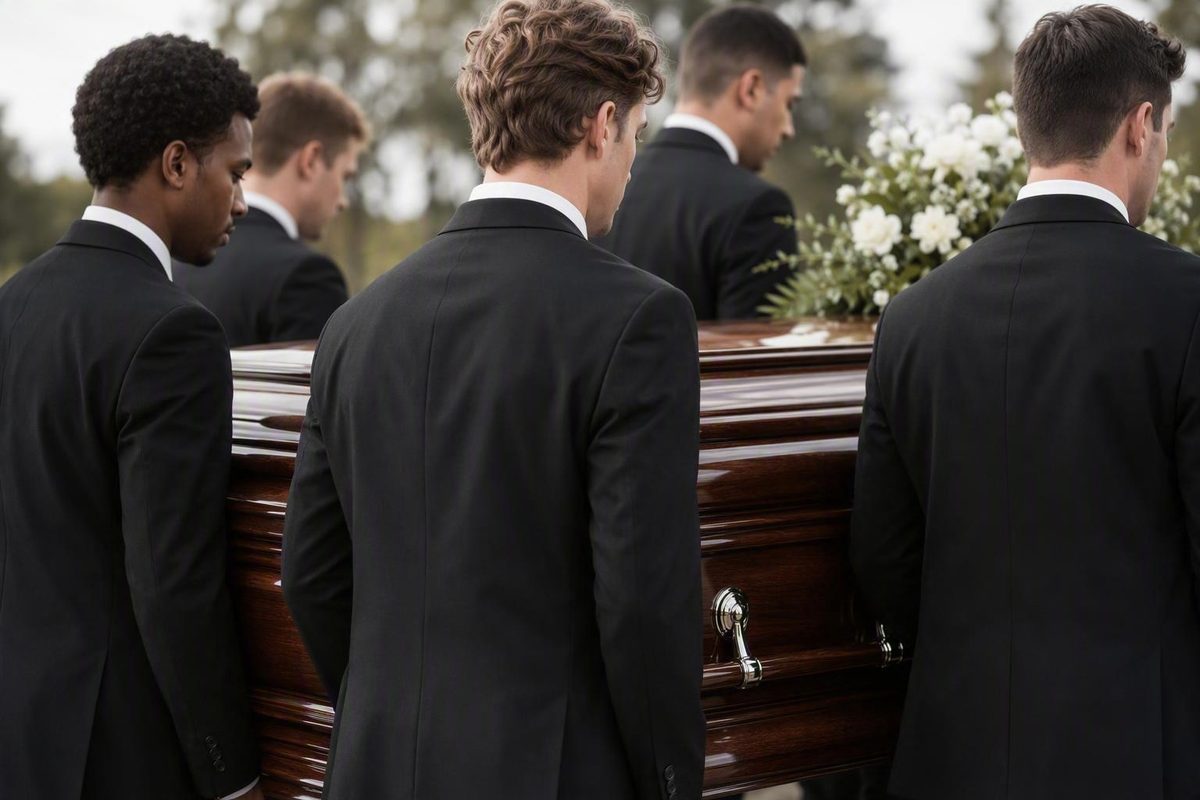
If nobody has provided a dress code, choose a dark suit or comparably formal dark outfit, a white or muted shirt or blouse, an understated tie if you wear one, and clean dark shoes with dependable traction. Black is traditional, but charcoal, dark navy, and deep gray are also suitable defaults. This is customary guidance, not a universal dress code.
Pallbearer attire has to do two jobs. It should look respectful and subdued, but it must also allow you to walk, bend, reach, and lift without restriction. Pallbearers may cross grass, gravel, uneven pavement, or other cemetery ground, so footwear and freedom of movement deserve as much attention as color and formality. Funeral-service guidance recommends conservative clothing, secure shoes with reliable traction, and following the family’s wishes above general convention (Evergreen Funeral Service’s pallbearer guidance).
Three dependable outfit formulas are:
- Dark suit, shirt, and tie: A black, charcoal, dark navy, or deep-gray suit; white or muted dress shirt; restrained tie; and secure dark shoes.
- Dark trouser suit or pantsuit: A coordinated dark jacket and trousers; muted blouse, shell, or dress shirt; and stable shoes.
- Movement-friendly dress or formal separates: A subdued dress, or a skirt or tailored trousers with a blouse and optional jacket, paired with shoes suited to the route.
Choose clothing that is clean, neat, and unlikely to attract attention through bright patterns, prominent branding, conspicuous accessories, or poor fit. At the same time, do not confuse “subdued” with “uncomfortable.” An outfit that pinches at the shoulders, restricts your stride, or needs constant adjustment is not a practical carrying outfit.
Most importantly, a request from the family overrides the default. The family may ask everyone to wear a particular color, dress casually, choose clothing connected to the deceased’s interests, or follow a celebration-of-life theme. Those instructions are not less respectful because they differ from traditional black funeral attire. Respect means supporting the family’s plans, not enforcing a rule they did not choose.
If the instructions are incomplete, ask rather than guess. A brief clarification can prevent unnecessary spending and make it easier for the pallbearers to coordinate.
Use this priority order when deciding what to wear
General funeral etiquette is only a fallback. When recommendations conflict, use this order:
- Follow the family’s stated request.
- Confirm applicable religious, cultural, military, or organizational protocol.
- Follow the funeral director’s, officiant’s, or service coordinator’s instructions.
- Coordinate with the other pallbearers.
- Use conventional dark formal or semi-formal attire when no other guidance exists.
Start by checking the obituary, invitation, funeral notice, memorial website, or direct message from the family. Look for references to colors, uniforms, themes, footwear, or the expected level of formality. The notice may request bright colors, business-casual clothing, a team color, traditional dress, or attire associated with the deceased. It may also identify whether the service is at a place of worship, funeral home, cemetery, private residence, or outdoor location.
Do not turn broad cultural examples into rules. Customs vary among families and within religious and cultural communities. Even if you have attended another funeral in the same tradition, expectations may differ at this service. Ask the family, officiant, or funeral director for service-specific guidance instead of relying on a generalized list of what a community supposedly wears.
The same caution applies to uniforms. A uniformed pallbearer should consult the relevant branch, department, honor guard, ceremonial unit, or protocol authority.
When contacting the family or coordinator, you can adapt this message:
“Is there a requested color or level of formality, should the pallbearers coordinate, and are there any footwear, cultural, religious, or ceremonial requirements?”
This asks the necessary questions without placing a large decision-making burden on someone who is grieving. If possible, direct the question to the person already coordinating the pallbearers rather than contacting several relatives separately.
The funeral director is the best contact for practical carrying details. Ask whether the procession will go outdoors, what terrain it will cross, whether stairs are involved, and whether the service moves between indoor and outdoor locations. Funeral staff commonly explain positioning, timing, and movement, and pallbearers should follow their directions even if they have carried a casket before (Evergreen Funeral Service’s guidance on funeral-director instructions).
Do not assume that an item must automatically be removed.
If you receive conflicting messages, return to the designated family contact or service coordinator. Resolve the disagreement privately instead of debating attire with other pallbearers immediately before the service.
Inclusive outfit options for active and honorary pallbearers
Choose clothing according to the service’s formality, the family’s expectations, and the physical demands of the role—not a mandatory gender-based formula.
Suitable options include:
- A conventional dark suit
- A trouser suit or pantsuit
- A movement-friendly dark dress
- A skirt with a blouse, jacket, or other formal top
- Tailored dark trousers with a dress shirt or blouse
- Coordinated formal separates
- Requested cultural, ceremonial, or uniform attire
Whatever the garment, favor subdued colors, secure closures, and cuts that permit a full stride and comfortable movement through the knees, hips, shoulders, and arms. Check that nothing drags, slips, catches, or requires repeated adjustment.
For a dress or skirt, practical questions matter more than a universal hemline or style. Can you take a full step? Can you bend your knees without the garment binding? Can you reach forward without the neckline, sleeves, or bodice shifting? Does the outfit work with stable footwear? Will the hem remain clear of your feet?
A dark trouser suit with flat shoes or low, stable block heels can be a practical choice, but it is only one option. Funeral-home guidance recognizes that women may serve as pallbearers and recommends conservative dark dresses or suits with shoes suitable for walking on grass (Forest Lawn’s tips for pallbearers).
It is also useful to distinguish the two roles:
- An active pallbearer physically assists with carrying or moving the casket as directed.
- An honorary pallbearer is recognized as part of the funeral but does not physically carry the casket.
An honorary role can preserve meaningful participation when carrying is not appropriate or desired. If you have a mobility, health, balance, pain, or other concern that could affect carrying, discuss it privately with the family or funeral director before the service. Do not independently change roles after the procession has been arranged. Funeral-service guidance identifies honorary participation as a possible alternative for someone who cannot take on the active role (Batchelor Brothers Funeral Services’ pallbearer guidance).
Unless organizers say otherwise, honorary pallbearers can dress to the same level of formality as active pallbearers. Similar clothing visually connects them with the group and acknowledges the shared honor. They may, however, receive different instructions about seating, procession order, boutonnieres, uniforms, or ceremonial details.
If you need an accommodation or particular footwear, tell the coordinator what you require and ask whether the route presents any relevant obstacles. The funeral director—not a general article—should confirm how the service can be arranged.
What to wear when you do not own a suit
You do not universally have to own or buy a black suit to serve as a pallbearer. A suit is a dependable traditional choice, but it is not the only way to look respectful and coordinated.
The strongest no-suit formula is:
- A dark blazer or sport coat
- Dark dress trousers
- A white or muted button-down shirt
- An understated tie when appropriate
- Clean, dark, dressy shoes with stable footing
The jacket and trousers do not need to match exactly. They should look intentional together and remain close in formality. A dark navy blazer with charcoal trousers, for example, generally appears more subdued than a sharply contrasting or brightly patterned combination. A commercial funeral-attire guide likewise presents a dark blazer or sport coat with a button-down shirt, restrained tie, dark trousers, and dark shoes as its leading alternative when a suit is unavailable (TieMart’s no-suit funeral attire guide).
If you do not have a jacket, use:
- Dark dress trousers
- A solid, long-sleeve dress shirt in white or a muted color
- A subdued tie if it suits the service
- Clean dark shoes
Make sure the shirt is neat and fits securely when you reach and bend. Without a jacket, fit and presentation are more visible, so try on the complete combination before the service.
Borrowing or renting may be practical, but neither is automatically necessary. Borrow only if the garment allows comfortable movement and the shoes fit securely. A jacket that restricts your shoulders or borrowed shoes that slip at the heel replace an appearance concern with a practical one. Renting may make sense if the family requests identical formalwear, but confirm the expectation before spending money.
Pallbearers can coordinate economically by agreeing on a palette and level of formality rather than purchasing identical outfits. A simple plan such as “dark neutral jacket and trousers, white or muted shirt, subdued tie, and dark shoes” creates visual cohesion while allowing each person to use clothing they already own.
In a last-minute situation, prioritize the cleanest, darkest, least attention-drawing outfit available and contact the family’s point person or funeral director. Do not withdraw solely because you are anxious that your clothing is not perfect. A specific message is easier to answer than a general question:
“I do not own a suit, but I have dark dress trousers, a white shirt, a navy blazer, and dark stable shoes. Will that fit the plans?”
Be cautious with fallbacks intended for general funeral attendees. A dark polo, sweater, khakis, clean jeans, or similarly casual clothing may suit a requested casual service, but it is not automatically the best choice for an active pallbearer at a formal funeral. If casual clothing is all you have, disclose that rather than assuming you cannot participate. The family may confirm that the service is informal or help identify another option.
Choose shoes for traction, stability, and the route
For an active pallbearer, footwear is a safety decision as well as an appearance decision. The route may include grass, gravel, mud, uneven pavement, curbs, stairs, wet flooring, or transitions between surfaces. Funeral-service guidance specifically advises supportive shoes and warns that pallbearers may encounter uneven cemetery ground (Schilling Funeral Home’s guidance for pallbearers).
Choose shoes that are:
- Clean and in good condition
- Supportive and comfortable
- Securely fitted
- Already broken in
- Suitable for the expected terrain
- Compatible with your mobility or medical needs
- Equipped with traction appropriate to the conditions
When safer options are available, avoid slick soles, loose footwear, unstable heels, and unfamiliar new shoes. Forest Lawn advises pallbearers to wear shoes suitable for walking on grass, while other funeral-provider guidance recommends reliable traction because cemetery surfaces may be uneven (Forest Lawn’s footwear guidance).
Flat shoes and low, stable block heels can both be practical. There is no universal heel-height rule: stability depends on the person, shoe construction, fit, surface, weather, and route. The relevant question is whether you can walk and carry securely in the actual setting.
Adapt the choice to expected conditions:
- Wet grass or mud: Favor dependable tread and a secure fit.
- Gravel: Choose a stable base that does not shift underfoot.
- Stairs or uneven pavement: Make sure the shoe remains firmly on your foot and permits controlled steps.
- Rain or snow: Favor weather-suitable footwear with traction, accounting for both outdoor ground and wet indoor flooring.
- Long processions or standing periods: Wear shoes that remain comfortable without changing your gait.
These are practical selection factors, not requirements for a particular brand, material, or style. If you use adaptive footwear, orthotics, braces, or medically necessary shoes, do not replace reliable footwear merely to imitate a conventional dress-shoe appearance. Ask the funeral director whether the route includes lawns, steps, slopes, or a long outdoor distance and explain any limitation that staff need to consider.
Before the service, try on the shoes with the socks or hosiery you will wear. Walk, turn, stop, and take several normal steps on a safe surface. If the heel lifts, the sole slips, or the shoe causes pain, choose a more dependable pair if one is available. This is a personal fit check, not a substitute for route-specific instructions from funeral staff.
Test the outfit for lifting and remove avoidable hazards
Do not wait until the funeral to discover that your jacket restricts your reach or that a hem catches underfoot. Put on the complete outfit—including underlayers, socks, outerwear, accessories, and shoes—and perform a brief movement check.
Try the following:
- Reach both arms forward.
- Raise and relax your arms to check the shoulders and sleeves.
- Bend your knees while keeping your footing stable.
- Take several full steps.
- Turn slowly and stop under control.
- Sit and stand to check the waist, shirt, skirt, or dress.
- Look down to confirm that hems and trouser legs remain clear of your shoes.
The jacket, shirt, trousers, skirt, or dress should not bind, ride up, drag, gape, or slip. Buttons and closures should remain secure. Commercial pallbearer guidance specifically recommends checking shoulder movement, full steps, and knee bending before the service (Memorials.com’s pallbearer attire guide).
Review loose items that could distract you or interfere with movement. When appropriate, a tie can be tucked inside a closed jacket or secured discreetly. Long hair can be controlled if it obstructs your view, and bulky pocket contents can be left elsewhere. Keep only what you need.
Use the same judgment with jewelry. Loose bracelets, long necklaces, raised rings, or large accessories may catch on clothing. This does not mean every pallbearer must remove all jewelry: wedding rings, religious jewelry, family pieces, and uniform items may be important. Adjust individual items only as needed and follow funeral-staff instructions. Guidance recommending secured ties, controlled hair, light pockets, and attention to snag-prone accessories should be treated as practical preparation rather than a universal ceremonial rule (Memorials.com’s carrying-focused guidance).
Use restrained fragrance and understated accessories unless the family requests something different. The aim is not to erase personal style but to avoid drawing unnecessary attention or creating discomfort in close indoor spaces.
It also helps to distinguish ceremony attire from carrying-stage adjustments. An overcoat, scarf, hat, ceremonial accessory, or other item may be appropriate during one part of the service but need securing before lifting. Conversely, weather may make outerwear necessary throughout. Ask staff what should happen and when.
Do not automatically remove a religious garment, uniform component, coat, tie, hat, or piece of jewelry. Customs and ceremonial requirements differ, and some items should remain in place. The funeral director, officiant, or relevant protocol authority should resolve the question.
Complete the movement check early enough to make a modest adjustment. You may only need a roomier shirt, lighter pockets, different shoes, a secured tie, or a less restrictive outer layer. The goal is not to create a perfect outfit from scratch; it is to identify foreseeable interference.
Adapt the outfit to the service, weather, and setting
The most appropriate pallbearer attire depends on the location, formality, family’s request, and expected conditions. Use these scenarios as adaptable starting points.
Traditional or formal service: Choose a dark suit or equivalent formal outfit, a white or muted shirt or blouse, an understated tie if worn, and secure dark footwear. Black is dependable, but charcoal, dark navy, and deep gray are also conventional options.
Casual funeral or celebration of life: Dark coordinated separates may be suitable, and a tie may be optional when that matches the requested tone. A blazer with trousers, a trouser suit with a muted top, or another polished combination can remain respectful without making the service more formal than intended. Follow any request for a particular color, themed shirt, or casual clothing.
Hot weather: Look for breathable, lightweight formal clothing that still permits comfortable movement. Do not assume that a jacket or tie may be omitted; ask the coordinator whether the pallbearers are expected to make the same adjustment.
Cold weather: Use warm layers and subdued, practical outerwear. Ask staff whether a long or bulky coat needs to be secured or adjusted before carrying rather than removing weather protection prematurely.
Rain: Prepare for outdoor moisture and wet indoor floors with weather-suitable layers and footwear offering reliable traction. If you plan to carry an umbrella before the procession, ask staff where it should be left before you take your carrying position.
Snow or freezing conditions: Prioritize secure footing, warmth, and weather protection. If you are considering separate indoor and outdoor shoes, confirm that the schedule and venue provide an appropriate place to change.
Graveside or outdoor service: Give extra attention to the forecast, terrain, layers, hem length, and shoe stability. A short route may still include grass, slopes, curbs, mud, or gravel. Funeral-home guidance notes that service location, season, weather, and graveside terrain can all affect attire and footwear choices (Wiles Remembrance Centers’ funeral-attire guidance).
Multiple locations: If the funeral includes a place of worship, procession, cemetery, and reception, choose an outfit that works indoors and outside. Secure layers are often more adaptable than one heavy garment.
Religious or cultural service: Do not prescribe a color or garment based on a broad description of the tradition. Ask the family, officiant, or funeral director about head coverings, colors, footwear, modesty expectations, ceremonial items, and any instructions specific to pallbearers.
Military or veteran funeral: Dress uniforms may be used in some services, but the relevant branch or ceremonial authority must confirm the proper uniform and protocol. Civilians should not add military-style items without instruction.
In every setting, return to the same functional test: Can you remain appropriately dressed, move without restriction, and follow staff directions without repeated clothing adjustments?
Coordinate with the group and complete a final check
Pallbearers do not universally need identical outfits. Similar formality and a shared dark-neutral palette often provide enough visual cohesion. One person may wear black, another charcoal, and another dark navy without the group looking disorganized, especially when the shirts, ties, or overall formality are coordinated.
Choose one point of contact to relay the family’s decisions. That person can confirm:
- Requested colors
- Suit, jacket, or uniform expectations
- Whether ties are requested
- Whether honorary pallbearers dress the same way
- Outdoor conditions and terrain
- Any family-provided item, such as a boutonniere
- Where and when pallbearers should report
A concise coordination message is:
“I have a charcoal suit and dark shoes. Are we coordinating suit colors, shirts, ties, or any other details?”
If you do not own a suit, describe what you have: “I have a navy blazer, charcoal dress trousers, a white shirt, and dark stable shoes. Does that work with the group?” Specific information is easier to answer than “What should I wear?”
Before leaving home, complete this final check:
- [ ] I reviewed the family’s dress request and service notice.
- [ ] I confirmed any cultural, religious, military, or ceremonial requirements.
- [ ] I know whether the pallbearers are coordinating colors, ties, jackets, or uniforms.
- [ ] I checked the weather and prepared for indoor and outdoor transitions.
- [ ] I asked about the route or terrain if it could affect my footwear.
- [ ] My shoes are secure, supportive, broken in, and appropriate for the expected surface.
- [ ] I performed a movement check in the complete outfit.
- [ ] My clothes remain secure when I reach, bend, and take a full step.
- [ ] My fragrance and accessories are restrained.
- [ ] Jewelry and long hair are controlled as needed.
- [ ] My pockets are light and free of bulky objects.
- [ ] My phone is silenced or turned off.
- [ ] I know the requested arrival time and meeting place.
Arrive at the time specified by the family or funeral home. There is no universal reporting time for every service. The funeral director needs an opportunity to gather the group, explain positions, and address changes, so do not assume that the public ceremony time is also the pallbearers’ arrival time.
Listen closely even if you have served before. The route, venue, equipment, and procedure may differ. Funeral-home guidance emphasizes following instructions from the family and funeral staff rather than relying on what happened at a previous service (Schilling Funeral Home’s pallbearer guidance).
If you are uncertain about carrying safely, raise the concern early and privately. You do not need to disclose more personal information than is necessary. An honorary role may be an alternative, but the family or funeral director must confirm the change and arrange the procession accordingly.
Respectful presence, safe movement, and support for the bereaved matter more than exact matching. Clothing serves the ceremony—not the other way around.
Frequently asked questions
Do pallbearers have to wear black?
No. Black is traditional and dependable, but it is not a universal requirement. Charcoal, dark navy, and deep gray are commonly recommended alternatives. If the family requests another color, casual clothing, ceremonial dress, or a celebration-of-life theme, follow that request.
When no guidance is available, choose dark, subdued formal or semi-formal clothing and stable shoes. Concentrate on neatness, coordination, and freedom of movement rather than treating black as the only respectful color.
Can a pallbearer wear a blazer and dress trousers instead of a suit?
Yes, provided the family has not required a suit or matching formalwear. A dark blazer or sport coat with dark dress trousers, a white or muted shirt, an understated tie when appropriate, and clean dark shoes is the strongest no-suit alternative.
Keep the pieces similar in formality and test the jacket for unrestricted shoulder movement. For a highly formal or coordinated service, confirm the combination with the group’s point of contact.
Should all pallbearers wear matching outfits?
Not necessarily. Identical clothing may be requested for a ceremonial or highly coordinated service, but it is not a universal rule. Most groups can look cohesive by agreeing on dark neutral colors and a similar level of formality.
Coordinate the most visible details first: suits or jackets, shirt colors, ties, shoes, and any requested ceremonial item. Exact shades and garment styles need not match unless the family or relevant protocol authority says otherwise.
What shoes should a pallbearer wear for a graveside service?
Wear clean, supportive, broken-in shoes with a secure fit and dependable traction. Account for grass, gravel, mud, slopes, uneven pavement, curbs, rain, or snow.
Avoid slick soles, loose footwear, unstable heels, and unfamiliar new shoes when you have a safer option. Medically necessary or adaptive footwear should take priority over imitating a conventional dress-shoe style. Ask the funeral director about the route if terrain or mobility is a concern.
What should an honorary pallbearer wear?
Unless organizers provide different instructions, an honorary pallbearer can dress to the same level of formality as the active pallbearers. That may mean a dark suit, trouser suit, dress, formal separates, uniform, or family-requested clothing.
Because an honorary pallbearer is recognized without physically carrying the casket, the role can preserve meaningful participation when carrying is not appropriate. Confirm the arrangement with the family or funeral director, including where to sit or walk and whether honorary and active pallbearers will coordinate clothing.
Follow the family’s wishes, match the service’s formality, wear stable shoes, test the complete outfit for movement, and ask the funeral director about anything uncertain. Black is a dependable tradition rather than a universal requirement. Respectful participation and safe carrying matter more than achieving a perfectly matched appearance.