
19 min read ·
How to Dress Respectfully for a Wake Without Overthinking It
Without a dress code, choose clean, modest business-casual clothes in muted colors. Bright colors, jerseys or casual dress come first when the family asks.
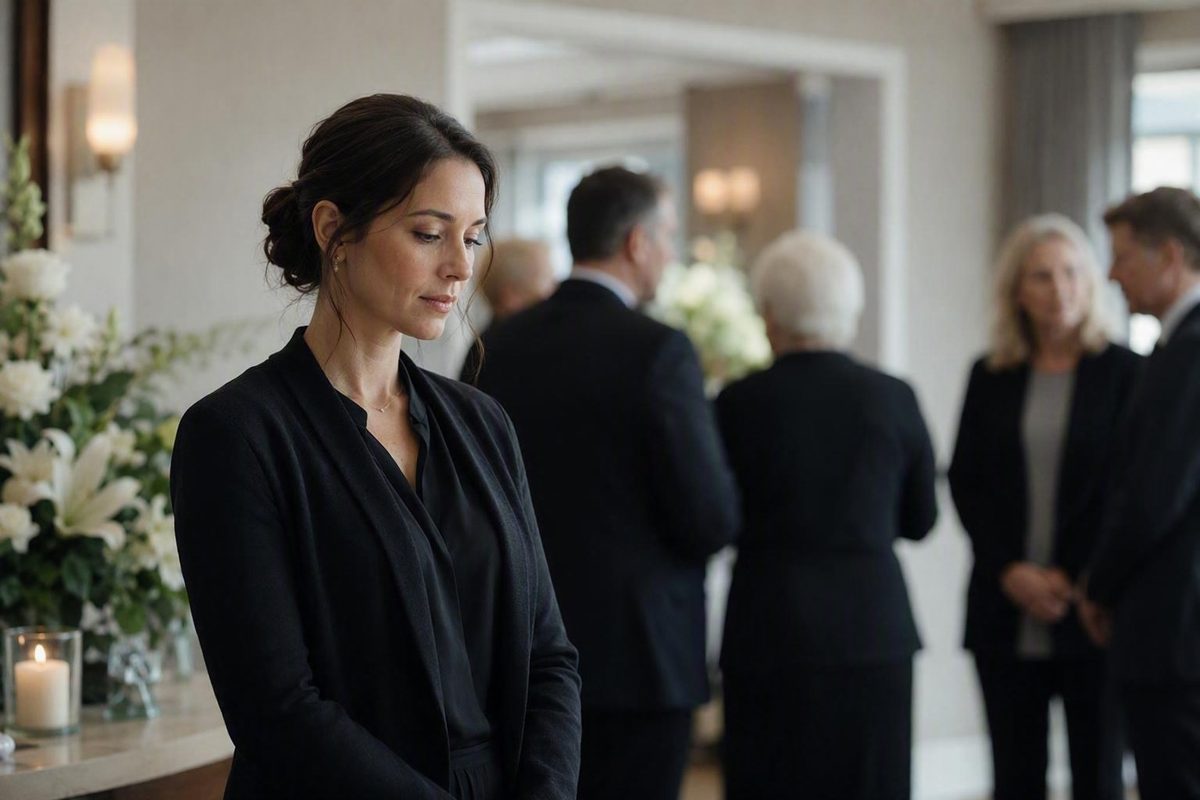
The short answer: choose neat, subdued clothing that does not draw attention
When no dress code has been provided, appropriate attire for a wake is clean, modest business-casual or semi-formal clothing in a dark or muted color. You do not need to wear all black, buy formalwear, or assemble a perfect outfit.
Two reliable formulas are:
- Dark slacks or chinos with a plain collared shirt, neat knit top, or simple sweater
- Tailored pants, a skirt, or a modest dress with simple shoes and an optional cardigan or blazer
The aim is to look presentable without making your clothing the focus. A wake is an opportunity to pay respects, remember the person who died, and support the bereaved—not a test of how well you understand formal etiquette.
Black remains a safe choice in many Western settings, but it is not mandatory. Navy, charcoal, gray, dark brown, deep green, burgundy, and other quiet colors can work just as well. General funeral-home guidance recommends conservative, business-casual-to-formal clothing in dark or muted colors while emphasizing that attendance and support matter more than ideal attire (Bateman-Allen Funeral Home’s attire guidance).
If you are unsure, use this order:
- Follow the family’s instructions.
- Respect relevant cultural or religious customs.
- Consider the venue and stated formality.
- Adjust for weather, terrain, comfort, and practical needs.
- If none of those factors settles the question, use the conservative business-casual default.
A request for colorful clothing, a favorite team jersey, workwear, or casual dress overrides the usual preference for subdued clothing. Ceremony-specific requirements may matter more than whether an outfit would ordinarily count as business casual. Practical shoes may also be more suitable for an outdoor gathering than polished shoes that make walking difficult.
Start with your own closet. Clothes that are clean, in good condition, reasonably wrinkle-free, and understated are usually enough. Pressing a shirt, removing lint, cleaning your shoes, or adding a simple cardigan or jacket can make an ordinary outfit look more intentional.
If what you own is not ideal but is neat, comfortable, and unlikely to attract attention, attend with confidence. Respectful presence matters more than buying a new black outfit.
How formal is a wake compared with a funeral?
A wake is generally a gathering where people pay their respects, remember the person who died, and offer condolences to family and friends, often before a funeral. It may involve conversation, photographs, prayers, storytelling, a receiving line, or time near an open or closed casket.
The terms wake, viewing, and visitation often overlap, but families and funeral homes do not always use them in exactly the same way. A viewing usually indicates that the body is present and may be viewed, while a visitation may occur with an open casket, a closed casket, or no casket. The event name alone therefore does not establish the dress code (Empathy’s guide to wake and viewing attire).
Wakes, viewings, and visitations are often somewhat less formal than funeral services, but that is a starting point rather than a universal rule. Some wakes follow nearly the same expectations as the funeral, while some funerals and celebrations of life are deliberately casual. Funeral-home guidance commonly presents business-casual or smart-casual clothing as suitable for a wake while describing funeral attire as generally more formal (Perinchief Chapels’ comparison of wake and funeral attire).
Dress for the particular event:
- Funeral-home wake, viewing, or visitation: Use the conservative baseline—subdued slacks, chinos, a skirt, a modest dress, a collared shirt, a simple blouse, or a sweater.
- Formal religious service: A suit, coordinated jacket and trousers, tie, modest dress, or similarly polished separates may be appropriate.
- Private-home gathering: Less formal clothing may be suitable, but do not assume that a home gathering is automatically casual.
- Celebration of life or explicitly casual event: Follow the stated theme or instructions, even when they differ from traditional mourning attire.
- Outdoor or graveside gathering: Keep the overall appearance neat while adapting your shoes and outerwear to the weather and ground.
The family’s wishes, the ceremony, the venue, and the event’s formality are more useful guides.
If you are attending both a wake and a funeral and cannot change, choose an outfit suitable for the more formal event. Dark trousers or a modest dress with a cardigan, blazer, or jacket can work for both. A tie or structured layer can be added for the funeral and removed during a less formal visitation.
Safe, inclusive outfit formulas using clothes you may already own
It is more useful to organize wake outfits by formality than by gender. Dresses are not required for women, suits are not required for men, and no particular garment belongs exclusively to one identity. Choose what fits you, the event, and the clothes you already have.
Standard business-casual wake
For most wakes without special instructions, suitable combinations include:
- Dark slacks or chinos with a plain collared shirt
- Tailored trousers with a simple blouse or neat knit top
- Dark pants with a crew-neck or V-neck sweater
- A skirt with a modest blouse, sweater, or cardigan
- A knee-length or longer simple dress with understated shoes
- Subdued separates with an optional blazer or structured cardigan
“Knee-length or longer” is a useful conservative option, not a measurement that must be enforced. The broader question is whether the garment lets you sit, stand, greet people, and move through the venue without frequent adjustment.
A plain polo may work in a business-casual setting if it is clean, subdued, and paired with neat trousers. If you are choosing between a polo and a graphic T-shirt, the polo is safer. If the choice is between wrinkled formal pants and clean, well-fitting chinos, the chinos may create the more respectful overall presentation.
More formal wake or religious service
For an event calling for greater formality, consider:
- A dark suit with a subdued shirt and polished shoes
- A coordinated jacket and trousers
- A modest dress with a blazer or tailored coat
- A skirt or tailored pants with a restrained top and structured jacket
- Dark dress pants with a pressed collared shirt and optional tie
A tie is usually optional unless the family, venue, ceremony, or your specific role indicates otherwise. Pallbearers, for example, may receive separate clothing instructions.
If you do not own a suit, you generally do not need to purchase one. Neatly pressed dark trousers with a collared shirt, blouse, sweater, or restrained top are a reasonable alternative. A cardigan or blazer can add formality, but it is not essential when the rest of the outfit is clean and polished.
Explicitly casual wake
If the obituary, invitation, or family clearly requests casual clothing, suitable options may include:
- Dark, undistressed jeans with a plain collared shirt
- Clean jeans with a simple sweater or knit top
- Dark jeans with a blouse and cardigan
- Chinos with a plain polo or button-down shirt
- Casual trousers with a restrained top and clean shoes
Jeans are context-dependent rather than automatically disrespectful. Dark, clean, intact jeans can work at a clearly informal gathering, particularly when the rest of the outfit looks intentional. If expectations are unknown, however, slacks or chinos remain the safer choice.
A low-cost formula
You can usually build an appropriate outfit from neutral basics:
- Choose the cleanest, best-fitting dark trousers, skirt, or simple dress you own.
- Add a plain shirt, blouse, knit top, or sweater.
- Remove lint and press visible wrinkles.
- Clean or wipe down your shoes.
- Add one structured layer if it improves the outfit.
Condition and presentation matter more than price, labels, or whether the clothes were marketed as funeral wear. Borrowing a jacket may help, but it is not necessary. The objective is respectful presence, not an expensive wardrobe.
Colors, patterns, shoes, and accessories: what is conventional without making it a rule
Black is traditional in many Western mourning settings, but it is only one suitable option. If you do not own black clothing—or it does not fit, suit the weather, or allow comfortable movement—choose another subdued color.
Low-risk choices include:
- Navy
- Charcoal
- Medium or dark gray
- Dark brown
- Deep green
- Burgundy
- Muted blue
- Taupe and other quiet neutrals
A lighter neutral shirt or blouse can be paired with darker trousers, a skirt, or a jacket. White, cream, pale blue, or a muted pattern does not make an outfit inherently inappropriate. The complete presentation matters more than one color.
Mourning colors and customs vary among cultures and families, so no color should be assigned a universal meaning. Blanket rules requiring black or prohibiting white are unreliable. When a particular tradition may be relevant, confirm the family’s expectations instead of trying to infer them from generalized etiquette.
For the lowest-risk choice, wear solid colors or small, subdued patterns. Fine stripes, restrained checks, and subtle floral designs may be suitable. Large graphics, fluorescent colors, prominent slogans, sequins, reflective fabrics, and loud contrasting patterns are more likely to draw attention.
Bright clothing can nevertheless be exactly right when the family requests it. Guests may be asked to wear the deceased’s favorite color, avoid black, display a team color, or dress for a celebration of life. Religious practices, community traditions, and commemorative clothing can also change what is appropriate (Tharp Funeral Home’s wake-clothing guidance).
Shoes
Conventional choices include:
- Loafers
- Flats
- Low or stable heels
- Polished dress shoes
- Plain boots
- Other clean, simple shoes
Closed-toe shoes are common, but they are not universally required. Choose footwear that lets you stand and walk comfortably. Clean, understated sneakers or supportive shoes may be reasonable when mobility, pain, work, travel, weather, or terrain makes them the practical option. Medically necessary footwear does not become inappropriate because it is less formal.
For an outdoor or graveside portion, prioritize shoes that can handle grass, gravel, mud, rain, snow, or uneven ground. Practical footwear is preferable to formal shoes that increase the risk of slipping, sinking into wet ground, or being unable to participate comfortably (Bateman-Allen Funeral Home’s practical footwear guidance).
Jewelry, bags, headwear, and fragrance
When no special guidance is given, keep accessories understated. A small bag, simple belt, ordinary watch, restrained jewelry, or meaningful memorial item is generally unobtrusive. This is not a ban on self-expression; it is simply a way to keep the clothing from becoming distracting.
A head covering worn as part of your faith—or required by the ceremony—may be appropriate. Expectations for other hats and headwear depend on the family, building, ceremony, and local custom. If you are uncertain, ask the venue or follow the family’s and officiant’s lead.
Avoid heavy perfume, cologne, or strongly scented products in a crowded indoor setting because they can distract or cause discomfort. General wake-attire guidance also recommends subdued accessories and a light approach to fragrance (Empathy’s guide to wake and viewing attire).
Jeans, sneakers, suits, ties, and bright colors: a conditional guide
Borderline items are easiest to assess in three groups: safest choices, context-dependent choices, and items usually best avoided.
Safest choices
When the family has not provided instructions, dependable options include:
- Tailored pants or dark slacks
- Chinos
- A modest dress
- A skirt with a simple blouse or sweater
- A plain collared shirt
- A restrained knit top
- A cardigan, blazer, or coordinated jacket
- Loafers, flats, low heels, dress shoes, or similarly simple footwear
- Solid colors or small, subdued patterns
These choices look polished without requiring full formalwear. They are also easy to adjust: add a jacket or tie for greater formality, or remove the jacket if the gathering is relaxed.
Context-dependent choices
Jeans: Clean, dark, undistressed jeans may work when the family requests casual clothing or the gathering is clearly informal. Pair them with a plain shirt, blouse, sweater, cardigan, or blazer. If you do not know what is expected, choose slacks or chinos instead.
Sneakers: Conventional guidance favors simple dress shoes, but clean, understated sneakers or supportive footwear may be reasonable for mobility, injury, work, travel, weather, or uneven terrain. Footwear should not be treated as a test of sincerity.
Suits: A dark suit is appropriate and can be especially suitable for a formal service, religious venue, or ceremonial role. It is usually not mandatory for an ordinary guest.
Ties: A subdued tie can make an outfit more formal, but it is generally optional unless expectations indicate otherwise. If uncertain, you can bring one and decide after seeing how the family or other attendees are dressed.
Bright colors and commemorative clothing: Bright clothing, uniforms, team apparel, or hobby-related clothing can be respectful when requested by the family. Such garments may reflect the deceased’s work, interests, identity, or community.
White or light clothing: A light shirt, blouse, jacket, or dress is not inherently disrespectful. Its suitability depends on the complete outfit and any relevant family, cultural, or ceremonial custom.
Items usually best avoided
Unless the family’s instructions make them appropriate, avoid:
- Graphic T-shirts or clothing with prominent slogans
- Athletic wear, gym clothes, or beachwear
- Ripped, stained, frayed, or visibly dirty garments
- Clothing that requires constant adjustment
- Very revealing garments
- Large or loud patterns
- Conspicuously flashy or noisy accessories
- Flip-flops or pool shoes in a conventional indoor setting
- Clothing carrying an offensive, provocative, or unrelated message
The issue is not that any fabric or style is inherently disrespectful. These items are simply more likely to look careless or make the clothing more noticeable than the occasion.
Fit, cleanliness, condition, and the overall combination are more useful indicators than price. An inexpensive pair of clean chinos and a pressed shirt may look more appropriate than an ill-fitting designer suit. Funeral and visitation guidance similarly treats a full suit as optional and dark, undistressed jeans as potentially suitable only in some casual settings (Funeral.com’s visitation and viewing outfit guide).
Let the family, faith tradition, and venue override generic etiquette
Before choosing your outfit, check the information available to you:
- Obituary
- Funeral-home notice
- Invitation
- Memorial or event page
- Text or email from the family
- Social media announcement
- Instructions from the venue or officiant
Look for phrases such as “casual attire,” “please wear bright colors,” “no black,” “wear blue,” “team apparel welcome,” or “come as you are.” These requests may be part of how the family wants to remember the person who died, not merely optional suggestions.
Family preferences may include:
- A favorite color
- A sports jersey or team color
- Military, first-responder, or occupational uniforms
- Motorcycle or club clothing
- Clothing related to a hobby
- Commemorative shirts
- Traditional cultural clothing
- A request for casual dress
- A request to avoid black
Following a meaningful request is not a breach of etiquette simply because the clothing would be unconventional at another wake. In that setting, participating in the family’s chosen tribute is the respectful choice.
Cultural and religious mourning practices differ, and conventional Western advice about dark clothing should not be treated as universal. Do not assume that a family follows a particular custom based on names, appearance, nationality, or presumed identity. Practices can vary among families, congregations, regions, and levels of observance.
A religious building or ceremony may have expectations involving modesty, head coverings, footwear, or ceremonial garments. Confirm rather than guess. Contact the family, officiant, funeral home, or venue if the published information does not answer your question.
A tactful way to ask is:
“I want to dress respectfully—has the family shared any preferences for the wake?”
If contacting an immediate family member might create more work during a difficult time, ask the funeral home, venue, a more distant relative, or another knowledgeable attendee.
The venue can suggest a level of formality, but it should not be your only evidence. A private home may host a highly traditional wake, while a funeral home may host an informal celebration. A restaurant, beach, community hall, or sports club may also have practical considerations that differ from those of a chapel. Use stated instructions first and the venue as supporting context.
Dress for weather, travel, work, accessibility, and children
Respectful clothing also has to be workable. Weather, disability, health, travel, caregiving, employment, and children’s needs are legitimate considerations—not etiquette failures.
Hot weather
Choose breathable fabrics, lightweight clothing, and simple layers. Suitable options include:
- Lightweight tailored trousers with a short-sleeved collared shirt
- A modest breathable dress
- A skirt with a lightweight blouse
- Chinos with a plain polo or neat knit top
- A light cardigan or unlined blazer that can be removed
Avoid beachwear unless the event is explicitly casual or the family requests it. Shorts, swimwear, pool shoes, and highly casual tank tops are less suitable when expectations are unknown. A restrained sleeveless dress or top may work, and a light cardigan or wrap can provide flexibility.
Cold, rainy, or snowy weather
Wear neat layers, a subdued coat, and weather-appropriate shoes or boots. Your coat does not have to be black; navy, gray, brown, dark green, or another quiet color is fine.
If the event includes a cemetery visit or outdoor gathering, consider:
- Water-resistant shoes or boots
- Soles suitable for wet or uneven ground
- A warm, unobtrusive coat
- Gloves and a simple scarf
- An umbrella
- Layers that can be removed indoors
The priority is to remain presentable while being able to stand, walk, and move between indoor and outdoor locations safely.
Accessibility, medical needs, and sensory comfort
Comfort, mobility, adaptive clothing, and medically necessary footwear should not be sacrificed for conventional etiquette. Wear what allows you to sit, stand, move, use mobility aids, manage pain, and attend safely.
Make the outfit as neat and subdued as reasonably possible, then prioritize access and health. Mobility aids and medical equipment do not need to match or be concealed for an outfit to be respectful.
Coming from work, school, caregiving, or travel
If you must arrive directly from work and changing is impractical, a clean work uniform may be acceptable. Remove conspicuous casual accessories or tidy up where feasible, but do not skip the wake merely because you cannot achieve ideal formalwear. Funeral-home guidance specifically recognizes work uniforms as a reasonable exception and places attendance and support above wardrobe perfection.
The same principle applies when coming from school, an airport, a long drive, or caregiving duties. Reasonable adjustments include:
- Removing a sports cap
- Changing a graphic top for a plain one
- Adding a sweater, cardigan, or jacket
- Wiping down your shoes
- Leaving travel gear in the car or coat area
- Choosing the neatest available clothes in your luggage
Do what is practical without treating imperfect clothing as a reason not to attend.
Children and teenagers
Children can wear neat, comfortable, subdued clothing such as:
- Simple pants or chinos with a plain shirt
- A skirt with a sweater or blouse
- A modest dress
- Dark jeans with a plain top at a casual event
- A school-appropriate collared shirt or knit top
- Clean, comfortable shoes
Children do not need miniature versions of adult formalwear. A suit, tie, formal dress, or uncomfortable shoes may make an unfamiliar and emotional event harder to manage. Funeral and cemetery guidance supports comfortable, conservative clothing for children while recognizing that very young children may wear practical everyday clothes (The Gardens’ wake-attire guidance).
For babies and very young children, bring necessary layers, supplies, and a change of clothes. For teenagers who own mostly casual clothing, choose the cleanest, least conspicuous combination available and add a plain sweater or jacket if practical.
A final decision tree and five-point outfit check
When you need to decide quickly, use this sequence.
Step 1: Has the family made an explicit request?
If yes, follow it. Bright colors, no black, casual clothing, uniforms, team apparel, or commemorative dress should take priority over generic etiquette.
If no, continue to the next step.
Step 2: Are there cultural or religious requirements?
Check for expectations involving modesty, head coverings, footwear, ceremonial clothing, or color. Confirm with the family, officiant, funeral home, or venue instead of relying on assumptions.
If no special requirement applies—or none has been communicated—continue.
Step 3: What do the venue and event format suggest?
A formal religious service may justify a suit, tie, jacket, modest dress, or polished separates. A standard funeral-home visitation usually suits the subdued business-casual baseline. A private home or casual celebration may allow greater flexibility, but stated instructions remain more important than location alone.
Step 4: What practical adjustments are necessary?
Account for heat, cold, rain, snow, outdoor terrain, travel, work, mobility, medical footwear, and children’s needs. Choose clothing that lets you participate comfortably and safely.
Step 5: Use the conservative default
If none of the earlier steps gives you a clear answer, wear clean, modest business-casual or semi-formal clothing in dark or muted colors.
Five ready-to-use examples are:
- Standard wake: Charcoal trousers, a plain shirt or sweater, and clean loafers or flats
- More formal wake: A dark suit or coordinated jacket and trousers with a subdued shirt, polished shoes, and an optional tie
- Casual request: Dark undistressed jeans, a plain top or collared shirt, an optional cardigan or blazer, and clean understated shoes
- Warm weather: Lightweight tailored pants or a modest breathable dress in a muted color with simple shoes
- Cold or outdoor gathering: Dark trousers, a sweater or collared shirt, a neat coat, and weather-appropriate footwear
Before leaving, apply this five-point check:
- Is the outfit clean and in good condition?
- Is it comfortable enough for standing, sitting, walking, and the length of the event?
- Is it modest and subdued, unless the family requested otherwise?
- Does it suit the venue, weather, and terrain?
- Is it unlikely to make the clothing the focus?
If the answer to those questions is yes, the outfit is probably appropriate.
Do you have to wear black to a wake?
No. Black is a safe and traditional choice in many Western settings, but it is not required. Navy, charcoal, gray, dark brown, deep green, burgundy, and other muted colors are also conventional options.
A lighter neutral shirt or blouse can work with darker trousers, a skirt, or a jacket. If the family requests bright colors, a favorite color, or no black, follow that request. Mourning customs vary, so no single color should be treated as universally required or prohibited.
Can you wear jeans to a wake?
Sometimes. Clean, dark, undistressed jeans can be appropriate when the family has requested casual clothing or the gathering is clearly informal. Pair them with a plain collared shirt, blouse, sweater, cardigan, or blazer and clean shoes.
When no dress code is available, slacks or chinos are the safer conventional choice. Jeans are not inherently disrespectful; their suitability depends on the event’s formality, their condition, the rest of the outfit, and the family’s wishes.
Do you need to wear a suit or tie to a wake?
Usually not. A suit is appropriate for a formal wake, religious service, or role requiring greater formality, but most guests can wear polished business-casual clothing instead.
Dark trousers with a pressed collared shirt, restrained top, sweater, blazer, or cardigan are reasonable alternatives. A tie is generally optional unless requested or customary for the ceremony, venue, or your role.
What should children or teenagers wear to a wake?
Children and teenagers can wear neat, comfortable, subdued clothing. Suitable options include simple pants, chinos, a skirt, a plain shirt, a sweater, a modest dress, or dark jeans at an informal gathering.
They do not need adult-style suits or formal dresses. Prioritize clothes that allow them to sit, move, and manage an unfamiliar or emotional occasion comfortably. For a teenager with mostly casual clothes, choose the cleanest and least conspicuous combination available.
Who should you ask when you are unsure about the dress code?
First check the obituary, invitation, event page, funeral-home notice, and messages from the family. If none gives an answer, ask the funeral home, venue, officiant, someone close to the family, or another knowledgeable attendee.
A simple script is: “I want to dress respectfully—has the family shared any preferences for the wake?” If contacting the immediate family might add stress, direct the question to the funeral home or another attendee instead.
When no special instructions exist, choose something clean, comfortable, modest, and subdued that suits the venue and weather. Make practical accommodations without embarrassment, and remember that sincere presence and support matter more than wearing black, owning formalwear, or purchasing a new outfit.