
13 min read ·
What Focal Role Do Sunflowers Play in Floral Arrangements?
They usually lead the eye, but smaller varieties can serve as secondary focals beside a larger bloom. Use visual weight to decide which flower leads.
Overview
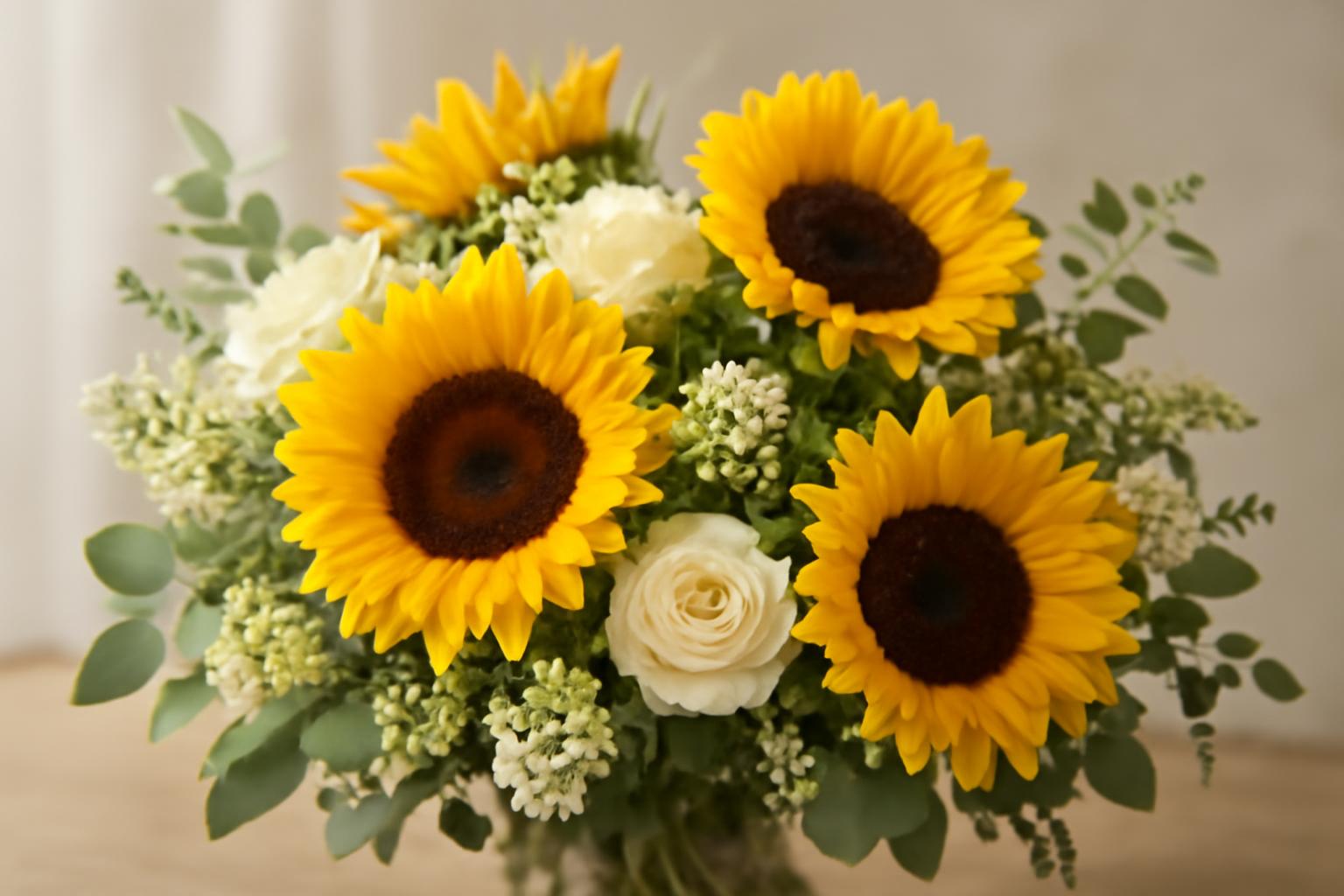
Sunflowers usually act as primary focal flowers in arrangements. Their large, brightly colored faces attract attention and establish where the eye looks first. Smaller sunflower varieties can instead become secondary focals when a larger or more visually prominent flower is meant to lead the design.
The sunflower’s exact role therefore depends on relative visual weight, meaning how strongly a flower attracts and holds attention compared with everything around it. Bouqs describes large sunflowers as focal flowers rather than supporting blooms, while Evans Flowers attributes their natural focal effect to bold size and color.
Once the role is clear, the remaining decisions become easier. The arranger can choose an appropriate number of sunflower heads, position them intentionally, and build outward with medium flowers, smaller accents, foliage, and open space. The goal is not simply to include sunflowers. It is to decide how much visual authority they should have.
Why Sunflowers Command Focal Attention
Sunflowers command attention because several prominent visual features appear together. The broad flower face forms a clear, recognizable shape, while the strong color and substantial bloom size give it more visual weight than many smaller flowers and delicate materials. Flower Synergy notes that the large blooms create visual impact without requiring many stems.
In practical terms, the focal flower establishes the design’s visual hierarchy. Hierarchy is the order in which the eye notices the arrangement’s components. The primary focal receives attention first, secondary forms or colors receive attention next, and smaller accents complete the composition without becoming its main subject.
That first decision affects more than flower choice. According to Sierra Flower Farm’s explanation of floral components, focal flowers commonly guide the style, color palette, and overall shape of a bouquet or arrangement. A sunflower placed high and forward can create a different emphasis from the same bloom placed lower among softer materials. The flower has not changed, but its position and relationship to nearby flowers have changed its authority.
This is why a sunflower should not be treated as interchangeable filler. Even one well-positioned head can pull the eye toward a particular area. Several heads can establish a repeated path through the design, but they can also compete with one another if every bloom has the same height, direction, and spacing.
The practical question is therefore not whether sunflowers are noticeable. They usually are. The question is whether the design should reinforce that natural prominence or deliberately place it beneath another focal element.
Decide Whether the Sunflower Is the Primary or Secondary Focal
Choose the sunflower’s role by comparing it with the other flowers in the arrangement. A focal is not defined by its name alone. Its role depends on whether it is the largest or most attention-holding component and whether the arranger intends viewers to notice it first.
| Design consideration | Sunflower as primary focal | Sunflower as secondary focal |
|---|---|---|
| Relative bloom size | The sunflower is among the largest faces in the arrangement. | A smaller sunflower appears beside a larger focal bloom. |
| Visual weight | Its size, color, position, or repetition attracts the eye first. | Another flower carries more visual weight and receives attention first. |
| Intended emphasis | The arrangement is organized around the sunflower faces. | The sunflower supports the principal bloom and provides a second place for the eye to rest. |
| Relationship to smaller materials | Medium and small components step down from the sunflower. | The sunflower helps bridge the transition from the largest focal to smaller accents. |
| Practical role | It sets the main visual direction. | It adds a recognizable face, color, rhythm, or continuity without becoming the central subject. |
This distinction is particularly useful with mini sunflowers. In the Six Elements of Floral Design explanation of secondary focals, mini sunflowers are presented as secondary focal flowers when paired with a larger, more visually prominent bloom. Their open faces still attract attention, but their smaller relative size allows them to support the dominant flower.
The same variety can therefore occupy different roles in different arrangements. A mini sunflower may lead a design composed mainly of delicate foliage and small accents. Place it beside a much larger focal bloom, and it can become a transitional component instead.
The deciding test is straightforward: identify where the eye goes first. If the sunflower holds that attention and the rest of the design supports it, it is the primary focal. If another bloom clearly leads and the sunflower connects that bloom to smaller materials, the sunflower is acting as a secondary focal.
Choose the Quantity and Placement of the Focal Blooms
Begin with a restrained quantity and add more only when the arrangement’s scale calls for it. Published arranging guidance repeatedly uses one to three sunflower heads as a starting range. Fiore Designs suggests that one to three heads can produce a cleaner, more balanced bouquet than a round design packed with large faces, while Fruits and Flowers recommends two to three sunflower focal points surrounded by medium flowers.
That range is a starting point, not a universal prescription. One sunflower can create a decisive focal point. Two can establish a visual relationship between different areas. Three can guide the eye through a triangular or staggered placement without requiring every head to sit together.
Position matters as much as count. Bouqs recommends spreading sunflower heads through a mixed bouquet instead of placing them all in one area. Distributed placement allows the focal color and shape to appear from more than one viewing angle. It also prevents a single dense block from becoming visually and physically heavy.
Place each head with a clear purpose. One might establish the main focal area, while another repeats the color lower or farther back. The arrangement should still have a readable priority rather than several equal clusters competing for attention.
Scale the Starting Count to the Bloom and Arrangement
Adjust the starting count by judging proportion, not by applying a fixed stem formula. Proportion concerns the relative sizes of the arrangement’s parts, while scale concerns how the completed design relates to its container and surroundings. The supplied evidence does not establish a dependable calculation connecting bloom diameter, vessel dimensions, and sunflower count.
A single large head can carry considerable visual weight in a compact arrangement. The same head may feel less dominant in a larger composition with more space, taller lines, or another substantial focal flower. Conversely, three broad sunflower faces may overwhelm a small vessel even though three falls within the commonly suggested starting range.
The container also changes how the flowers read. A vessel with strong visual presence needs flowers that look proportionate to it, but that does not automatically mean adding more sunflower heads. Height, stem spacing, supporting foliage, and the size of the other blooms can increase the arrangement’s apparent scale without repeating the focal face.
The University of Rhode Island’s basic floral-design guidance defines proportion through the relative size of an arrangement’s parts and advises fitting the finished design to its surroundings. Applied here, the principle is to evaluate each sunflower in context. Start with a small number, step back, and add another only if the design needs greater visual weight or a clearer path for the eye.
Adapt Focal Placement to the Arrangement Format
Placement should reflect where the arrangement will be seen and what the focal flowers need to accomplish. The available evidence supports several broad applications, although it does not provide rigid rules for every bouquet, centerpiece, tall design, or installation.
- In a bouquet, use the sunflower to establish a clear viewing area while distributing additional heads so the design does not become a flat cluster of matching faces.
- In a centerpiece, arrange the focal heads for the intended viewing angles and keep their height compatible with the design’s practical setting.
- In larger event work, concentrate sunflowers where they mark an important area rather than repeating them uniformly across every piece.
Fiore Designs describes sunflowers leading the eye in a bridal bouquet, creating a strong ceremony cluster, or appearing selectively in key reception arrangements. This supports a placement principle based on emphasis: use the blooms where their visual presence performs a specific job.
For a bouquet, that job may be giving the design a recognizable front and a clear visual center. For a centerpiece, it may be carrying the eye around a lower grouping. For ceremony or reception work, it may be identifying selected focal locations without making every arrangement equally sunflower-heavy.
The form changes, but the underlying decision remains consistent. Place the sunflower where attention should land, then use supporting materials to connect that point to the rest of the design.
Build a Supporting Hierarchy Around the Sunflowers
Supporting materials should reinforce the sunflower’s focal role through differences in size, form, height, and texture. If every flower is equally large, bright, and forward-facing, the viewer has little guidance about where to look first. A clearer hierarchy lets the sunflower lead while other components provide continuity and depth.
Smaller flowers can surround sunflower heads without repeating their full visual weight. Bouqs specifically identifies smaller asters and chrysanthemums as supporting options in mixed sunflower designs. Fruits and Flowers also suggests grasses, wheat stalks, or ferns for height and movement.
Foliage and linear materials have a different job from face flowers. They can extend the outline, create direction, or separate prominent heads. Airier textures can soften the transition into open space. None of these materials needs to disappear, but they should not unintentionally become another dominant mass.
Build from the focal decision outward. If sunflowers are primary focals, select companions that step down in visual weight. If mini sunflowers are secondary focals, place the largest bloom first in the hierarchy, use the mini sunflowers as an intermediate layer, and reserve the smallest flowers or foliage for detail.
Supporting flowers are most effective when they connect rather than compete. Their purpose is to make the focal placement feel intentional, give the eye a path through the arrangement, and prevent the sunflower heads from looking isolated.
Use Medium Blooms to Bridge the Scale
Medium blooms create a gradual transition between broad sunflower faces and delicate filler. Without that intermediate layer, a large focal bloom placed directly beside tiny flowers can produce an abrupt change in scale. A medium flower gives the eye a visual step between the two.
A practical hierarchy begins with a few sunflower faces, continues through medium flowers, and finishes with smaller blooms, foliage, grasses, or other airy elements. Fruits and Flowers gives daisies, zinnias, and gerberas as examples of medium flowers around two to three sunflower focal points. The principle is more important than any single flower list: the transitional layer should carry less visual weight than the sunflower but more than the smallest accents.
Medium face flowers can also repeat part of the sunflower’s shape without matching its size. That repetition can create rhythm while preserving the hierarchy. The eye recognizes a relationship among the blooms, yet the larger sunflower remains the dominant destination.
Sierra Flower Farm characterizes supporting floral components as a buffer between bold focal flowers and subtler filler or airy materials. In a sunflower arrangement, that buffer prevents the design from jumping directly from a few visually heavy faces to scattered fine details.
The result should read in stages. The viewer notices the sunflower, moves to the medium flowers, and then discovers the smaller textures and greenery.
Choose a Palette That Preserves the Hierarchy
Color can reinforce sunflower dominance or soften it, depending on how much contrast and repetition the design contains. Because the supplied evidence does not test specific palette formulas systematically, contrasting, warm, and neutral directions are best treated as conceptual choices rather than universal combinations.
A contrasting palette can make the sunflower’s yellow or warm color appear more pronounced. Cooler blue-purple notes, for example, may create a stronger visual distinction, but their effect still depends on proportion, saturation, placement, and the other materials present.
A warm-harmonious direction can repeat related golden, orange, or red notes. This can integrate the sunflower into a broader field of warm color, although too many similarly strong flowers may weaken the focal hierarchy. The sunflower remains dominant only if its size, position, or visual weight still distinguishes it.
A softened-neutral direction can place the sunflower near whites, creams, pale flowers, or restrained greenery. Evans Flowers offers white roses, lisianthus, and snapdragons as possible companions. These examples show how lighter supporting flowers can surround the sunflower without necessarily matching its intensity.
Whichever direction is chosen, one component should remain visually dominant. Since focal flowers can guide the arrangement’s palette and style, color should support the intended order of attention rather than create several unrelated points of equal strength.
Keep Bold Focal Blooms from Overpowering the Design
Preserve the sunflower’s impact by using restraint, separation, varied heights, and contrasting textures. Too many large faces at one level can turn an arrangement into a dense block. The problem is not that sunflowers are inherently unsuitable for mixed designs. It is that their visual weight compounds quickly when they are repeated without enough variation or breathing room.
Several practical checks help prevent that effect:
- Leave visible space around at least some sunflower heads instead of pressing every bloom against its neighbor.
- Stagger focal flowers so the heads do not form one flat row or a single round mass.
- Vary stem heights enough to create depth while keeping the intended focal area readable.
- Turn heads in considered directions rather than making every face point identically forward.
- Alternate broad flower faces with medium blooms, foliage, grasses, or finer textures.
- Remove a sunflower if repetition is making the design feel heavier rather than clearer.
Evans Flowers advises against overcrowding because sunflowers benefit from room in a bouquet. Sierra Flower Farm similarly recommends varying heights, slightly staggering focal flowers, and letting linear flowers extend upward to produce a layered composition.
Asymmetry can further reduce blockiness. It does not require making the arrangement unstable or visually random. It means allowing the focal weight to be distributed unequally but deliberately. A principal sunflower can sit near the main focal area, while a second or third head appears at a different height or depth to continue the eye’s movement.
Negative space is equally functional. Open areas define the edges of each bloom and make individual sunflower faces easier to read.
Restraint also prevents the arrangement from becoming overly literal or repetitive. Fiore Designs warns that too many sunflower heads can make a bouquet look bulky. Since large blooms already provide substantial impact, adding more is not always the best way to strengthen the focal point. A clearer placement, stronger height relationship, or better transition into supporting flowers may accomplish more.
The final test is whether the eye can identify a principal area and then move through the rest of the design. If every sunflower demands equal attention at once, reduce, reposition, or separate the focal faces until the hierarchy becomes legible.
Support Heavy Heads and Thick Stems
Successful focal placement must work physically as well as visually. Sunflower heads are heavy and their stems are thick, so an ambitious angle or elevated position needs adequate anchoring. Fiore Designs notes that their heavy heads and thick stems make secure mechanics especially important.
Start by checking whether the vessel and internal support can hold the intended position. A visually balanced placement may still fail if a heavy head pulls its stem outward, rotates away from the focal area, or shifts the arrangement’s weight toward one side. The container should have enough physical presence for the finished design, and the stems should remain securely supported.
The selected stem length also affects stability. The Mississippi State University Extension guide to designing with sunflowers and zinnias notes that heavy-headed sunflower stems can be cut short and layered in a waterproof container. It also recommends large, heavy containers for a simple sunflower design. These are format-specific options, not requirements for every arrangement, but they illustrate the connection between head weight, stem length, and vessel support.
Hydration must remain part of the design plan. Stems need reliable access to water, and any mechanics used should not defeat that requirement.
Finally, set each head’s direction before treating the focal placement as finished. A sunflower face that turns away from the intended viewing area changes the hierarchy even if its stem remains secure. Step back from the arrangement, check the primary viewing angles, and confirm that the focal heads point where attention is meant to land.
Sunflowers usually lead arrangements because their broad faces, strong color, and visual weight command attention, but deliberate role selection, restrained quantity, layered support, open space, and secure mechanics determine whether that focal impact feels balanced.