
18 min read ·
The Safest Way to Dress for a Black-Tie Event
Standard black tie generally calls for a tuxedo or dinner suit, and a black business suit remains a suit even when paired with a bow tie or patent shoes.
The short answer: what black tie means for a man
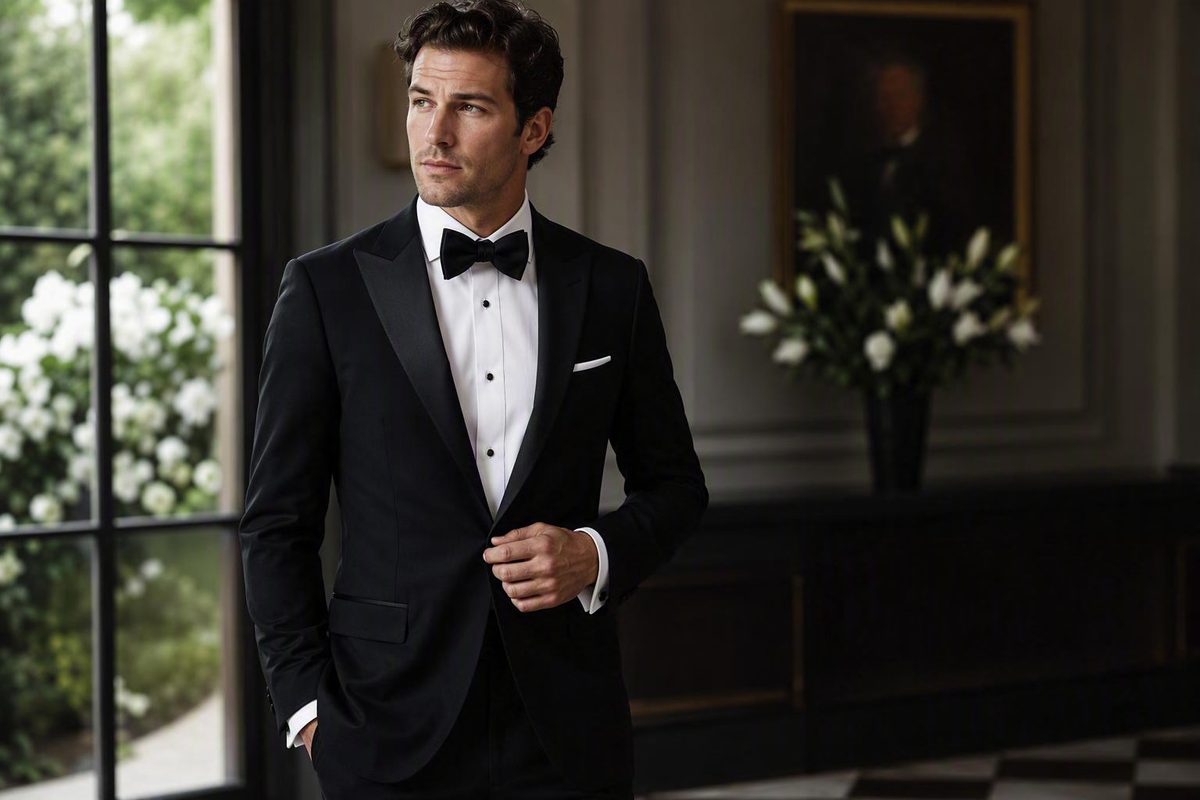
For a man, standard black-tie attire means a tuxedo, also called a dinner suit, worn with a white formal shirt, black bow tie, matching formal trousers, and polished black shoes. A regular black or dark business suit with a black necktie is not the traditional equivalent. As GQ’s explanation of black-tie attire puts it, the invitation calls for a tuxedo and bow tie—not simply a suit and a black tie.
The safest one-line formula is:
Black or midnight-blue dinner jacket + matching tuxedo trousers + white formal shirt + black bow tie + plain black dress socks + polished black formal shoes.
Black tie is an evening dress code positioned below white tie and above ordinary business attire. Traditional terminology sometimes classifies it as semi-formal in contrast with white tie, but in ordinary contemporary language it is understood as formal dress. In American English, the outfit is usually called a tuxedo; in British English, dinner suit or dinner jacket is more common. These terms refer to the same general category of formal eveningwear, as summarized in the overview of black-tie terminology and components.
You may encounter black tie at galas, formal dinners, balls, awards events, proms, cruises, and some weddings. That does not mean every event applies every historical rule identically. The invitation, event website, and direct instructions from the host take priority over generic etiquette.
When the invitation simply says “black tie” with no modifier, the traditional and safest response is the complete tuxedo ensemble. Variations may be acceptable in particular social circles or at fashion-oriented events, but they should not be assumed.
A head-to-toe black-tie checklist
A successful black-tie outfit is easier to assemble when you treat it as a coordinated system rather than a collection of individually formal garments. The jacket, trousers, shirt, tie, socks, and shoes should all support the same restrained evening look.
Black-tie essentials
- Black or midnight-blue dinner jacket
- Matching formal trousers
- Crisp white formal shirt
- Black bow tie
- Solid black dress socks
- Polished black formal shoes
Traditional refinements
- Satin or grosgrain lapel facings
- Satin-covered jacket buttons
- Satin or braid trim on the trouser outseams
- French cuffs and understated cufflinks
- Pleated, piqué, or Marcella-style shirt front
- White pocket square
- Cummerbund or low-cut evening waistcoat
- Shirt studs, if the shirt is designed for them
Jacket
Choose a black or midnight-blue dinner jacket. Midnight blue is a traditional, conservative alternative to black rather than a fashion departure. The lapels are commonly faced in satin or grosgrain, creating the contrast that distinguishes eveningwear from an ordinary suit.
Peak lapels and shawl collars are established formal choices. A peak lapel has upward-pointing edges and produces a sharper, more structured appearance. A shawl collar is continuous and rounded, giving the jacket a softer evening character. Some modern tuxedos use notch lapels, but peak and shawl styles remain safer when you want an unmistakably formal result.
Single- and double-breasted dinner jackets can both work. What matters most is that the jacket is recognizably eveningwear, matches the trousers, and fits cleanly. It should close without pulling across the chest or waist, while the shoulders should lie naturally rather than collapsing or extending conspicuously beyond your own.
Trousers
Wear the trousers made to match the dinner jacket. Tuxedo trousers commonly have satin or braid trim running down each outer seam, echoing the jacket’s lapel facing. They traditionally omit belt loops and instead use side adjusters or suspenders.
The trousers should fall cleanly toward the shoes. Avoid a conspicuously cropped length that exposes too much sock while standing, but also avoid excess fabric pooling around the ankles. Press the crease and check the seat, thighs, and waistband for strain before the event.
Do not substitute unrelated black business trousers merely because their color appears similar.
Shirt
Choose a crisp white formal shirt. The white shirt creates the deliberate contrast at the center of a black-tie outfit and keeps attention on the face.
A pleated front, piqué bib, or Marcella-style front is traditional, but these features are not mandatory at every modern event. A clean formal shirt with an appropriate collar can work even if its front is comparatively plain.
Both a formal spread or turndown collar and a wing collar can be appropriate. The spread or turndown collar usually produces the most straightforward modern look; the wing collar has a more visibly traditional character. French cuffs with cufflinks are also traditional, but they should be understood as a refinement rather than a universal minimum. The Hockerty black-tie guide likewise recognizes both wing and spread collars while identifying pleated or Marcella fronts and French cuffs as classic choices.
Whichever style you choose, make sure the shirt is opaque, freshly pressed, and designed so the bow tie sits neatly beneath the collar.
Neckwear
Wear a black bow tie. A regular black necktie may be physically black, but it is not the standard neckwear for strict black tie.
A self-tied bow tie is favored by many style authorities because its slight irregularity looks natural and traditional. A well-proportioned pre-tied bow, however, should not be treated as a definitive dress-code violation. If you are uncomfortable tying your own, a restrained pre-tied version is preferable to an oversized, shiny, novelty, or poorly tied bow.
The bow should be proportionate to your face and collar. Avoid bright colors, conspicuous patterns, and novelty shapes unless the invitation specifically permits creative black tie.
Shoes
Black patent-leather shoes are the classic conservative option. Highly polished, plain black Oxfords are also widely suitable and may be more versatile if you do not want footwear reserved exclusively for formal eveningwear.
Keep the design simple. A closed-lace Oxford with minimal decoration is safer than a heavily brogued business shoe. Trainers, casual boots, conspicuously textured suede, and distressed leather usually undermine the formality of the outfit.
Before leaving, remove dirt from the soles and edges, inspect the heels, and polish the uppers. Formal shoes do not need to be new, but they should look deliberately maintained.
Socks
Wear solid black over-the-calf dress socks. The extra height helps prevent bare skin from showing between the trouser hem and shoe when you sit or cross your legs.
Choose a fine dress sock rather than a thick athletic sock. Avoid visible logos, bright colors, novelty motifs, and bulky ribbing for a traditional event. Socks are a small part of the outfit, but an exposed strip of pale leg or a playful pattern can become unexpectedly prominent when seated.
Tuxedo versus ordinary suit: how to see the difference
Color alone does not turn a business suit into a tuxedo. A black suit remains a business or lounge suit if it lacks the construction and styling associated with formal eveningwear.
The easiest differences to see are the contrasting lapels, formal buttons, trouser trim, waistband construction, and intended accessories. Although manufacturers vary, the following comparison covers the usual distinctions:
| Feature | Tuxedo or dinner suit | Ordinary business suit |
|---|---|---|
| Lapels | Commonly faced in satin or grosgrain; peak and shawl styles are established formal choices | Usually made from the same fabric as the rest of the jacket |
| Buttons | Often covered in satin or a coordinating formal fabric | Usually horn, plastic, metal, or ordinary fabric-covered buttons |
| Trouser seam | Commonly finished with a satin or braid stripe along the outseam | Normally has no contrasting side stripe |
| Waistband | Traditionally uses side adjusters or suspenders and often has no belt loops | Commonly includes belt loops and is designed to accept a belt |
| Shirt | White formal shirt, potentially with a pleated, piqué, or Marcella front and formal cuffs | Standard office or dress shirt in a wider range of colors and patterns |
| Neckwear | Black bow tie | Long necktie is common; bow tie is optional styling rather than part of a fixed code |
| Footwear | Patent leather or highly polished plain black formal shoes | Business Oxfords, Derbies, loafers, or other dress shoes |
| Appropriate invitation wording | Plain black tie, black-tie requested or preferred, black-tie optional, or creative black tie | Business formal, cocktail attire, or black-tie optional when a dark suit is expressly permitted |
Tuxedo jackets also commonly use jetted or otherwise formal pockets, reducing visual clutter. The trousers are intended to form one complete evening suit with the jacket rather than functioning as interchangeable black pants. These details collectively produce the distinctive black-tie silhouette; no single accessory transforms an ordinary suit by itself. The comparison of tuxedos and suits similarly identifies lapel facing, covered buttons, trouser trim, and formal accessories as central differences.
That is why adding a bow tie and patent shoes to a business suit does not make it a tuxedo. The result may be dressier than ordinary office wear, but the suit’s underlying construction remains unchanged.
A well-tailored black suit can still look polished and respectful. It is principally a fallback for black-tie optional, an expressly relaxed event, or a situation in which the host confirms that suits are acceptable. It is not the default response to an unmodified black-tie invitation.
Essential, traditional but optional, and creative details
Black-tie advice can become confusing when one guide presents a preference as a rule and another treats every rule as optional. A more useful approach is to divide the outfit into three levels: essential, traditional but optional, and creative or event-dependent.
Essential
The formal foundation consists of:
- Matching dinner jacket and tuxedo trousers
- White formal shirt
- Black bow tie
- Solid black dress socks
- Polished black formal shoes
These pieces identify the outfit as black tie. If you are working within a limited budget or borrowing individual items, prioritize this foundation before buying decorative accessories.
Traditional but optional
Understated cufflinks are a natural addition when the shirt has French cuffs. Silver-tone, gold-tone, black, or similarly restrained designs are generally easier to coordinate than novelty cufflinks. If the shirt accepts studs instead of ordinary front buttons, choose studs that coordinate rather than compete with the cufflinks.
A neatly folded white pocket square can add definition without introducing a competing color. A simple straight fold is sufficient; large sculptural folds tend to draw more attention than black tie requires.
Black formal suspenders can support trousers designed for them, although they normally remain hidden beneath the jacket. If the trousers have side adjusters and stay securely in place, suspenders may be unnecessary.
A black or midnight-blue cummerbund covers the waistband and creates a continuous visual transition between the shirt and trousers. A low-cut evening waistcoat serves a similar purpose. These are alternatives: you would not normally stack a waistcoat over a cummerbund. Contemporary guides differ on whether a waist covering is expected, so neither should be described as universally mandatory. Paul Smith’s black-tie guide treats the cummerbund as optional while maintaining the tuxedo, white shirt, bow tie, and formal shoes as the central outfit.
Tuxedo trousers traditionally use side adjusters or suspenders rather than a belt. Beyond the fact that many have no belt loops, a belt introduces a visible buckle and divides the clean formal waistline. If your tuxedo trousers have belt loops, their presence does not make the garment unusable, but leaving the belt off is generally the more coherent black-tie choice if the trousers can be secured properly.
Keep jewelry restrained. A wedding ring, signet ring, discreet bracelet, or simple dress watch may fit the occasion, depending on the event and your usual style. There is no need to declare watches universally allowed or forbidden. A smartwatch is more visibly utilitarian, so consider whether it distracts from the outfit; if in doubt, leave it off rather than trying to make it a focal accessory.
Creative or event-dependent
Creative black tie permits controlled personalization while preserving an unmistakably formal base. Depending on the event, that could mean a deep-colored dinner jacket, velvet texture, distinctive cufflinks, or a restrained variation in the pocket square.
Begin with the classic formula before changing it. A velvet jacket worn with proper formal trousers, a white shirt, black bow tie, and black shoes remains easier to read as eveningwear than an outfit in which every component departs from convention.
Brighter colors, conspicuous prints, fashion-forward shirts, turtlenecks, and contrasting trousers are not safe defaults for an ordinary black-tie invitation. They may work for a red-carpet-style celebration, holiday event, or invitation that explicitly says creative black tie, but they depend heavily on context.
The same caution applies to a pre-tied bow tie. Some menswear authorities prefer a self-tied bow, but the practical priority is a black bow tie of sensible size and fabric. A restrained pre-tied bow is less risky than replacing it with an ordinary long necktie.
How to decode black tie, optional, preferred, and creative
Small changes in invitation wording can materially change the expected outfit. Read the complete phrase rather than focusing only on the words “black tie.”
| Invitation wording | Safest interpretation | Is a dark suit an alternative? |
|---|---|---|
| Black tie | Wear the complete tuxedo or dinner-suit ensemble | Not as the default |
| Black-tie preferred or requested | The host is clearly expressing a preference for tuxedos | Usage varies; check the event guidance or ask |
| Black-tie optional | A tuxedo remains appropriate and may be preferred, but a formal dark suit is recognized | Yes, preferably black or very dark navy |
| Creative black tie | Retain a formal base while allowing controlled color, texture, or accessories | Depends on the event; “creative” does not mean casual |
| White tie | Wear the more formal white-tie ensemble, including a tailcoat | No; this is a separate and more formal dress code |
Plain black tie
Treat an unmodified black-tie invitation as a request for a tuxedo. Wear the full classic ensemble unless the host provides more specific instructions.
A black or midnight-blue dinner suit is the conservative choice. Colored velvet, contrasting jackets, and fashion-driven alternatives introduce unnecessary uncertainty when the wording itself offers no flexibility.
Black-tie preferred or requested
This wording signals that the host would like guests to wear tuxedos. The difficulty is that usage is not perfectly consistent: one host may mean “please wear a tuxedo if at all possible,” while another may use the phrase as a polite but firm expectation.
Do not automatically interpret “preferred” or “requested” as permission to wear any suit. Look for a dress-code page, guest information sheet, or examples supplied by the organizer. If you are considering a suit, ask the host or designated contact.
Black-tie optional
A tuxedo is fully appropriate. The “optional” language means that a well-tailored dark suit is also a recognized alternative.
For the suit option, choose black or very dark navy, a crisp white shirt, conservative dark neckwear or a black bow tie, subdued accessories, and polished black shoes. Keep the outfit closer to evening formality than office wear: avoid pale business shirts, prominent stripes, brown shoes, colorful ties, and bulky daytime accessories.
Formal styling can make a dark suit more suitable for the occasion, but it does not transform the suit into a tuxedo. The Generation Tux guide to non-tuxedo alternatives recommends the dark-suit option principally when the wording is optional or preferred and emphasizes a white shirt, restrained accessories, polished footwear, and careful fit.
Creative black tie
Creative black tie allows personality within a formal framework. You might introduce a deep-colored or textured dinner jacket, a distinctive pocket square, or another controlled change while retaining formal trousers, a polished shirt, and evening shoes.
The phrase does not authorize jeans, trainers, open-collar shirts, or ordinary nightlife clothing. If an outfit would not look formal without its most decorative piece, it probably lacks the necessary foundation.
White tie
White tie is more formal than black tie. It is a separate dress code involving a tailcoat and its own prescribed components. Tails do not belong to an ordinary black-tie outfit, so do not rent a tailcoat simply because the event sounds exceptionally elegant.
When any wording remains unclear, use this decision sequence:
- Read the exact dress-code phrase on the invitation.
- Check the event website or guest information.
- Follow explicit examples or instructions from the host.
- Consider the venue, event purpose, and overall tone.
- Ask the host or organizer if you are still uncertain.
Direct host instructions override generic etiquette. If the invitation says black tie but the organizer explicitly permits dark suits, you may follow that permission. Conversely, if a host explains that “preferred” means tuxedos are expected, do not rely on a looser definition found elsewhere.
What to do if you do not own a tuxedo
Not owning a tuxedo does not mean you cannot attend, but it does mean you should investigate your options rather than assume a business suit will satisfy the dress code.
Use this conservative fallback hierarchy:
- Wear a tuxedo you already own.
- Rent, borrow, or otherwise obtain an appropriate tuxedo.
- Check whether the invitation or event website permits a dark suit.
- Ask the host or organizer directly.
- Use a conservative dark suit only when flexibility is stated—or, as a last compromise, when a tuxedo is genuinely unavailable and the host cannot be reached.
For an unmodified black-tie invitation, finding a tuxedo is safer than assuming an ordinary suit will be accepted. Renting can be practical for an infrequent event, while buying may make sense for someone who expects repeated use; neither choice is universally better. Allow enough time to try on the complete outfit and resolve obvious fit problems, but there is no single rental deadline that suits every provider or event.
If the invitation says black-tie optional, wear a sharply tailored black or very dark navy suit with a white shirt, subdued neckwear, polished black shoes, and restrained accessories. Avoid making the outfit look like routine office wear.
If a tuxedo is genuinely unavailable and the host cannot be reached, a clean, conservative dark suit is less disruptive than arriving in casual clothing. It remains a compromise rather than strict compliance, so keep every other element quiet and formal.
Fit and condition matter whichever route you take. The jacket should close without strain. The collar should sit against the shirt rather than standing away from it. Trousers should fall cleanly instead of bunching heavily or ending at a conspicuously cropped height. Press the shirt and trousers, remove loose threads, and inspect the outfit under good lighting.
Do not try to compensate for an ordinary suit with flashy accessories. A novelty bow tie, oversized pocket square, shiny vest, or mismatched tuxedo trousers usually makes the substitution more obvious. Simplicity is the better fallback.
Common black-tie mistakes to avoid
Mistake: Interpreting “black tie” literally as any black tie. Correction: Wear a black bow tie with a tuxedo. An ordinary long black necktie is not the traditional standard.
Mistake: Wearing a business suit to strict black tie. Correction: Use a tuxedo for an unmodified invitation. Reserve a black or very dark navy suit principally for black-tie optional or an event the host has expressly relaxed.
Mistake: Wearing a belt with tuxedo trousers. Correction: Use the trousers’ side adjusters or formal suspenders. Many traditional tuxedo trousers omit belt loops, and avoiding a belt preserves the clean waistline.
Mistake: Pairing a dinner jacket with mismatched ordinary trousers. Correction: Wear the formal trousers made to match the jacket. Similar-looking black fabrics can differ noticeably in color and sheen.
Mistake: Choosing conspicuously casual footwear. Correction: Wear black patent-leather shoes or highly polished, plain black formal shoes. Trainers, distressed shoes, suede casual styles, and heavily brogued business shoes are not conservative black-tie choices.
Mistake: Treating the event as an opportunity for novelty accessories. Correction: Keep shirts, socks, cufflinks, and pocket squares restrained unless the invitation explicitly says creative black tie. Patterned shirts, loud socks, oversized jewelry, and novelty bow ties undermine the deliberately uniform character of the dress code. The Real Men Real Style guide to black-tie mistakes similarly identifies the long necktie, belt, casual footwear, and mismatched styling as common departures from traditional black tie.
Mistake: Showing bare leg when seated. Correction: Wear black over-the-calf dress socks and confirm in a chair that your trouser hem does not expose skin.
Mistake: Assuming tails are required. Correction: A tailcoat belongs to white tie, which is more formal. Standard black tie uses a dinner jacket without tails.
Before leaving, perform one final mirror check:
- Do the jacket and trousers match?
- Are the shirt and trousers pressed?
- Is the black bow tie sitting neatly?
- Are the shoes clean and polished?
- Is the waistband secure without a belt?
- Are the socks long enough to conceal the leg when seated?
- Are the accessories restrained?
- Does the outfit follow the invitation’s exact wording?
When the invitation simply says black tie, confidence comes from choosing the established formula rather than trying to reinterpret it: a black or midnight-blue tuxedo, matching trousers, white formal shirt, black bow tie, black socks, and polished black shoes. Keep accessories restrained, skip the belt and ordinary necktie, and treat colored or creative variations as invitation-dependent. If the wording is optional, preferred, or unclear, check the host’s instructions before substituting a dark suit.
Can a man wear a black suit instead of a tuxedo to a black-tie event?
Not as the safest response to a plain black-tie invitation. Standard black tie generally calls for a tuxedo or dinner suit, and a black business suit remains a suit even when paired with a bow tie or patent shoes.
A black or very dark navy suit is a recognized alternative when the invitation says black-tie optional or the host expressly permits suits. For black-tie preferred or requested, check the event guidance rather than assuming that a suit is acceptable.
If a tuxedo is genuinely unavailable and the host cannot be reached, a conservative, well-fitted dark suit is preferable to casual clothing. Treat it as a practical compromise, not as an exact substitute.
Does a black-tie tuxedo have to be black?
No. Midnight blue is a traditional and conservative alternative to black. It can be worn with matching formal trousers, a white shirt, black bow tie, black socks, and polished black shoes.
Other colors and fabrics require more judgment. Burgundy, emerald, bright colors, conspicuous patterns, and velvet may be appropriate for creative black tie or an event that encourages expressive eveningwear, but they are not as universally safe as black or midnight blue.
Should a man wear a bow tie or a regular necktie for black tie?
Wear a black bow tie. That is the traditional standard for strict black tie.
A regular black necktie does not become correct merely because it is black. Long neckties may appear in modern or relaxed interpretations, but they are not the safest response to an ordinary black-tie invitation.
A self-tied bow tie is traditionally preferred by many menswear authorities, although a restrained pre-tied bow is not necessarily a dress-code failure. Correct color, proportion, and overall formality matter more than turning the tying method into a test.
Are a cummerbund or waistcoat required with a tuxedo?
Generally, no. Both are traditional waist coverings, but contemporary practice often treats them as optional.
If you wear one, choose either a cummerbund or a low-cut evening waistcoat, not both. A black or midnight-blue cummerbund is the safest choice. The waistcoat should be designed for eveningwear rather than borrowed from an ordinary three-piece business suit.
Even without a waist covering, avoid a belt. Use side adjusters or suspenders to keep the trousers secure and maintain a clean formal waistline.
Does black tie require a tailcoat?
No. A tailcoat belongs to white tie, which is more formal than black tie.
For black tie, wear a dinner jacket or tuxedo jacket without tails. If an invitation genuinely says white tie, do not assume that your black-tie tuxedo is sufficient; it is a different dress code with a different ensemble.