
19 min read ·
How to Choose a Respectful Memorial-Service Outfit
An explicit family request for color, florals, a jersey or themed clothing should generally override the subdued-color default.
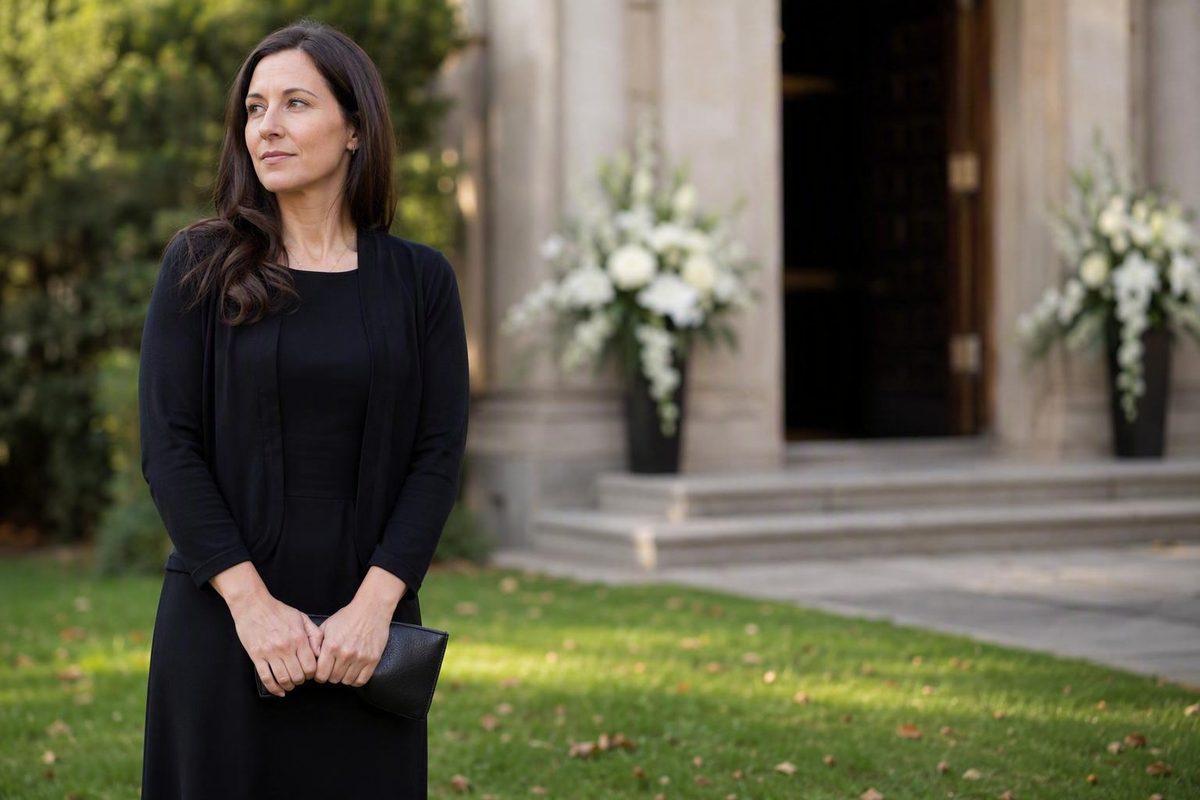
The quick answer: what to wear when no dress code is given
When no dress code is provided, a safe default is neat, modest, understated clothing appropriate to the setting. Choose an outfit that looks cared for, lets you participate comfortably, and is unlikely to draw unnecessary attention away from the person being remembered or the grieving family.
A simple outfit formula is:
- Dark or muted trousers, a modest dress, tailored separates, or an understated jumpsuit
- A plain collared shirt, blouse, knit top, sweater, cardigan, or blazer
- Clean, practical shoes suited to the venue
- Minimal accessories and restrained patterns
You generally do not need an all-black outfit, a suit, or newly purchased formalwear. Dark work trousers with a plain top and cardigan may be entirely suitable. So may a simple navy dress, charcoal pants with a sweater, or chinos with a collared shirt. When no instructions are given, memorial-attire guidance commonly recommends modest clothing in dark or muted colors while emphasizing that the service’s tone and setting still matter.Gallagher Funeral Home’s memorial-attire guidance
Use this decision order:
- Follow explicit family or invitation instructions. If the announcement requests a color, theme, jersey, floral print, or particular style, that request generally takes priority over conventional advice.
- Confirm religious or venue requirements. A place of worship or community venue may have expectations involving coverage, footwear, or head coverings.
- Match the tone and location. A traditional ceremony in a formal venue may call for tailored clothing, while a garden celebration of life may be intentionally relaxed.
- Account for weather, terrain, and personal needs. Practical footwear, suitable layers, comfort, and accessibility needs may take priority over rigid fashion conventions.
- Use conservative default etiquette. If nothing else is known, choose the more subdued and polished of the practical outfits available to you.
“Understated” does not have to mean severe or uncomfortable. It usually means avoiding clothing that becomes the focus of the room, such as highly reflective materials, large slogans, prominent logos, or unusually revealing cuts. A quiet pattern, familiar jewelry, or a well-kept everyday garment can still be appropriate.
Before buying anything, look at what you already own. Clean or press the clothes, remove lint, check for missing buttons or obvious damage, and combine the most polished basics available. Respectful presentation depends more on neatness, condition, and suitability than on price, brand, or whether an outfit was purchased for the occasion.
Do you need to wear black, a suit, or a tie?
No. Black, a suit, and a tie can all be appropriate, but none is universally required at every memorial service.
Black remains customary in many Western settings, particularly for formal or traditional services. Suitable subdued alternatives may include:
- Navy
- Charcoal
- Medium or dark gray
- Dark brown
- Burgundy
- Forest green
- Deep purple
- Other quiet, muted tones
Do not treat black as automatically correct regardless of context. A family may ask guests to wear a loved one’s favorite color, cheerful florals, a sports jersey, or another meaningful item. Some cultural traditions may also use mourning colors other than black. The family’s stated wishes and locally confirmed customs are more relevant than a blanket color rule.
For a formal or traditional service, a dark suit with a plain shirt and simple tie is a dependable option. A tie can make an outfit look more formal, but it is not always necessary. Less-formal alternatives include:
- Dress trousers with a collared shirt
- Tailored trousers with a subdued blouse or knit top
- A modest dress
- A pantsuit
- A skirt-and-blouse combination
- A blazer over a plain shirt or top
- A fine-gauge sweater with tailored trousers
The overall presentation matters more than any one garment. Dark trousers, a pressed shirt, clean shoes, and an optional jacket may look more appropriate than an ill-fitting suit in poor condition.
Memorials range from formal religious ceremonies to gatherings in homes, gardens, restaurants, community halls, and outdoor spaces. Some are solemn and traditional; others are themed celebrations of life. The event’s stated character should therefore guide the outfit more than a universal rule.Ocean County Cremation Service’s overview of memorial-service settings
When two outfits are equally comfortable and practical and you cannot obtain further guidance, choose the more understated one. For example:
- Charcoal trousers rather than heavily faded jeans
- A plain sweater rather than a graphic T-shirt
- A simple dark dress rather than a bright party dress
- Clean loafers, flats, boots, or other restrained shoes rather than conspicuous athletic footwear
This is a cautious default, not a universal judgment about particular garments. The bright shirt or team jersey that might seem out of place at an unspecified formal service may be exactly right when the family asks guests to wear it.
Outfit formulas for each type of memorial service
The most useful way to choose dress attire for a memorial service is by formality and setting rather than by assigning every garment to a gender.
| Service type | Useful outfit formula | Footwear | Details to confirm |
|---|---|---|---|
| Formal or traditional | Dark suit with a simple shirt and optional tie; modest dark dress; or tailored dark separates with a blouse, sweater, or blazer | Clean dress shoes, flats, loafers, understated boots, or another polished option | Place-of-worship expectations, family instructions, indoor-to-outdoor transitions |
| Semi-formal or business casual | Navy or charcoal trousers with a plain top and optional jacket; modest dress; pantsuit; skirt-and-top combination; or understated jumpsuit | Clean, simple shoes comfortable enough for the full service | Whether a jacket or tie is expected, reception setting, weather |
| Explicitly casual | Chinos or neat trousers with a plain collared shirt, knit top, sweater, or cardigan | Clean practical shoes; restrained sneakers when appropriate | Whether “casual” includes jeans, outdoor terrain, planned activities |
| Celebration of life | Polished separates, a modest dress or jumpsuit, or family-requested colors, florals, jerseys, Hawaiian shirts, or meaningful accessories | Appropriate to the venue and planned activity | Whether a theme is optional or expected, venue restrictions |
| Graveside or outdoor | Tailored trousers or a modest dress with adaptable layers and a subdued weatherproof outer layer | Stable shoes or boots suitable for the ground | Walking distance, standing time, weather, shelter, terrain |
| Virtual memorial | Plain or subtly patterned shirt, blouse, sweater, or jacket that looks neat on camera | Usually not visible | Camera framing, background, lighting, whether you may speak |
| Gender-neutral default | Tailored dark trousers with a button-down shirt, understated knit top, sweater, cardigan, or blazer | Simple flats, loafers, boots, dress shoes, or other practical footwear | Desired formality, fit, comfort, venue requirements |
Formal or traditional services
For a more formal ceremony, use dark or muted colors and clean, structured garments. A dark suit with a simple shirt works with or without a restrained tie, depending on the expected formality. Other reliable choices include a modest dark dress or tailored trousers with a blouse, sweater, jacket, or blazer.
The clothes should fit well enough that you can sit, stand, walk, and greet people without repeatedly adjusting them. “Formal” does not require uncomfortable heels, a skirt, or a particular silhouette. A polished trouser-based outfit can be equally suitable.
Semi-formal or business-casual memorials
A semi-formal memorial allows more flexibility while still calling for a composed appearance. Try navy trousers with a muted shirt, charcoal pants with a fine-gauge sweater, a simple dress with a cardigan, a pantsuit, or a subdued jumpsuit with a blazer.
A tie or full matching suit may be unnecessary. If you are uncertain, a neutral jacket can add formality or coverage and be removed if the gathering proves more relaxed.
Explicitly casual memorials
“Casual” should still be read as neat and intentional, not as permission to wear whatever happens to be closest. Chinos, clean utility-style trousers, or other well-kept pants can work with a plain collared shirt, sweater, knit top, or cardigan.
Clean dark jeans may be suitable when the invitation, venue, or organizer clearly indicates a casual gathering. They are not the safest default for an unspecified service in a formal venue. If wearing jeans, choose a pair without heavy distressing, conspicuous decoration, or pronounced fading and combine them with a polished top and clean shoes.
Celebrations of life
A celebration of life may be formal, casual, colorful, or themed. Do not infer from the name alone that anything goes; read the invitation carefully.
If the family requests bright colors, florals, a favorite team’s clothing, Hawaiian shirts, band merchandise, or another meaningful theme, participating can be more respectful than arriving in conventional black. Funeral-service guidance recognizes that family-requested bright, casual, or themed clothing may suit a celebration of life.Eversole Mortuary’s discussion of alternative and themed attire
If no theme is mentioned, polished semi-formal clothing remains a reasonable starting point. You can introduce restrained color through a shirt, scarf, tie, pin, or other small accessory without making the outfit visually dominant.
Virtual memorials
For virtual attendance, focus on what the camera shows. Wear a neat plain top or restrained pattern, and check the fit and camera framing while seated. Keep the visible background and clothing unobtrusive so attention remains on the speakers. Published virtual-attendance guidance likewise recommends respectful on-camera clothing and avoiding distracting patterns.Life Remembered’s memorial-service attire guide
Jeans, sneakers, sandals, patterns, and other context-dependent choices
Individual garments are rarely respectful or disrespectful in every setting. It is more useful to divide them into dependable defaults, context-dependent options, and items generally best avoided unless requested.
Dependable defaults
These choices usually work when the dress code is unclear:
- Dark or muted trousers
- Modest dresses or tailored separates
- Plain collared shirts, blouses, sweaters, and knit tops
- Subdued cardigans, jackets, shawls, or blazers
- Clean, practical footwear
- Minimal jewelry and restrained accessories
- Solid colors or quiet patterns
They are dependable because they can adapt to different levels of formality without attracting much attention.
Context-dependent options
These items can be appropriate, but the venue, instructions, weather, and wearer’s needs matter:
- Clean dark jeans: Reasonable for an explicitly casual memorial, an outdoor gathering, or a venue where denim is normal. Less dependable for an unspecified religious or formal service.
- Clean sneakers: Potentially suitable for a casual setting or when needed for comfort, mobility, or extended walking. Choose a restrained practical pair when possible.
- Avoid open-toed casual sandals What To Wear to a Funeral: A Woman’s Guide to Dressing with Respect — The Death Network.
- Short sleeves: Usually reasonable in hot weather or informal settings. Carry a cardigan, shawl, or jacket if additional coverage may be expected.
- Jumpsuits: An understated, well-fitting jumpsuit can function much like tailored separates or a dress.
- Subtle prints: Small florals, restrained geometric patterns, or low-contrast designs can work when they do not dominate the outfit.
- Meaningful accessories: A pin, scarf, tie, piece of jewelry, or color associated with the person being remembered can be thoughtful when proportionate to the occasion.
Closed-toe dress shoes are a common etiquette recommendation, not a universal requirement. For grass, gravel, stairs, slopes, or wet ground, stable footwear should take priority over a more formal-looking but impractical shoe. Outdoor memorial guidance consistently recommends shoes and layers suited to weather and uneven terrain.Farewelling’s memorial-service attire guide
Medical footwear, adaptive clothing, mobility aids, and other accessibility needs are legitimate considerations. Necessary accommodations do not make an outfit disrespectful.
Generally best avoided unless requested
When no theme or unusual instruction has been given, consider avoiding:
- Loud slogans or novelty messages
- Large, prominent logos
- Flashy embellishments, sequins, or highly reflective materials
- Very distracting patterns
- Clothing that requires frequent adjustment
- Excessive or noisy jewelry
- Strong fragrance
- Clothing that is dirty, badly damaged, or unsuitable for the venue
“Revealing” is contextual rather than reducible to one mandatory neckline or hemline. The practical goal is sufficient coverage for the setting and freedom to sit, stand, bend, and participate without discomfort or distraction.
An explicit family request changes the analysis. A bright shirt, floral dress, costume element, sports jersey, or other unusual item may become the most appropriate choice when it carries meaning and the family has encouraged it.
Dress for the venue, weather, terrain, and length of the service
Location and physical conditions can matter as much as formality. Consider the full schedule: the ceremony, any graveside portion, procession, reception, walking distance, expected standing time, and transitions between indoor and outdoor spaces.
Outdoor and graveside services
For a graveside or outdoor memorial, plan for:
- Grass, gravel, mud, sand, or uneven paths
- Slopes and steps
- Extended standing or walking
- Limited shelter
- Changing temperature or weather
Wear stable flats, boots, loafers, broad heels, or another shoe appropriate for the ground. Thin heels can be impractical on soft soil, while some formal shoes may provide poor traction in wet conditions. Necessary boots or weather-resistant footwear are not disrespectful merely because they are less formal. Layers and terrain-appropriate shoes are standard recommendations for outdoor services.The Death Network’s venue and weather guidance
Use adaptable layers. A sweater, cardigan, blazer, shawl, raincoat, or subdued coat can be added or removed without rebuilding the outfit.
Hot-weather services
In warm conditions, choose breathable, modest clothing and lighter layers rather than forcing yourself into heavy formalwear. Options include:
- Lightweight trousers with a plain short-sleeved top
- A breathable dress with an optional cardigan
- An unlined jacket over a simple shirt
- A lightweight jumpsuit or coordinated separates
- Restrained sun protection appropriate to an outdoor venue
Consider shade, sun exposure, humidity, and how long you may be outside. A jacket or tie that suits the indoor ceremony can often be removed outdoors if the service’s tone permits it.
Cold or wet weather
For cold, snow, or rain, consider:
- A subdued coat or weatherproof jacket
- Warm layers
- Gloves and a scarf
- An umbrella
- Weather-appropriate shoes or boots
Outerwear does not need to match the outfit perfectly. Use the quietest practical coat you own, but prioritize adequate protection from the conditions. Memorial-attire guidance supports adapting outerwear, fabrics, and footwear to climate and expected standing or walking.Queen-Lee Funeral Home’s weather and comfort guidance
Indoor services
Indoor temperatures can be unpredictable. Bring a neutral cardigan, blazer, light jacket, or shawl for warmth or additional coverage. This can be particularly useful in places of worship, funeral homes, large halls, and venues where you do not know local expectations.
If the service moves from an indoor ceremony to a graveside committal or reception, choose shoes comfortable enough for the entire schedule. A neutral layer can also help an outfit move from business casual to slightly more formal.
Virtual attendance
Test your clothing in the actual camera view. Plain or low-contrast tops generally keep attention on your face, while visually busy patterns may distract. Check that the framing remains appropriate when you sit back or lean forward.
Inclusive and last-minute options for real-life needs
Attending respectfully does not require a perfect wardrobe. If you are grieving, traveling, coming directly from work, managing a disability, or working within a limited budget, use the best suitable combination already available.
Last-minute combinations from ordinary clothes
Try one of these:
- Dark work trousers, a plain top, a cardigan, and clean practical shoes
- A simple muted dress with a jacket or shawl
- Chinos with a collared shirt or sweater
- Tailored trousers with a button-down and understated shoes
- A plain knit top with charcoal pants and a blazer
- A subdued jumpsuit with a cardigan
- A dark skirt with a plain blouse or fine-gauge sweater
Check fit and condition rather than the label. Press or steam the clothes if possible, remove lint, wipe the shoes, and repair an obvious loose button or hanging thread. A familiar outfit that fits well may be better than borrowed formalwear that is uncomfortable or needs constant adjustment.
Borrowing an outfit, repeating something worn to another service, or using the best clothing already in your wardrobe is reasonable. Buying or renting new formalwear is not necessary to demonstrate care.
Children and teenagers
Children and teenagers can generally wear clean, comfortable, polished clothing appropriate to their age, the weather, and the service’s tone. Examples include:
- Chinos or dark trousers with a polo, collared shirt, sweater, or cardigan
- A simple dress with a sweater or jacket
- A plain top with a skirt or neat trousers
- Clean dark jeans for an explicitly casual gathering
- Neat school-uniform pieces when they are the most practical option and do not conflict with event or venue expectations
Comfort matters, particularly during a long service. Avoid clothing that is unnecessarily restrictive, difficult to manage, or unsuitable for the temperature. Expectations should reflect the child’s age, family resources, and available wardrobe rather than imposing an inflexible adult standard.
Gender-neutral combinations
A gender-neutral outfit can be assembled from:
- Tailored dark trousers
- A button-down shirt or plain knit top
- A fine-gauge sweater
- A cardigan or blazer
- Simple flats, loafers, boots, dress shoes, or restrained sneakers where appropriate
Choose a cut and combination that feel comfortable and authentic while matching the expected formality. There is no need to wear a dress, skirt, suit, tie, or gendered accessory solely because conventional guides assign it to a particular category.
Adaptive clothing and personal needs
Medical, mobility, sensory, pregnancy-related, and other accessibility needs may reasonably take priority over general etiquette preferences. Choose clothing and footwear that allow you to attend and participate safely and comfortably.
Adaptive clothing, medical devices, mobility aids, and necessary footwear do not make an outfit disrespectful. The objective is thoughtful attendance, not concealing necessary equipment or enduring avoidable distress to satisfy a generalized convention.
Going directly from work
If you must travel from work to the service:
- Remove or cover prominent logos where practical.
- Add a neutral cardigan, sweater, jacket, or blazer.
- Change into the neatest suitable shoes available, if practical.
- Wipe off visible dirt or dust and tidy the outfit.
- Retain any work clothing or equipment that remains necessary.
If you are uncertain whether a uniform or work-specific item suits the venue, check with the organizer when possible. A neat work outfit with a neutral layer is generally preferable to missing the service because you could not achieve an ideal formal look.
How to handle cultural, religious, and venue-specific expectations
Do not rely on a broad faith-by-faith list. Dress practices can vary within the same religion or culture according to community, family, region, venue, denomination, the nature of the observance, and your role in it.
Some communities may prefer mourning colors other than black. Others may have expectations involving covered shoulders or legs, footwear removal, head coverings, or clothing used in a particular place of worship. These details should be confirmed locally rather than inferred from a generic etiquette guide. Broad memorial-attire guidance likewise places family wishes, setting, and locally applicable customs ahead of a universal dress code.Aura Funerals’ memorial-service dress-code guide
Check, in order:
- The invitation
- The obituary
- The memorial website
- The event announcement or venue page
- Messages from the organizer
If the answer remains unclear, ask the organizer, officiant, funeral director, venue, or a family contact already coordinating logistics. When possible, avoid placing an unnecessary practical question on the person most immediately bereaved.
You can say:
“I want to dress appropriately—has the family requested any particular colors, level of formality, or cultural attire?”
For a venue-specific question:
“Are there any clothing, footwear, or head-covering requirements at the place of worship?”
If a family theme appears to conflict with venue requirements, do not guess which instruction takes priority. Ask whether the themed item can be adapted—for example, by wearing a requested color under a more covering layer or incorporating it through an accessory.
Be precise about the type of gathering. In particular, shiva is a specific Jewish mourning observance, not a generic synonym for every Jewish memorial service. Confirm what event you are attending rather than relying on assumptions.
A final memorial-attire checklist
Before leaving, run through this list:
- Family instructions: Have I followed any requested color, theme, jersey, floral print, or meaningful item?
- Venue rules: Have I checked for coverage, footwear, or head-covering expectations?
- Formality: Does the outfit fit the stated tone?
- Color: If no request was given, are the colors reasonably dark, muted, or understated?
- Fit: Can I sit, stand, walk, and greet people without repeatedly adjusting the clothing?
- Coverage: Is the outfit suitable for the venue and activity?
- Condition: Is it clean, well kept, and free from conspicuous damage?
- Footwear: Are the shoes clean, stable, and appropriate for the walking and standing involved?
- Layers: Do I have a neutral cardigan, blazer, shawl, jacket, or coat if needed?
- Weather: Am I prepared for heat, cold, rain, wind, or sun?
- Terrain: Can the shoes handle grass, gravel, mud, stairs, slopes, or wet ground?
- Accessories: Are jewelry, bags, ties, scarves, and other details restrained unless the family requested something expressive?
- Patterns and logos: Are they quiet enough not to dominate the outfit?
- Fragrance: Is it minimal or absent?
- Comfort and access: Does the outfit accommodate my practical and accessibility needs?
Then ask one final question: Is this outfit clean, comfortable, safe, and unlikely to draw attention away from the service?
If the answer is yes, it is probably suitable. When uncertainty remains, bring an adaptable neutral layer. It can add warmth, coverage, or formality without requiring you to predict every condition in advance.
The fallback is simple: dark or muted wardrobe basics plus clean practical shoes are usually a sound starting point when no instructions are available. An explicit family request for color, florals, a jersey, themed clothing, or another meaningful item should generally override that subdued-color default.
For a related discussion, see Mortuary Guide’s article on whether black is required at a funeral. Funeral and memorial-service expectations can differ, so the particular family, venue, and event should still guide your decision.
Frequently asked questions
Do you have to wear black to a memorial service?
No. Black is customary in many Western settings and remains suitable for many formal memorials, but it is not mandatory at every service. Navy, charcoal, gray, dark brown, burgundy, forest green, deep purple, and similarly subdued colors may also work.
Follow the invitation or family’s request first. If guests are asked to wear a loved one’s favorite color, bright clothing, florals, or a meaningful theme, that request is generally more appropriate than defaulting to black.
Can you wear jeans or sneakers to a memorial service?
Sometimes. Clean dark jeans or restrained sneakers can fit an explicitly casual memorial, outdoor gathering, or setting where the organizer has indicated relaxed clothing. Sneakers may also be appropriate for accessibility or practical needs.
They are not the safest default for an unspecified formal or traditional service. If you have equally practical alternatives, choose tailored trousers and simple shoes. Whatever you wear should be clean, in good condition, and suitable for the venue and terrain.
What should you wear to a celebration of life?
Start with the invitation. A celebration of life may call for polished semi-formal clothing, but it may instead encourage bright colors, floral prints, Hawaiian shirts, team jerseys, or clothing connected to the person’s interests.
When no theme is provided, choose neat business-casual or semi-formal clothing: tailored trousers and a plain top, a modest dress, a subdued jumpsuit, or chinos with a collared shirt or sweater. Do not assume that “celebration” automatically means very casual.
What should children or teenagers wear to a memorial service?
Choose clean, comfortable, polished clothing adjusted for the child’s age, the weather, the service’s tone, and what the family already owns. Dark trousers or chinos with a plain shirt or sweater, a simple dress with a cardigan, or a neat top with a skirt or trousers can all work.
Children do not need miniature versions of adult formalwear. Prioritize clothing they can sit, walk, and manage comfortably throughout the service. For an explicitly casual gathering, clean dark jeans may be reasonable.
How can you politely ask about the memorial-service dress code?
Keep the question brief and practical:
“I want to dress appropriately—has the family requested any particular colors, level of formality, or cultural attire?”
For a service in a place of worship, ask:
“Are there any clothing, footwear, or head-covering requirements at the venue?”
Check the invitation, obituary, event page, or memorial website first. If the information is unavailable, contact the organizer, officiant, funeral director, venue, or a family member already handling logistics.
Reduce the decision to three steps: follow the family’s request, confirm any venue or cultural requirements, and choose clean, modest, understated clothing that is safe and comfortable for the setting. Black and formalwear are options, not universal requirements. If you are still unsure, a brief question to the organizer is more respectful than relying on assumptions.
Thoughtful presence and support for the family matter more than fashion perfection.