
17 min read ·
How Much Time to Allow for Catholic Funeral Rites
Allow about an hour for the Funeral Mass itself. That excludes an earlier Vigil, procession formation, cemetery travel, committal, burial and reception.
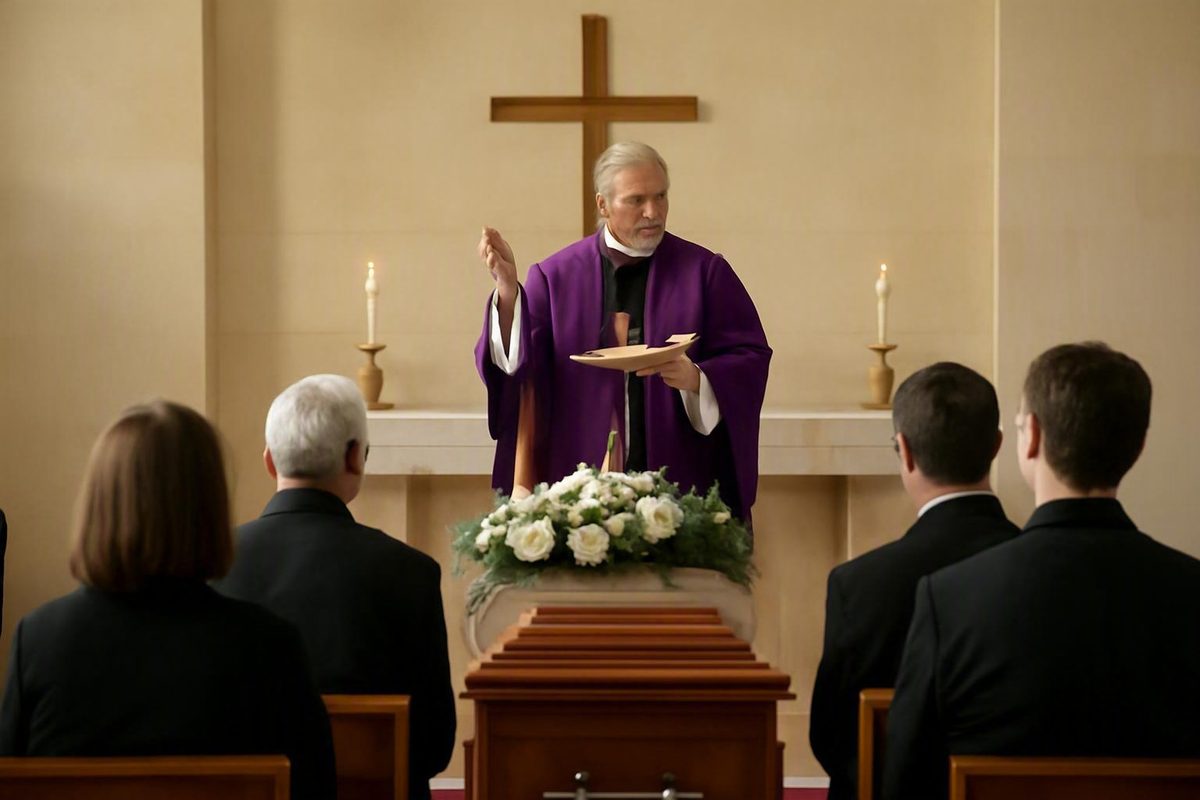
The short answer: allow about an hour for the Funeral Mass
A Roman Catholic Funeral Mass commonly lasts about 45–60 minutes. An official Archdiocese of Philadelphia resource describes approximately one hour as typical, while noting that the number of readings, prayers, and other circumstances can affect the duration (Archdiocese of Philadelphia timing guidance).
Some fuller Funeral Masses may last 60–90 minutes, particularly when the plans include more music or readings, personal remarks where permitted, or a larger number of people receiving Communion. This longer range comes from a commercial funeral-music provider and is a planning estimate, not an official minimum or maximum established by the Church (full Funeral Mass estimate).
A Catholic funeral liturgy without Mass is generally shorter, with a practical estimate of about 30–40 minutes. If the church service is followed by burial or interment elsewhere, the complete itinerary will take considerably longer.
| Part of the funeral | Approximate planning time | What the estimate covers |
|---|---|---|
| Funeral Mass | Commonly 45–60 minutes; a fuller Mass may take 60–90 minutes | The liturgy in the church |
| Funeral liturgy without Mass | About 30–40 minutes | A Catholic funeral liturgy that omits the Eucharistic portion |
| Rite of Committal | About 15–20 minutes after arrival | Prayers and formal committal at the place of interment |
| Mass through committal, including travel | Roughly 2–3 hours | Church liturgy, procession arrangements, travel, and committal |
The figures in the table are approximate planning ranges, not official Catholic time limits. The 45–60-minute, 30–40-minute, 15–20-minute, and two-to-three-hour estimates come from a commercial Catholic funeral-planning guide and depend on which rites are included, congregation size, travel, and local arrangements (Catholic funeral schedule estimates).
These estimates normally cover separate portions of the day. “About an hour” generally means the Funeral Mass itself, not a Vigil held earlier, the formation of a vehicle procession, travel to the cemetery, the Rite of Committal, completion of the burial, or a reception.
If you need one simple answer to “how long is a Roman Catholic funeral?”, allow about an hour for the Funeral Mass. If a cemetery committal follows at another location, reserve a larger block and confirm the complete itinerary with the parish and funeral director.
What counts as the Catholic funeral?
The word “funeral” does not always identify the same event. This difference explains why published estimates can range from less than an hour to most of a morning or afternoon.
In its fullest form, a Catholic funeral may be spread across three principal stages:
- The Vigil
- The Funeral Mass or a funeral liturgy without Mass
- The Rite of Committal
Not every funeral includes every stage, and the rites do not necessarily occur in one uninterrupted sequence. Catholic educational guidance describes this three-part pattern while noting that the Vigil is optional and that not every funeral follows the complete form (overview of Catholic funeral stages).
The Vigil commonly takes place separately, often on the evening before the funeral. Depending on local arrangements, it may be held at a church, funeral home, or residence.
Because the Vigil is frequently a separate event, its duration normally is not included when a parish says that the Funeral Mass will last about an hour. Visitation, a rosary, personal stories, or other prayers connected with the Vigil also need their own place on the schedule.
The Funeral Mass is the central church liturgy when Mass is celebrated. It includes the Liturgy of the Word and the Liturgy of the Eucharist. If the approved arrangements instead call for a funeral liturgy without Mass, the service omits the Eucharistic portion and distribution of Communion.
The Rite of Committal takes place at the cemetery, crematorium, or another place of interment. When it follows a church liturgy, the family and guests may need to wait while a procession forms and then travel to the committal location. That transition can consume substantially more time than the rite itself.
In ordinary conversation, “funeral” can therefore mean:
- The Funeral Mass alone
- A funeral liturgy without Mass
- A cemetery or crematorium service
- The complete itinerary from the church through the committal
When an invitation, obituary, parish notice, or funeral director lists a start and end time, check which scheduling point the end time represents:
- The final prayer in church
- The end of the procession out of the church
- Departure of the funeral procession
- Arrival at the cemetery
- Completion of the Rite of Committal
- Completion of the physical burial
- The beginning or end of a reception
This distinction matters for guests as well as immediate family. Someone attending only the church liturgy may need roughly the duration of a regular appointment, while someone joining the cemetery procession may need to keep a much larger portion of the day free.
Why a Funeral Mass takes about an hour
A Funeral Mass is not one continuous address or memorial speech. It is an ordered liturgy consisting of processions, Scripture, prayers, music, the Eucharist, and the final commendation. The number of elements—and the participation required for each—helps explain why approximately an hour is a reasonable starting estimate.
Introductory rites
At the beginning of the liturgy, the celebrant receives and greets the family and congregation. The introductory rites may include:
- A procession into the church
- Sprinkling the casket or urn with holy water
- Placement of the funeral pall
- An entrance song
- An invitation to prayer
- The opening prayer
Movement takes time, particularly when family members participate in placing the pall or when a large procession enters the church. Music also affects the pace because the processional and liturgical actions unfold with the selected hymn rather than according to a fixed timer.
Liturgy of the Word
The Liturgy of the Word may include:
- A first biblical reading
- A responsorial psalm
- A second reading where included
- The Gospel acclamation and Gospel
- A homily
- Intercessions, also called the Universal Prayer
Family members or friends may be invited to proclaim readings or participate in the intercessions. The overall duration can vary with the readings selected, the homily, musical treatment of the psalm, and the movement of participants to and from the lectern.
Liturgy of the Eucharist
When the funeral is celebrated as a Mass, it continues with the Liturgy of the Eucharist. This includes the presentation of the gifts, Eucharistic prayer, Lord’s Prayer, and distribution of Holy Communion.
The Communion procession is one reason a Mass attended by a large congregation may take longer than one attended by a small group.
Anyone uncertain about receiving Communion should ask the parish rather than rely on general online advice. For scheduling purposes, the relevant questions are whether Communion will be distributed and how the parish expects that portion of the liturgy to proceed.
Final commendation and procession
After Communion and the prayer that follows, the liturgy moves toward its conclusion. The closing portion may include:
- An invitation to the final commendation
- Incensation where used
- The Song of Farewell
- The Prayer of Commendation
- A blessing
- The procession from the church toward the place of committal
A parish outline from St. Joseph Catholic Church in Libertyville presents this progression from the introductory rites through the Liturgy of the Word, Eucharist, final commendation, and procession (order of a Roman Catholic Funeral Mass).
No reliable universal minute count can be assigned to each element. A short homily does not guarantee a short Mass, just as one additional hymn does not add a predictable number of minutes. The pace reflects the celebrant, congregation, music, building, and choices approved for that funeral.
How long is a Catholic funeral without Mass?
A Catholic funeral liturgy without Mass commonly takes about 30–40 minutes as a practical planning estimate, although the parish should confirm the expected duration for the particular service (non-Mass funeral timing estimate).
This form is generally shorter because it omits the Liturgy of the Eucharist and distribution of Holy Communion. It is not, however, simply a brief secular memorial. It may retain substantial elements of Catholic worship, including:
- Introductory prayers
- Scripture readings
- A responsorial psalm
- A Gospel reading
- A homily or reflection
- Intercessions
- Music
- The final commendation
- A concluding procession
The exact form depends on the arrangements approved by the parish. A service without Mass may be used when a full Mass is not part of those arrangements, but no single circumstance should be presented as a universal rule. The Archdiocese of Philadelphia explains that a Catholic funeral may proceed without a traditional Mass and that this form omits Communion (Catholic funeral without Mass).
A funeral liturgy without Mass must also be distinguished from a simple cemetery or crematorium chapel service. One Catholic educational guide estimates that a straightforward service in those settings may take around 20 minutes, while warning that music, multiple readings, or shared memories may require a longer booking.
That cemetery or crematorium estimate should not be used as the expected length of a church Funeral Mass. The services differ in setting, structure, and content. Even without the Eucharistic portion, a church funeral liturgy can include Scripture, a homily, prayers, music, final commendation, and processional movement.
The parish’s planned order is therefore more reliable than the service’s name alone. A non-Mass liturgy with additional approved elements may require more time than a simpler form with fewer participants.
How long to allow for the church, procession, and committal
When a Funeral Mass and cemetery committal occur in one continuous sequence, allow roughly two to three hours from the beginning of Mass through the end of the committal. This is a commercial planning estimate rather than an official Catholic rule (Memorials.com Catholic funeral-planning guide).
For calendar purposes, divide the itinerary into four blocks:
- Church liturgy: commonly about an hour for the Funeral Mass
- Formation of the procession: time for the family, hearse, clergy, and other vehicles to leave in order
- Travel: approximately 15–45 minutes in the commercial planning guide, depending on distance
- Rite of Committal: approximately 15–20 minutes after arrival
The full estimate accounts for more than driving time. People must leave the church, return to their vehicles, receive any necessary instructions, and enter or assemble at the cemetery.
Ask the funeral director whether the stated end time means the end of the rite or the completion of all burial activity.
Sample itinerary A: Funeral Mass followed by committal
For a Funeral Mass beginning at 10:00 a.m., an illustrative schedule might be:
- 10:00 a.m.: Funeral Mass begins
- Around 11:00 a.m.: The liturgy ends and the procession begins to form
- Late morning: The procession travels to the cemetery
- After arrival: The Rite of Committal begins
- Around noon or later: The sequence concludes, depending on travel and staging
This is an illustration, not a promised end time. A longer Mass, distant cemetery, heavy traffic, mobility needs, or a large procession could move completion later. If the cemetery has a fixed appointment, the parish and funeral director should work backward from that time rather than assuming the Mass will end at an exact minute.
Sample itinerary B: Liturgy without Mass followed by committal
For a non-Mass liturgy beginning at 10:00 a.m., an illustrative sequence could be:
- 10:00 a.m.: Funeral liturgy without Mass begins
- Approximately 10:30–10:40 a.m.: The liturgy concludes
- Afterward: The procession forms and travels to the cemetery
- After arrival: Approximately 15–20 minutes are reserved for the committal
This itinerary may be shorter than one built around a Funeral Mass, but travel can still occupy a significant part of the schedule. Omitting Mass does not necessarily turn the entire event into a brief appointment.
Sample itinerary C: Cemetery or crematorium chapel service
A simple cemetery or crematorium chapel service may take around 20 minutes, but this is not equivalent to a Funeral Mass. Music, multiple readings, or shared memories may require additional time or a longer venue booking (simple cemetery or crematorium service guidance).
In every example, plan around confirmed venue times. The priest, parish office, funeral director, cemetery, and transportation provider may each control a different part of the itinerary.
What can make a Catholic funeral longer?
Published estimates ranging from less than an hour to considerably longer are not necessarily contradictory. Sources may be measuring different combinations of rites. One may mean only the liturgy in church, while another includes procession formation, cemetery travel, and committal. A broader schedule may also include a separate Vigil or reception.
Within the church liturgy itself, several variables can affect the duration.
Readings and prayers
The number and length of readings and prayers can change the pace. Participant movement also matters: a family reader may need to come forward, receive direction, proclaim the reading, and return to a seat.
The Archdiocese of Philadelphia specifically identifies the number of readings and prayers as one reason an approximately one-hour Funeral Mass can vary.
Music
A Funeral Mass may include an entrance hymn, responsorial psalm, music during the presentation of gifts, Communion music, the Song of Farewell, and a recessional. Whether the music is congregational, choral, instrumental, or abbreviated will influence the flow.
Music can also lengthen a non-Mass service or committal. Families should not assume that every requested selection can be added without affecting the schedule, particularly when a cemetery or crematorium has a fixed appointment window.
Communion and congregation size
Distribution of Communion can move a Funeral Mass toward the longer end of the range when many attendees participate. The number of ministers and physical layout of the church may affect the pace, but the size of the Communion procession remains a practical scheduling factor.
A funeral-music planning source identifies Communion participation, music, readings, and eulogies as matters to discuss with the priest when estimating the duration (factors affecting Funeral Mass duration).
Personal remarks and shared memories
Personal remarks may take place during the Vigil, at the conclusion of the committal, or at another approved point rather than during Mass. Placement depends on diocesan and parish guidance. Moving personal stories to the Vigil may keep the Funeral Mass closer to its expected duration while making the earlier event longer.
Local rules should not be mistaken for universal Catholic policy. For example, the Diocese of Syracuse identifies the Vigil or conclusion of the committal as the preferred time for personal stories. Its local guidelines limit a permitted eulogy during Mass to one speaker and three minutes (Diocese of Syracuse funeral guidelines). That is a diocesan practice, not a rule that automatically applies to every Catholic parish.
A rosary or an extended period of shared memories can similarly lengthen whichever event includes it. If these occur during a separate Vigil, they do not extend the Funeral Mass but still require their own calendar block.
Processions and travel
The transition from church to cemetery can be unpredictable. Variables include:
- The number of vehicles
- Parking arrangements
- The time required for the family to leave the church
- Instructions given to drivers
- Distance between venues
- Traffic conditions
- Cemetery entry and staging
- Mobility needs among participants
There is no useful universal buffer that covers every procession. A small-town parish with a nearby cemetery will have a different schedule from an urban church followed by a cross-city journey.
Local arrangements
Parishes and dioceses may have different practices concerning readings, music, personal remarks, ministers, and the placement of particular elements. The celebrant’s approach and the church’s physical layout can also affect the pace.
For that reason, an event-specific answer from the parish is more reliable than a general estimate. Ask not only “How long is the funeral?” but also “Which rites, locations, and transitions are included in that time?”
A practical checklist for confirming the schedule
The officiating priest or parish is the best source for the expected duration of the liturgy. The funeral director can then coordinate transportation, cemetery or crematorium appointments, and reception timing around the parish schedule.
Use the following checklist before publishing an obituary, arranging transportation, reserving a venue, or telling guests when the day will end.
Confirm the form of the church service
Ask:
- Is this a Funeral Mass or a funeral liturgy without Mass?
- Will it take place in a church, funeral home, cemetery chapel, or crematorium chapel?
- Does the quoted duration cover only the service?
- What start and end times does the parish expect based on the approved plans?
A label such as “Funeral Service” may not tell an unfamiliar guest whether Mass will be celebrated. Request the formal description and expected conclusion time.
Clarify what “end time” means
Ask whether the stated end time refers to:
- The final prayer
- The end of the recessional
- Departure of the hearse
- Departure of the last procession vehicle
- Arrival at the cemetery
- Completion of the Rite of Committal
- Completion of the burial
These points may be separated by a few minutes or by a substantial journey. A calendar entry ending when the church service concludes does not mean the family will also have finished at the cemetery.
Review the approved liturgical elements
Confirm:
- The number of readings
- The selected hymns and other music
- Who will read or participate
- Whether Communion will be distributed
- Whether personal remarks are permitted
- Where any remarks will occur
- Whether a rosary is planned
- Whether accessibility arrangements may affect movement
Do not rely on a generic Funeral Mass template if the parish has already prepared a specific order for the service.
Schedule the Vigil separately
Determine whether the Vigil will occur the previous evening, earlier on the same day, or on another date. Enter it as a separate calendar event with its own arrival and end times.
If the Vigil includes visitation, a rosary, multiple speakers, or additional prayers, ask how long the facility has been reserved. Do not add that time to the Funeral Mass estimate unless the events are actually scheduled as one continuous program.
Confirm cemetery or crematorium details
Ask:
- Where will the committal take place?
- How far is it from the church?
- Will guests travel in a formal procession or independently?
- Where will vehicles assemble?
- What time is the committal booked?
- Does the cemetery have entry or staging instructions?
- Does the quoted time cover prayers only or completion of the burial?
If cremation is involved, confirm whether the committal will follow immediately, occur later that day, or take place on another date. When the rites are divided across different days, create separate appointments rather than reserving one continuous block.
Keep the reception separate
A luncheon or reception is not included in the normal estimate for the church liturgy or the sequence through committal. One commercial planning guide estimates that a reception may add another one to two hours, although its actual duration depends entirely on the family’s arrangements (Memorials.com Catholic funeral-planning guide).
Record venue access, guest arrival, food service, speeches, and closing time separately. If cemetery travel runs late, designate someone who can update the reception venue.
Guidance for attendees
Guests should check the invitation, obituary, or parish information for separate listings for the Vigil, Funeral Mass, committal, and reception.
Allow reasonable time for parking, finding the entrance, and taking a seat, but do not assume that one arrival rule applies to every church. If you intend to join the cemetery procession, ask where to park and whether drivers will receive identifying markers or instructions.
When only a church start time is published, avoid scheduling an immediate appointment afterward if you plan to attend the committal. The end of Mass and completion of the full funeral itinerary can be separated by procession formation, travel, and cemetery arrangements.
For planning, keep three levels in mind:
- Funeral Mass: allow about one hour
- Funeral liturgy without Mass: allow about 30–40 minutes
- Mass, procession, cemetery travel, and committal: allow roughly two to three hours
These are approximate ranges rather than fixed Church rules. The parish should confirm what is included and coordinate the definitive itinerary with the priest, funeral director, and place of interment.
Frequently asked questions
Does the one-hour estimate include the burial?
Usually not. The approximately one-hour estimate generally refers to the Funeral Mass in the church (Archdiocese of Philadelphia guidance). It normally excludes formation of the procession, travel to the cemetery, the Rite of Committal, and completion of the burial.
When committal immediately follows Mass at another location, plan for the broader church-to-cemetery itinerary rather than using the Mass end time as the end of the funeral.
How long is a Catholic funeral without Mass?
Use about 30–40 minutes as a practical estimate, subject to confirmation by the parish (Memorials.com Catholic funeral-planning guide). This form omits the Liturgy of the Eucharist and distribution of Communion, so it is generally shorter than a Funeral Mass.
It may still include Scripture, a homily or reflection, prayers, music, final commendation, and a procession. The approved order is more important than the service label alone.
How long does the Rite of Committal take at the cemetery?
A practical planning estimate is approximately 15–20 minutes after arrival (Memorials.com Catholic funeral-planning guide). The estimate covers the prayers and formal committal, not the journey to the cemetery.
Allow additional time for procession formation, parking, walking to the place of interment, cemetery staging, and any delay between the church and graveside.
Does the Vigil count as part of the funeral time?
The Vigil may be part of the broader Catholic funeral rites, but it is commonly scheduled as a separate event before the Funeral Mass. It therefore should not automatically be included in the quoted duration of the church service.
Treat it as its own calendar block and confirm whether it includes visitation, a rosary, personal stories, Scripture, or other prayers.
Can Communion, readings, music, or a eulogy make the service longer?
Yes. The number of readings and prayers, musical selections, Communion participation, congregation size, participant movement, and approved personal remarks can all affect the schedule.
A larger Communion procession or additional music may move the service toward the longer end of its expected range. Policies for personal remarks vary, and a parish may direct stories to the Vigil, committal, or reception rather than include them during Mass. Confirm every planned element with the officiating parish before publishing an exact end time.